
.jpeg)
문화적 파도에서 유통 인프라로: 글로벌 유통 확장의 단계별 모델
From Cultural Wave to Retail Infrastructure: A Stage-Based Model of Global Retail Expansion
1 칼빈대학교
2 단국대학교
1 Calvin University
2 Dankook University
DOI: https://doi.org/10.17287/kmr.2026.55.1.447
초록
본 연구는 한류의 글로벌 확산이 한국 유통 기업의 해외 진출에 있어 어떻게 전략적 시너지를 창출하는지 분석한다. 기존 연구들이 한류를 주로 문화적 현상으로 바라본 것과 달리, 본 논문은 한류를 진입 장벽을 낮추고 신뢰를 촉진하며 해외 시장에서 문화적·경제적 가치의 공동 창출을 가능하게 하는 평판 자산으로 개념화한다. 평판 대여, 문화적 하이브리드성, 양방향 신뢰 전이의 이론적 메커니즘을 바탕으로 글로벌 유통 확장의 단계별 모델을 개발하였다. 글로벌 유통 기업(월마트, 까르푸, 코스트코)과 한국 편의점 체인(GS25, CU)의 비교 사례 분석을 통해, 성공적인 확장은 세 단계 과정을 거친다는 것을 발견했다. (1) 진입 단계에서 기업은 한류의 평판 자본을 촉매제로 대여함으로써 외부인 비용을 극복하고, (2) 성장 단계에서 본사의 시스템 역량과 현지 파트너의 맥락적 지식을 결합한 공동 창조적 하이브리드성을 통해 시장 안착을 확보하며, (3) 성숙 단계에서 기업의 성공이 국가 브랜드를 강화하여 상호 보완 효과를 만드는 양방향 신뢰 전이의 선순환이 나타난다. 이러한 결과는 문화적 소프트 파워와 유통 하드 파워 사이의 역동적인 상호작용을 규명함으로써 수정 업살라 모델과 신뢰 전이 이론을 확장하며, 지속 가능한 글로벌 전략 및 ESG 경영에 대한 실무적 시사점을 제공한다.
Abstract
This study examines how the global diffusion of Hallyu (the Korean Wave) generates strategic synergies for Korean retail firms in their international expansion. While prior research has largely viewed Hallyu as a cultural phenomenon, this paper conceptualizes it as a reputational resource that lowers entry barriers, facilitates trust, and enables the co-creation of cultural and economic value in foreign markets. Drawing on the theoretical mechanisms of reputation renting, cultural hybridity, and bidirectional trust transfer, this study develops a stage-based model of global retail expansion. Through a comparative case analysis of global retailers (Walmart, Carrefour, Costco) and Korean convenience store chains (GS25, CU), the study finds that successful expansion follows a three-stage process: (1) In the entry stage, firms overcome the liability of outsidership by renting Hallyu’s reputational capital as a catalyst; (2) In the growth stage, they secure market settlement through co-creative hybridity, combining headquarters systemic capabilities with local partners contextual knowledge; and (3) In the maturity stage, a virtuous cycle of bidirectional trust transfer emerges, where corporate success reinforces the national brand, creating mutual reinforcement effects. These findings extend the revised Uppsala Model and trust transfer theory by elucidating the dynamic interplay between cultural soft power and retail hard power, offering practical implications for sustainable global strategy and ESG management.
Ⅰ. Introduction
Since the late 1990s, Hallyu (the Korean Wave) has evolved from a regional trend into a global cultural phenomenon, driven by the worldwide proliferation of digital cultural content such as K-Pop and K-Dramas. Unlike traditional cultural exports, which have often faced resistance due to perceptions of cultural imperialism, Hallyu is characterized by cultural hybridity, a process in which global trends and local consumer values interact to generate new cultural forms (Bhabha, 1994; Jang and Song, 2016; Kwak and Ryoo, 2024). This hybridity not only ensures the sustainability of Hallyu but also serves as a mechanism for securing cultural legitimacy across diverse markets.
The influence of Hallyu has extended beyond the entertainment industry to adjacent sectors such as tourism, consumer goods, and retail services, creating substantial economic spillover effects. Prior reports indicate that the increase in Hallyu content exports directly stimulates demand for Korean consumer goods, enhances national brand equity, and facilitates cross-border trade (Yoo and Ko, 2025; Song and Kang, 2017). For instance, the Export-Import Bank of Korea estimated that a USD 100 million increase in Hallyu content exports leads to a USD 180 million increase in consumer goods exports. Similarly, the Korea Creative Content Agency analyzed that a USD 1 million increase in content exports raises national brand value by USD 410,000 (Korea Trade News, 2024). These findings suggest that Hallyu is not merely a cultural phenomenon but a critical strategic resource driving the global expansion of Korean firms.
Despite the growing recognition of Hallyu's cultural and economic value, academic discussion on how firms can strategically leverage Hallyu in their global expansion remains insufficient. Existing studies have largely addressed the cultural appeal of Hallyu (Jang, 2013; Kim, 2025), the global strategies of multinational retailers (Lee and Kang, 2006; Gereffi and Christian, 2009), or trust transfer between brands (Ailawadi et al., 2008; Koschate-Fischer et al., 2014) in isolation. However, there is a paucity of research that integrates these perspectives to explain why some retailers fail when transplanting standardized models (e.g., Walmart, Carrefour) while others succeed by internalizing cultural hybridity into their operations (e.g., Costco, GS25, CU).
In particular, the withdrawal of Walmart and Carrefour from the Korean market highlights the limitations of standardization strategies that neglect local context. Conversely, the success of Costco and the recent overseas achievements of Korean convenience stores (K-CVS) demonstrate how cultural hybridity translates into competitive advantage. This suggests that interpreting global retail strategies through the simple dichotomy of Standardization vs. Localization is insufficient. Therefore, a new conceptual framework is required to explain how retail firms can link the reputational capital of Hallyu with their global strategies.
The objective of this study is to identify the success factors of retail firms global expansion utilizing the cultural reputation of Hallyu and, based on this, to establish a Stage-Based Model of Global Retail Expansion. Specifically, this study focuses on three key mechanisms. First, the reputation renting strategy. This study conceptualizes Hallyu as a reputational asset that firms can borrow during the initial market entry stage and analyzes how this lowers entry barriers for latecomer Korean retail firms.
Second, cultural hybridity. Going beyond simple localization, this study elucidates the mechanism of securing long-term market fit through the process of co-creation, where global identity and local cultural resources combine to create new market value.
Third, bidirectional trust transfer. Extending existing unidirectional trust transfer models, this study proposes a cyclical structure in which Hallyu and retail brands mutually reinforce each other's credibility, thereby creating sustainable competitive advantage.
Through this, the study aims to provide a roadmap for Korean retail firms to transform the soft power of Hallyu into a sustainable global strategy. Furthermore, this model, which integrates cultural respect, co-creation with local communities, and long-term trust building, aligns with the direction of ESG management, encompassing not only commercial success but also contributions to local society. In this context, this study defines cultural infrastructure not merely as a physical sales channel, but as a strategic platform that consumes and reproduces Korean culture while strengthening national brand assets within the local market.
Ⅱ. Theoretical Background
2.1 Strategic Significance of Hallyu and Cultural Hybridity
2.1.1 The Essence of Hallyu: Hybridity of Universality and Particularity
Originating from anthropology and cultural studies, cultural hybridity refers to the creative process in which distinct cultural elements interact to generate new meanings and forms (Bhabha, 1994). Bhabha defined this concept not merely as the physical mixture of two cultures, but as an active agency that creates a Third Space through negotiation. The key driver behind the global proliferation of Hallyu lies precisely in this hybridity.
Hallyu has established a unique cultural form by creatively combining Korean aesthetics, sentiments, and social values (particularity) while adopting the grammar of Western pop culture (universality). This dual attribute simultaneously offers global audiences cultural familiarity and exotic novelty (Jang and Song, 2016; Kim, 2025). In particular, the hybridity of Hallyu is qualitatively different from the Western-centric cultural imperialism of the past. Whereas cultural imperialism marginalized local cultures by unilaterally imposing dominant values, Hallyu adopts a mode of mutual enrichment that respects and embraces local traditions and contexts (Jang, 2013).
For instance, consumers in transitional societies such as Tunisia or Vietnam accept Hallyu without resistance because it provides an alternative modernity that stimulates their desire for modernization while bypassing aversion to Westernization. Therefore, the essence of Hallyu lies in its ability to maintain its own cultural identity while flexibly incorporating other cultures to create cultural resonance (Kwak and Ryoo, 2024; Hyun and Hong, 2023; Shin et al., 2022).
2.1.2 Hybridity as Global Business Strategy
On the cultural foundation established by Hallyu, firms global expansion strategies are required to move beyond existing dichotomous discussions. Traditionally, global business strategies have been discussed within the spectrum between standardization, which pursues efficiency, and localization, which enhances local fit (Dumitrescu and Vinerean, 2010). The concept that emerged to resolve this tension is Robertson’s (1994) glocalization. Under the banner of “Think Global, Act Local,” glocalization adopts a dual-structure strategy of maintaining global standards and brand identity (universal) while modifying detailed product specifications or marketing to suit local conditions (particular). However, this strategy still presupposes a top-down hierarchy where the headquarters is the subject and the local market is the object of adaptation, and it has limitations in that the scope of localization remains at the level of instrumental adaptation of product design or marketing mix.
In contrast, cultural hybridity proposed in this study refers to a process of reciprocal co-creation that goes beyond passive adaptation. This is not a case of a firm unilaterally adjusting to the local market, but rather the creation of completely new values and business models by combining the firm’s core competencies (e.g., IP, systems) with local cultural resources (e.g., consumers, partners, traditions).
The hybridity strategy is distinguished from glocalization in the following aspects. First is the active nature of the process. It is not simple modification, but the creation of a third value through collaboration with local partners. Second is the extensibility of the outcome. It secures social legitimacy by deeply rooting itself in the local society through socioeconomic contributions such as job creation and infrastructure modernization, rather than merely stopping at product sales.
In conclusion, if glocalization is a logic of balance and adaptation, cultural hybridity is a logic of fusion and co-creation. This is a key mechanism that allows global retail firms to position themselves not as simple commercial actors in the local market, but as cultural and economic partners that ensure sustainable growth.
Source: Adapted from Dumitrescu and Vinerean (2010), Jang and Song (2016), Kim (2025), and Kwak and Ryoo (2024).
2.2 Reputation Renting in Retail Expansion
2.2.1 Entry Barriers in Global Expansion
The fundamental challenge firms face when entering foreign markets has traditionally been explained as the liability of foreignness (Zaheer, 1995). This refers to the additional costs incurred due to unfamiliarity with the local language, culture, and regulatory environment, as well as being perceived as a stranger by local consumers. The early Uppsala Model posited that to overcome this, firms should sequentially enter countries with close psychic distance and gradually accumulate market knowledge (Johanson and Vahlne, 1977).
As the business environment has become increasingly networked, Johanson and Vahlne (2009) redefined the nature of entry barriers through their revised Uppsala Model. They argued that the source of uncertainty faced by firms lies not merely in the foreignness, but in the liability of outsidership stemming from a lack of embeddedness in the relevant market’s business network. Transitioning from an outsider to an insider requires a long period of interaction and relationship commitment.
However, empirical evidence from K-retailers presents a striking anomaly to these gradualist perspectives. For instance, GS25 in Vietnam rapidly ascended to the No. 1 brand position immediately post-entry, outpacing established global competitors such as Circle K and Family Mart, which had entered the market four to six years earlier. Similarly, CU achieved the milestone of opening 200 stores in Mongolia within just four years of entry. Such accelerated expansion and immediate market dominance cannot be fully elucidated by existing theories.
2.2.2 Reputation Renting: Leveraging Cultural Capital as a Catalyst
This study proposes the concept of reputation renting as a strategic mechanism to overcome outsidership. Originally introduced by Chu and Chu (1994), reputation renting refers to a strategy where a firm with low recognition leverages the fame of a reputable agent who has already established high trust to reduce uncertainty regarding its own quality. This study extends this concept beyond interfirm alliances to the convergence of cultural and retail industries. Here, Hallyu functions not merely as entertainment, but as reputational capital accumulated in the global market through consistent quality and appeal over a long period (Keller, 1993).
The specific mechanism operates as follows. In markets such as Vietnam or Mongolia, Korean retail firms (e.g., GS25, CU) are initially nothing more than unfamiliar outsiders. However, by actively introducing K-Dramas, K-Pop, and Korean food culture content into their stores, local consumers come to perceive these spaces not as strange foreign shops, but as familiar and aspirational physical spaces of Hallyu. In other words, by renting the positive halo effect of Hallyu, firms save the immense time and cost required to build trust independently and acquire the status of a quasi-insider immediately upon entry.
In conclusion, reputation renting in retail expansion operates as an efficient catalyst that allows latecomer firms to offset the costs of outsidership and accelerate initial market settlement in markets where cultural capital is highly accumulated.
2.3 Bidirectional Trust Transfer and Mutual Reinforcement
2.3.1 Unidirectional Trust Transfer
Studies addressing trust transfer within brand portfolios or between retailers and private brands (Ailawadi et al., 2008; Koschate-Fischer et al., 2014; Seenivasan et al., 2016) have primarily focused on the one-way influence from the parent brand to the sub-brand. The Country-of-Origin Effect where the positive image of advanced nations or cultural powerhouses transfers to trust in products from those countries also assumes the flow of trust is unidirectional (Bilkey and Nes, 1982).
Yet, unlike manufacturing, the retail industry is characterized by frequent and experiential consumer contact points. Therefore, there is a high probability that consumers direct brand experiences can, in turn, influence the source image. Consequently, to explain the modern global retail environment—especially business models combined with cultural content—a dynamic framework encompassing the reverse flow and circulation of trust is required.
2.3.2 Bidirectional Trust Transfer between Hallyu and Retail Brands
To fill this theoretical gap, this study proposes the bidirectional trust transfer model (Kim and Chung, 2024a, 2024b). This perspective posits that trust does not flow unilaterally between Hallyu and retail brands but forms a cyclical structure of mutual reinforcement.
In the initial entry stage, retail firms lower consumer entry barriers by renting the positive reputation of Hallyu. However, once the firm successfully settles in the local market and accumulates positive Customer Experience through product quality, service reliability, and cultural resonance, the direction of trust is reversed. A feedback effect occurs where trust in the firm reinforces the value of the overall national brand.
For example, when Vietnamese consumers experience high-quality ready-to-eat food and a modern store environment at GS25, this extends beyond a simple preference for the specific convenience store to a perception that Korean food culture is hygienic and sophisticated. Similarly, the pleasant rest areas and social infrastructure functions provided by CU in Mongolia enhance trust in the national brand of Korea. This elevated national brand value, in turn, leads to increased favorability toward Hallyu content and other Korean products, completing a Virtuous Loop that further solidifies the competitiveness of the retail brand.
In conclusion, bidirectional trust transfer is a key mechanism of the maturity stage, where the retail store evolves beyond a simple sales channel into Cultural Infrastructure that consumes and reproduces the culture of the home country while strengthening national brand assets. This is significant in theoretically elucidating the reciprocal relationship where cultural appeal creates economic value, and economic success, in turn, reinforces cultural legitimacy.
Ⅲ. Methodology
3.1 Research Design: Inductive Theory Building
This study aims to investigate the dynamic process by which cultural resources (soft power), exemplified by Hallyu, combine with the systemic capabilities of retail firms (hard power) to settle in global markets. Given the exploratory nature of this research, this study prioritizes inductive theory building following the methodology advocated by Eisenhardt (1989). The primary objective is to identify and conceptualize nascent mechanisms such as reputation renting and bidirectional trust transfer, rather than to perform deductive hypothesis testing. While the absence of large-scale consumer surveys may limit statistical generalizability, this qualitative approach is more appropriate for capturing the dynamic and complex interplay between cultural wave and systemic retail infrastructure. At the same time, to ensure rigor in the research process, it adheres to the principles of multiple case study design as outlined by Yin (2018).
3.2 Rationale for Case Selection: Theoretical Sampling
To enhance the validity of the study and promote theoretical extension, this study applies theoretical sampling rather than random sampling (Eisenhardt and Graebner, 2007). In particular, polar types were selected to clearly reveal the attributes of the research subjects, thereby ensuring the distinctiveness of the comparative analysis.
3.2.1 Control Cases: Success and Failure of Global Retailers in the Korean Market
The Korean market has provided a unique environment where opportunities and crises coexist for global retail firms. This study selected Walmart and Carrefour, which failed in this market, and Costco, which successfully settled, as control cases.
-
1) Failure Cases (Walmart, Carrefour)
Despite their immense capital and brand power, these firms revealed the limitations of cultural imperialism by adhering to their headquarters standardized models and overlooking local consumer preferences and culture. These cases serve as counter-evidence showing that the absence of cultural hybridity leads to failure.
-
2) Success Case (Costco)
In contrast, Costco successfully adapted to the Korean market by building trust with local consumers and contributing to society while maintaining its global standard of warehouse-style discount stores. This case demonstrates that standardization and hybridity are not mutually exclusive and serves as a crucial comparative reference supporting the theoretical framework of this study.
3.2.2 Main Cases: Expansion of K-Retail Utilizing Hallyu
For the analysis group (Success Cases), GS25 (Vietnam) and CU (Mongolia), Korean convenience store chains that have achieved remarkable results in overseas markets by leveraging the reputational capital of Hallyu, were selected.
1) Selection Rationale
According to KOFICE(2024) data, Vietnam ranks among the highest in Hallyu acceptance. Mongolia exhibits high cultural receptivity to Korea. Our selection of these markets follows the principle of theoretical sampling (Eisenhardt, 1989), specifically choosing polar types where the cultural phenomenon is most salient. This allows us to observe the complex mechanism of cultural transformation into retail infrastructure under near-ideal conditions, thereby maximizing the ability to generate a robust theoretical model. Generalizability to low-Hallyu markets is left as a future research question.
2) Performance and Significance
These firms have produced tangible results, such as achieving the No. 1 market share in local markets within a short period (GS25 in Southern Vietnam, CU in Mongolia) or their partners listing on the local stock exchange (IPO). They represent optimal samples that empirically demonstrate the achievement of co-creative hybridity by combining cultural resources (Hallyu) with systemic retail business, and further, the bidirectional trust transfer between national and corporate brands. This case configuration enables a multi-dimensional examination of the importance of cultural hybridity and trust transfer as key mechanisms for successful global retail expansion through a cross-analysis of inbound and outbound perspectives surrounding Korea.
3.3 Data Collection: Data Triangulation
To eliminate subjective bias that may occur in qualitative research and ensure the reliability and validity of the results, this study applied the data triangulation technique. The data sources are threefold: First, from an internal corporate perspective, we utilized in-depth interview data with global business managers at BGF Retail (CU) and GS Retail (GS25). The data collection followed a rigorous two-step process to ensure depth and accuracy. Initially, structured questionnaires were administered via email to secure preliminary data. Subsequently, in June 2024, face-to-face in-depth interviews, each lasting approximately 90 minutes, were conducted to elaborate on the written responses and discuss strategic nuances. The interviewees included the Head of Overseas Business (Executive Director) at BGF Retail and the Head of Overseas Business Promotion Part at GS Retail. The sessions focused comprehensively on localization strategies, supply chain logistics, specific success and failure cases, and future expansion plans. Second, from a macroeconomic environmental perspective, data from the 2024 Global Hallyu Trends by the Korean Foundation for International Cultural Exchange (KOFICE) were utilized. Third, as objective performance indicators, corporate financial data, IPO disclosure materials of local partners, and major media reports were collected.
3.4 Data Analysis: Phased Analysis
The collected data were analyzed in two stages: within-case analysis and cross-case analysis. First, the expansion process of each firm was independently described according to the chronological flow of entry, growth, and maturity to identify unique contexts. Subsequently, through cross-case analysis, common patterns and differences between cases were contrasted to derive key constructs—reputation renting, co-creative hybridity, and bidirectional trust transfer—and crystallize them into propositions.
Ⅳ. Within-Case Analysis
4.1 Comparative Analysis of Global Retailers in Korea
4.1.1 Failure Cases: Walmart and Carrefour
Walmart and Carrefour entered the Korean market in 1998 and 1996, respectively. At the time of entry, they were dominant players equipped with immense capital and global retail know-how, yet both withdrew in 2006, marking a failure. While existing studies have attributed their failure to a lack of understanding of local consumer preferences or poor location strategies (Kim, 2009)1, this study interprets it more fundamentally as a lack of cultural hybridity and the limitations of cultural imperialism.
First, both firms fell into the trap of standardization by mechanically transplanting their home-country success formulas into the Korean market. They adhered to warehouse-style store layouts, high shelving, and product assortments centered on processed goods, which directly conflicted with Korean consumers' preference for high-quality fresh food, accessibility, and a comfortable shopping environment.
Second, in establishing relationships with local stakeholders, they prioritized unilateral control over co-creation. They leveraged their global sourcing capabilities to demand excessive unit price reductions from domestic suppliers or engaged in unfair trade practices. Furthermore, they adhered to headquarters-centric policies regarding employee welfare and labor relations that were divorced from local sentiments, thereby losing social legitimacy. This attitude reflects a culturally imperialistic perspective that views the local market merely as an object for the extension of the headquarters system (Gereffi and Christian, 2009; Lee and Kang, 2006).
Consequently, the cases of Walmart and Carrefour suggest that global brand reputation or economies of scale do not guarantee success in local markets. By adhering to rigid standardization strategies without modification or fusion that considers the local cultural context, they failed to create value through cultural hybridity, which ultimately led to market withdrawal. Their failure serves as a counter-example paradoxically demonstrating that a flexible hybridity strategy combining headquarters efficiency with local particularity is essential for global retail firms to settle in local markets.
4.1.2 Success Case: Costco
Unlike Walmart or Carrefour, Costco, which entered the market as Price Club in 1994 and rebranded in 1997, has successfully settled in the Korean market, achieving continuous growth. Costco’s warehouse-style stores, bulk sales method, and high shelves appear to follow a standardized model similar to Walmart. However, Costco realizes cultural hybridity by maintaining this global standard while integrating unique operational practices that could resonate with Korean consumers and stakeholders.
Costco’s hybridity strategy manifested in building local trust across three major dimensions.
First is the symbiotic pricing policy with suppliers. Costco adhered to a policy of limiting margins to 8-15%, which was significantly lower than that of domestic hypermarkets (20-25%) or department stores (over 50%) at the time. This policy became the foundation for forming mutual trust among the firm, suppliers, and consumers by guaranteeing suppliers profitability while providing overwhelming price competitiveness to members. This contrasts with Walmart, which caused conflict by demanding excessive unit price reductions from supplier.
Second is the improvement of employee welfare and service quality through internal marketing. Costco treated local personnel not as mere objects of cost reduction but as partners in value creation. Whereas Walmart was criticized for low wages and poor welfare benefits, Costco provided industry-leading wages and welfare packages, including health insurance. In fact, Costco’s turnover rate was 17% (6% after one year), significantly lower than Walmart’s 44%, and this job satisfaction naturally led to a high level of customer service, enhancing Korean consumers satisfaction (Cascio, 2006a, 2006b).
Third is the securing of legitimacy through social contribution. Costco demonstrated its responsibility as a member of the local community beyond simple profit-seeking. By acting as the largest donor to food banks among hypermarkets in Korea, donating approximately 6.2 billion KRW from 2009 to 2014, it strengthened its social legitimacy as a corporate citizen through continuous social contribution activities (Kim, 2019).
In conclusion, Costco’s case proves that standardization and hybridity are not mutually exclusive. Costco exercised flexibility by respecting and integrating local labor practices, supply chain culture, and social expectations while maintaining the headquarters operational efficiency of a membership warehouse club. This implies that global retail firms do not necessarily have to abandon their headquarters identity for localization, and that sustainable competitive advantage can only be secured when operational standards and local contexts are combined to co-create value.
4.2 Analysis of Korean Retailers in Global Markets
4.2.1 Contextual Setting: Formation of High Cultural Capital in Target Markets
Prior to the individual firm analysis, it is necessary to understand the unique environmental context shared by the Vietnamese and Mongolian markets. In both markets, the entry of Korean retail firms operated not merely as commercial expansion but as a mechanism to resolve local cultural thirst.
First, in the case of Vietnam, data from the Korean Foundation for International Cultural Exchange (KOFICE, 2024) indicates an overwhelming propensity for pop culture consumption, with a 92.1% experience rate for Korean dramas. This backdrop allowed local consumers to accept Korean retail brands as the physical realization of the lifestyle they aspired to through media.
Meanwhile, in Mongolia, the cultural influence is evidenced by changes in everyday language beyond statistical figures. According to an interview with a BGF Retail official (Yoon, 2024), the brand name CU is used as a generic noun to refer to convenience stores in Mongolia, indicating that the Korean retail model has deeply penetrated as a local lifestyle standard.
In summary, Vietnam demonstrates extensive content consumption, while Mongolia exhibits an overwhelming brand synchronization phenomenon, both representing the tangible reality of high-involvement cultural capital. This context functioned as fertile soil where the reputation renting strategy could effectively lower entry barriers and facilitate rapid consumer acceptance during the initial entry of Korean retail firms.
4.2.2 Case A: GS25 in Vietnam
1) Entry Stage: Hallyu and Reputation Renting
GS25 entered the Vietnamese market in 2018 through a Joint Venture with Son Kim Group, strategically deploying reputation renting to leverage the country’s high cultural receptivity, evidenced by a 92.1% K-drama experience rate (KOFICE, 2024). The brand successfully positioned its stores as venues for cultural consumption rather than mere retail outlets. This strategy significantly mitigated marketing costs and entry barriers, as a GS Retail manager noted: “From the moment we hung the signboard, people flocked in. It seemed they didn't come to buy goods, but to feel the mood of being a protagonist in a drama Backstreet Rookie” (Interviewee A, 2024).
This phenomenon indicates that for young Vietnamese consumers, visiting GS25 was a cultural ritual. Choi Geum-seong, CEO of GS25 Vietnam, articulated this distinction: “Vietnamese consumers perceive consumption itself as a cultural experience... It is an act of converting into content rather than simple purchasing. In this process, emotional communication (of the K-brand) is essential” (Lee, 2025). A Son Kim Group representative further corroborated this mechanism, stating, “Young Vietnamese people want to experience K-Food as a culture itself, not just tteokbokki recreated in a Vietnamese style,” confirming the effective renting of Korea’s national brand image (Cha, 2025).
2) Growth Stage: Value Creation through Co-Creative Hybridity
Sustainable growth was achieved through co-creative hybridity, synergizing the headquarters systemic capabilities with the local partner’s contextual insights. Operational synergy with Son Kim Retail resolved institutional and labor challenges, while product strategies involved the joint creation of a safe street food category (Lee, 2025). Eo Dong-il, MD of GS25 Vietnam, emphasized this hybridity: “This is a differentiated localization strategy unique to Vietnam... instant-cooked tteokbokki is a signature product” This was complemented by localized menus such as Banh mi and tropical fruit beverages (Park, 2025).
Spatial hybridity was also critical. Unlike standard Korean stores (avg. 46.3m$^{2}$), GS25 Vietnam utilized large-format stores (115 - 540 m$^{2}$) equipped with air-conditioned seating areas to accommodate the motorbike-centric lifestyle and tropical climate, thereby extending dwell time (Park, 2025). Furthermore, marketing activities were culturally reinterpreted; the Music Beer Festival was rebranded as the GS25 Vietnam Music Festival, removing Beer to target younger demographics and integrating V-Pop artists with K-Pop content (Kang, 2025).
3) Maturity Stage: Bidirectional Trust Transfer
This strategy established GS25 as a dominant lifestyle platform, achieving the No. 1 market share in Southern Vietnam with 385 stores by 2024, outpacing early movers like Circle K. The success of the retail brand facilitated a bidirectional trust transfer. KOFICE (2024) data reveals that 84.7% of local consumers reported a positive change in their perception of Korea after experiencing Korean content, with a 99.1% purchase rate for Korean products (ranking 1st among 26 nations). The high-involvement product purchase rate also stood at 94.0%. This confirms a virtuous loop wherein positive retail experiences reinforce the national brand, which in turn strengthens trust in GS25, evolving the retailer into a cultural infrastructure and export pipeline for Korean enterprises.
4.2.3 Case B: CU in Mongolia
1) Entry Stage: Reputation Renting and Institutional Voids
BGF Retail’s CU entered Mongolia in 2018 via a Master Franchise agreement with Central Express (now Premium Nexus). Initially, CU utilized reputation renting by introducing K-Drama tie-in products and K-Pop-inspired store designs to attract consumers with favorable views of Korean culture. However, the primary entry barrier was not cultural distance but an institutional void characterized by severe winter climates and a lack of public infrastructure, such as heating and public restrooms. CU strategically positioned its stores to fill these environmental deficiencies.
2) Growth Stage: Infrastructure Co-Creation
Growth was driven by co-creative hybridity, specifically manifesting as Social hybridity. The most notable initiative was the Toilet Revolution, where CU installed clean restrooms open to the public. A local report described this impact: “In Mongolia, it is known as the Toilet Revolution... Many people came to use the restrooms installed inside the stores, and it became a hideout for young people to rest while drinking warm coffee” (Choi, 2025).
This initiative transformed the convenience store into a social infrastructure with public good characteristics. Ginbold Chinzorig, CEO of Premium Nexus, evaluated this strategy: “Installing public restrooms in all stores received a great response from many people in Mongolia, where social infrastructure is lacking ... convenience stores have contributed to the improvement of public welfare” (Kim, 2025b). Simultaneously, product and logistics hybridity were implemented. CU combined local staples like Buuz and Khuushuur with Korean trends such as Yonsei Milk Cream Bread (Yoon, 2024; Cho 2024). Furthermore, it established a food center in Khonkhor and introduced the industry’s first Digital Picking System (DPS/DAS), increasing efficiency by 20–30% and enabling a nationwide logistics network extending 900km to Khuvsgul (Yu, 2025).
3) Maturity Stage: Institutionalization and Bidirectional Trust Transfer
By functioning as social infrastructure, CU secured the No. 1 retail position, expanding from 21 stores in 2018 to 490 by June 2024, and achieving the first overseas surplus in the industry (1H 2024). This success demonstrates bidirectional trust transfer, where retail trust evolves into institutional legitimacy. A BGF Retail official testified: “Now in Mongolia, Convenience Store = CU is used like a proper noun. This is the background that allowed our partner... to list on the Mongolian Stock Exchange within three years of entry” (Yoon, 2024).
Consequently, the partner company, Premium Nexus, successfully listed on the MSE in November 2021, raising a record 28.5 billion Tugrik for a non-financial IPO. It currently ranks 1st among retail distributors by market capitalization. This evidence confirms that consumer trust at the store level transferred to the corporate brand, and ultimately to institutional valuation (IPO), establishing the Korean retail system as a local standard and completing the virtuous cycle of trust (Yoon, 2021; Kim, 2022).
Ⅴ. Cross-Case Analysis and Propositions
This study identified that the global expansion of retail firms is not a monolithic strategy but an evolutionary process unfolding across sequential stages, based on a comparative analysis between the main cases (GS25, CU) and the control cases (Walmart, Carrefour, Costco). This section extracts common patterns across these cases to elucidate the key mechanisms of reputation renting, co-creative hybridity, and bidirectional trust transfer, and derives generalizable propositions based on these findings.
The following propositions are derived as theoretical building blocks rather than statistically verified conclusions. By mapping qualitative evidence to these key constructs, the study aims to establish a preliminary framework that can guide future research. Statistical verification of these assumed causal relationships, particularly the cognitive link between retail experience and national image perception, is intentionally deferred to subsequent quantitative verification.
5.1 Entry Stage Pattern: Overcoming Outsidership via Reputation Renting
The first common pattern observed in the cases of GS25 (Vietnam) and CU (Mongolia) is the strategic approach to overcoming the liability of outsidership—specifically, the lack of brand recognition during the initial entry phase. Both firms positioned Hallyu as a form of national cultural capital at the forefront, rather than relying solely on their corporate brand power.
5.1.1 Observed Pattern
GS25 promoted its brand in Vietnam through K-Drama merchandise and K-Pop marketing, while CU designed its stores in Mongolia as spaces for experiencing Korean culture. This strategy is distinct from Walmart and Carrefour, which entered markets relying exclusively on capital and systemic power without such cultural mediators, thereby failing to overcome the psychological barriers of local consumers. It is, however, comparable to Costco’s use of the “American lifestyle” image, yet K-retailers differentiated themselves by leveraging cultural content rather than just product origin as the source of reputation.
5.1.2 Analysis
In markets where cultural capital is highly accumulated (e.g., Vietnam, Mongolia), latecomer firms can effectively rent the cultural stature of their home country. This strategy offsets the initial uncertainty felt by consumers and drastically lowers the costs of market entry.
5.1.3 Proposition 1
The more the cultural capital of the home country is accumulated within the target market, the more likely a retail firm is to offset the costs of the liability of outsidership and accelerate initial market settlement by employing a reputation renting strategy.
5.2 Growth Stage Pattern: Co-Creative Hybridity Beyond Passive Adaptation
The renting metaphor does not imply permanent dependence. Instead, it is a strategic maneuver that leverages existing cultural capital to accelerate network entry, which is then solidified into enduring social legitimacy through localized value creation. The decisive factor distinguishing firms that successfully settled after entry (Costco, GS25, CU) from those that failed (Walmart, Carrefour) lies in the mode of localization. While failed firms adhered to cultural imperialism by imposing headquarters standards or engaged in mere passive adaptation, successful firms performed co-creation by interacting with local partners to generate new value.
5.2.1 Observed Pattern
Costco maintained its global standard while offering a merchandise mix aligned with local tastes and symbiotic supplier policies. GS25 created a new category of safe street food by combining Vietnam's street food culture with modern hygiene systems. CU identified the harsh winter climate and lack of infrastructure in Mongolia, transforming convenience stores into social infrastructure functioning as heated shelters, public restrooms, and a nationwide logistics network.
5.2.2 Analysis
Unlike passive adaptation or instrumental glocalization, co-creative hybridity creates a Third Value that fills specific institutional voids in the host market, such as the lack of heating infrastructure in Mongolia (CU) or hygiene standards in Vietnam (GS25). Theoretically, this represents a fusion where the headquarters' systemic hard power (operational capabilities) and the local partner’s contextual soft power (local knowledge) interact to generate novel value, rather than simply adjusting existing models. This distinction is critical: while the absence of this reciprocal creation leaves a firm as a stranger—exemplified by Walmart’s failure—its success transforms the firm into a legitimate and essential insider within the local society.
5.2.3 Proposition 2
The sustainability of global retail expansion depends not on simple standardization or localization, but on the achievement of co-creative hybridity, where the headquarters systemic capabilities and the local partner's contextual capabilities combine to generate new forms of customer value (e.g., social infrastructure, hygienic food culture).
5.3 Maturity Stage Pattern: Bidirectional Trust Transfer and Mutual Reinforcement
Finally, in the maturity stage, a phenomenon was observed where trust between the corporate brand and the national brand flows not unidirectionally, but bidirectionally.
5.3.1 Observed Pattern
In Mongolia, the successful listing (IPO) of CU's partner and the usage of CU as a proper noun for convenience stores signify that the Korean retail system has been elevated to a local standard. In Vietnam, GS25's success serves as a platform facilitating the entry of other Korean consumer goods firms. Interview results indicate that local consumers have developed a higher level of trust in the entire national brand of Korea through positive experiences (cleanliness, kindness, taste) at these convenience stores.
5.3.2 Analysis
This transcends the unidirectional transfer described by traditional Country-of-Origin theory (Nation → Firm). The firm's successful localization and hybridity activities reinforce the national brand assets, and the strengthened national brand, in turn, enhances the firm's competitiveness, forming a Virtuous Loop.
5.3.3 Proposition 3
When a retail platform secures social legitimacy in the local market through hybridity, bidirectional trust transfer occurs, where trust in the firm reinforces the value of the national brand. This creates a sustainable competitive advantage through mutual reinforcement effects.
Ⅵ. Discussions: Integrating the Mechanisms
The comparative case analysis of this study demonstrates that the global expansion of retail firms is not a monolithic strategy but a dynamic process wherein distinct mechanisms are sequentially integrated across three stages: Entry, Growth, and Maturity. This process is underpinned by three core mechanisms: reputation renting, co-creative hybridity, and bidirectional trust transfer.
This figure illustrates the dynamic process of overcoming the liability of outsidership. (1) Entry Stage: Firms utilize reputation renting of Hallyu as a catalyst to mitigate initial uncertainty. (2) Growth Stage: co-creative hybridity integrates headquarters systemic capabilities with local partners contextual assets to create third value via interaction e.g., social infrastructure, localized K-food. (3) Maturity Stage: bidirectional trust transfer creates a virtuous loop where corporate success reinforces the national brand, establishing the firm as cultural infrastructure.
It is crucial to differentiate the role of reputation renting by stage. We contend that renting serves primarily as a temporary catalyst in the initial entry stage to mitigate the liability of outsidership. The transformation from this temporary reliance to permanent bidirectional trust is achieved only through the intervening mechanism of co-creative hybridity in the growth stage, proving that the success is not merely borrowed but earned through co-creation.
6.1 Entry Stage: Reputation Renting via Hallyu as a Catalyst
The primary barrier in the entry stage is the liability of outsidership (Johanson and Vahlne, 2009). This study confirms that the reputation renting strategy, which leverages the external cultural asset of Hallyu, functions as a decisive catalyst for market entry at this stage. Hallyu transcends simple entertainment; it possesses the character of reputational capital imbued with a positive image and trust accumulated over a long period. Latecomer Korean retail firms can borrow this image to signal quality to local consumers and foster cultural intimacy.
Specifically, GS25’s marketing campaigns tied to K-Pop merchandise and dramas upon entering Vietnam, and CU’s positioning of its Mongolian stores as spaces for experiencing Korean culture, are all part of this reputation renting strategy. Such strategies offset the psychological barriers and skepticism consumers feel toward unfamiliar foreign brands with the halo effect of Hallyu content. Consequently, this mechanism efficiently reduces the immense time and cost required for independent trust-building and accelerates the initial settlement speed by allowing the outsider firm to rapidly penetrate the local market network.
6.2 Growth Stage: Co-Creative Hybridity and Value Creation
While reputation renting serves as a primer to induce consumer interest in the initial entry stage, the core task in the growth stage is to convert this transient interest into sustainable loyalty and financial performance. Thus in the growth stage, the focus shifts to co-creative hybridity, a mechanism exceeding passive localization. co-creative hybridity is an active process wherein the headquarters system assets (operational excellence: advanced logistics systems, PB product planning, store operation manuals) combine with the local partner’s contextual assets (real estate networks, deep understanding of lifestyle, regulatory response capabilities) to generate a third value. As consistently highlighted in the interviews—that “the greatest success factor is the capability of the partner”—the combination of these two assets creates market-specific solutions through chemical fusion rather than simple physical addition.
This process, exemplifying the Uppsala model’s ‘knowledge creation (Johanson and Vahlne, 2009),’ allows firms to fill institutional voids—such as CU’s social infrastructure in Mongolia or GS25’s modernized street food in Vietnam—thereby securing sustainable market fit and social legitimacy beyond simple cultural adaptation.
6.3 Maturity Stage: Bidirectional Trust Transfer
If the entry stage was a process of transferring the trust of the national brand to the firm via reputation renting, the maturity stage is the point where the trust accumulated by the firm flows back to the national brand, generating bidirectional trust transfer. This study confirms that mutual reinforcement effects occur between the retail firm and the national brand (Hallyu) at this stage, acting as a key mechanism for sustainable competitive advantage.
Specifically, the high-quality service, hygienic food culture, and sophisticated spatial experiences local consumers encounter through GS25 or CU expand beyond simple preference for individual firms to a positive perception of Korean culture as a whole. For example, the trust built by Vietnamese consumers experiencing GS25’s localized menus and services led to increased acceptance of Korean food culture (K-Food experience rate 93.8% KOFICE, 2024). In Mongolia, CU’s function as social infrastructure (opening restrooms, providing shelters) dramatically strengthened the social legitimacy of Korean firms and culture within local society. This enhanced national brand and status of Hallyu, in turn, act as a powerful halo supporting the brand value of retail firms, forming a virtuous loop of continuously amplifying trust.
This mutual reinforcement evolves the retailer into cultural infrastructure, completing a virtuous cycle of co-evolution between cultural soft power and commercial hard power.
6.4 A Stage-Based Model of Retail Globalization
Synthesizing the case analysis and discussion, this study proposes a stage-based model of retail globalization that explains the process of retail firms expanding into global markets utilizing cultural resources. This model proceeds through three stages—entry, growth, and maturity—each driven by a unique strategic mechanism: reputation renting, co-creative hybridity, and bidirectional trust transfer.
First, the model is linear in its developmental logic. In the entry stage, firms use Hallyu as a catalyst to overcome outsidership and lower initial market uncertainty through reputation renting. In the subsequent growth stage, co-creative hybridity—combining headquarters systems with local context through interaction with partners—operates as the core growth engine securing market fit. Finally, in the maturity stage, sustainable competitive advantage is completed through bidirectional trust transfer, where accumulated consumer experience strengthens mutual trust between the national brand and the corporate brand.
Second, the model is cyclical in its application. The strong trust capital and brand legitimacy formed in the maturity stage do not remain static but are reinvested as resources for new market entry or category expansion through a feedback loop. In other words, success (maturity) in one market functions as enhanced reputational capital for the next market entry (entry), transforming the firm’s global expansion from a one-off success into a scalable trajectory.
In conclusion, this model redefines global retail strategy not as a static choice between standardization vs. localization, but as a dynamic process where cultural resources and management strategies are organically integrated over time. It presents a sustainable roadmap where firms initially enter by renting cultural appeal (Renting), gradually co-create value with local society (Creating), and ultimately expand their cultural and economic territory through mutual trust (Transferring).
Ⅶ. Conclusion and Implications
7.1 Summary of Findings
This study elucidated the dynamic mechanism by which Hallyu, serving as a cultural resource (soft power), transforms into system-based retail infrastructure (hard power) and settles in global markets. Through a comparative case analysis of global retailers entering Korea (Walmart, Carrefour, Costco) and Korean retailers expanding overseas (GS25, CU), this research demonstrated that global retail expansion is not a monolithic strategy but an evolutionary process following the stages of Entry-Growth-Maturity.
The findings identify a three-stage process for successful global retail expansion. First, in the entry stage, firms lower initial entry barriers through a reputation renting strategy. As evidenced by GS25 and CU, incorporating Hallyu content and images into store environments functions as a catalyst that offsets local consumer uncertainty and overcomes the limitations of being an outsider.
Second, in the growth stage, co-creative hybridity operates as the core driver. Unlike Walmart and Carrefour, which failed due to the trap of standardization, Costco and K-retailers successfully settled by combining headquarters systemic capabilities with local partners contextual capabilities to co-create Third Value, such as social infrastructure (CU in Mongolia) or localized food culture (GS25 in Vietnam).
Third, in the maturity stage, firms secure sustainable competitive advantage through bidirectional trust transfer. The study confirmed the formation of a Mutual Reinforcement loop, where positive consumer experiences accumulated at retail stores enhance the value of the national brand (Hallyu), which in turn elevates corporate trust.
7.2 Theoretical Contributions
By addressing the convergence of the retail and cultural industries, this study extends and deepens existing theories. First, it offers a theoretical extension of the Revised Uppsala Model. This study extends the concept of reputation renting from inter-firm alliances (Chu and Chu, 1994) to the culture-industry nexus, establishing that in markets with high cultural capital accumulation, latecomers can drastically shorten the period of outsidership by borrowing reputational capital.
Second, it provides a managerial concretization of the concept of cultural hybridity. Whereas existing glocalization often remains a passive and instrumental adaptation of global standards, this study reinterprets hybridity from the perspective of co-creation. This signifies an active process where headquarters resources combine with local resources to generate new market value and social utility previously non-existent, presenting a third strategic alternative beyond the standardization-localization dichotomy.
Third, it elucidates the dynamics of trust transfer theory. This study empirically demonstrates the bidirectionality and cyclicality wherein corporate activities reinforce national brand assets (Kim and Chung, 2024a, 2024b). This theoretically establishes that retail firms function as cultural infrastructure that not only distribute but also strengthen and reproduce national brands, offering a new framework to explain the complementary relationship between cultural and general industries.
7.3 Managerial Implications
The findings suggest that the global strategy of Korean retail firms must shift from simple product export to the construction of cultural infrastructure that coexists with local society.
First, the implementation of stage-specific tailored strategies. Management should actively rent Hallyu’s reputational capital in the entry stage to reduce marketing costs and lower entry barriers. However, in the growth stage, firms must not rely solely on Hallyu but should develop localized products and services through co-creation with local partners.
In particular, partner selection should prioritize cultural literacy—the ability to reinterpret Korean culture within the local context—over mere capital strength.
Second, the realization of social hybridity from an ESG management perspective. The success cases identified in this study (Costco, GS25, CU) share the commonality of securing social legitimacy through contributions to local society. Practices such as local hiring and neighborhood revitalization by GS25 in Vietnam, provision of social infrastructure (restrooms, heating) by CU in Mongolia, and high wages and welfare benefits by Costco demonstrate that sustainable growth is only possible when firms respect local culture and fulfill social responsibilities. Thus, cultural hybridity is not merely a marketing tool but a core implementation strategy for ESG management that builds trust as a member of local society and accumulates long-term brand equity.
Third, the cultivation of export platforms at the policy level. Retail firms act as pipelines leading the joint entry of other manufacturing sectors (K-Food, K-Beauty). Therefore, governments and related agencies should move beyond one-off support for K-Pop events and focus policy capabilities on resolving Non-Tariff Barriers—such as establishing logistics systems, supporting halal certification, and simplifying customs procedures—to help retail firms settle locally. This represents a new model of public-private cooperation that combines the soft power of Hallyu with the hard power of the retail industry to enhance national competitiveness.
7.4 Limitations and Future Research Directions
While this study theoretically elucidates the convergence of Hallyu and the retail industry, it has the following limitations that should be addressed in future research.
First, the empirical boundaries and potential generalizability of the findings warrant careful consideration. This study focused on the specific context of Vietnam and Mongolia, markets characterized by high receptivity to Hallyu. Consequently, there are limitations in generalizing these findings to markets where the home country's cultural influence is weaker or the psychic distance is significantly greater. Future research should expand the empirical scope to diverse cultural clusters, such as Europe or North America, to verify whether the mechanisms of reputation renting and bidirectional trust transfer function universally or are unique to the specific high-engagement context of Hallyu.
Second, methodological limitations and the need for quantitative verification. This study derived a theoretical model through inductive case study research following the methodology advocated by Eisenhardt (1989) but did not statistically verify consumer attitude changes or trust transfer effects. Future research needs to empirically measure the impact of Hallyu favorability on brand trust (reputation renting) and the impact of brand experience back on national image (trust transfer) using quantitative methods. In particular, while this study infers a bidirectional relationship based on qualitative evidence, the direct causal mechanism—specifically, the extent to which a consumer’s offline store experience quantitatively influences their perception of the national brand—remains to be statistically proven. Future research should rigorously verify this causality through survey-based quantitative analysis.
Third, consideration of digital transformation. This study focused on offline retail stores and did not fully encompass strategies in the e-commerce environment, which has accelerated post-pandemic. As the influence of online platforms and algorithms on trust formation grows, future research should include discussions on how Hallyu’s reputational capital can be utilized and expanded in digital environments.
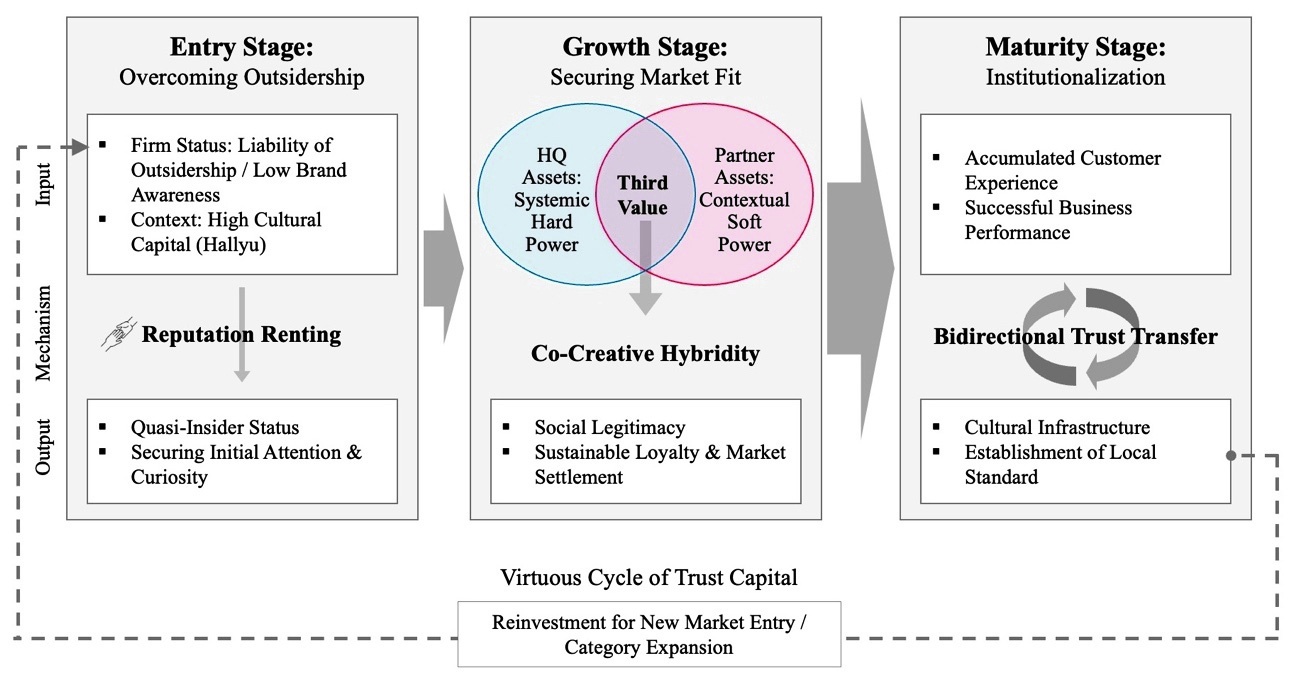
Table 1
| Category | Localization | Glocalization | Cultural Hybridity |
|---|---|---|---|
| Definition | The process of unilaterally modifying products and services to comply with local laws, institutions, and culture. | A dual-structure strategy that maintains global standards while partially adapting specific attributes to local conditions. | A creative process where global identity and local cultural resources interact to jointly co-create a 'Third Value.' |
| Approach | Passive Adaptation (Compliance) : Thorough customization based on local preferences. | Instrumental Adjustment (Balance) : Pursuing a balance between global efficiency and local responsiveness (Think Global, Act Local). | Active Creation (Fusion) : Generating new cultural meanings and forms based on mutual respect. |
| Key Mechanism | Physical modification of product/service features. | Adjustment of marketing mix and minor specifications. | Co-creation : Developing new business models and social values together with local partners/consumers. |
| Brand Identity | Risk of diluting brand consistency and global identity. | Maintenance of global identity combined with local friendliness. | Securing Cultural Legitimacy : Acquiring the status of an Insider within the local society. |
| Market Outcome | Securing short-term market fit. | Efficient market entry and expansion of market share. | Sustainable Competitive Advantage : Simultaneous achievement of economic performance and socioeconomic contribution. |
Table 2
| Category | Failure Cases: Walmart & Carrefour | Success Case: Costco |
|---|---|---|
| Strategic Stance | Cultural Imperialism : Unilateral imposition of headquarters systems and disregard for local context | Hybrid Standardization : Maintenance of global standards (warehouse style) combined with respect for local stakeholders |
| Store & Product | Adherence to Western warehouse models ignoring Korean preferences (e.g., high shelves, processed goods focus) | Maintenance of the warehouse model but complemented with a product mix favored by locals (e.g., high-quality fresh food, luxury goods) |
| Supplier Relations | Escalation of conflict due to demands for excessive price cuts and unfair trade practices (Zero-Sum) | Building mutual trust by strictly adhering to a margin cap policy (8–15%), guaranteeing supplier profitability (Win-Win) |
| Organization & HR | Degradation of service quality due to low wages and high turnover (Walmart turnover rate: 44%) | Securing high job satisfaction and service quality through industry-leading compensation (Costco turnover rate: 17%) |
| Outcome | Market Exit due to failure in localization and loss of social legitimacy | Market Settlement through securing a loyal customer base and continuous growth |
Source: Reconstructed based on Gereffi and Christian (2009), Kim (2009), and Cascio (2006a, 2006b).
Table 3
| Stage & Mechanism | GS25 (Case of Vietnam) | CU (Case of Mongolia) |
|---|---|---|
| 1. Entry [Reputation Renting] | Utilization of K-Content : Secured initial brand awareness and reduced marketing costs by leveraging Hallyu content such as the drama Backstreet Rookie | Utilization of K-Image : Stimulated initial curiosity by positioning stores as Korean cultural experience spaces through Korean-style interiors and K-Food displays |
| 2. Growth [Co-Creative Hybridity] | Operational Hybridity : Convergence of local street food (Banh mi) with Korean instant cooking systems (Tteokbokki) : Provision of large-scale tasting areas and motorbike drive-thrus tailored to local lifestyle. | Social Hybridity : Addressing the institutional void by providing heated shelters and free public restrooms considering the harsh winter climate : Development of meat-based convenience foods reflecting the nomadic dietary culture. |
| 3. Maturity [Bidirectional Trust Transfer] | Lifestyle Platformization : Achieved No. 1 market share in Southern Vietnam : Positive store experiences translated into preference for the Korean national brand, acting as a bridge for other Korean firms | Institutionalization of Brand : Success of the local partner's (Premium Nexus) IPO on the Mongolian Stock Exchange : The brand name CU became a generic noun for convenience stores, establishing the Korean retail system as a local standard. |
Source: Reconstructed based on GS Retail and BGF Retail Sustainability Reports (2018–2024), Shin et al. (2022), Hyun and Hong (2023), and interview data.
Table 4 Mapping Key Constructs to Empirical Evidence
| Theoretical Dimension | Key Construct | Representative Evidence (Verbatim Quotes & Observations) |
|---|---|---|
| Entry Stage | Reputation Renting (Utilization of Hallyu as a Catalyst) | [GS25] “Customers didn't come to buy goods; they came to feel like protagonists in a K-Drama.” (INT-A) [CU] “We positioned our stores as a K-Culture Experience Space using K-Pop designs to attract young Mongolians.” (Archival Data) |
| Growth Stage | Co-Creative Hybridity (Fusion of Hard & Soft Power) | [GS25] “We combined our instant cooking system with Vietnam's Banh mi culture... creating a new category.” (INT-B) [CU] “The Toilet Revolution was a joint effort to solve Mongolia's lack of infrastructure using our facility standards.” (Media Report) |
| Maturity Stage | Bidirectional Trust Transfer (Mutual Reinforcement) | [GS25] “Positive store experiences are making Vietnamese consumers trust other Korean products more.” (KOFICE Survey) [CU] “ 'CU has become a proper noun for convenience stores... leading to our partner's successful IPO.” (INT-C) |
Table 5 Mechanism of Co-Creative Hybridity: Synergizing Hard and Soft Power
| Domain | HQ's Input (Hard Power: System) | Local Partner's Input (Soft Power: Context) | Hybrid Outcome (The Third Value) |
|---|---|---|---|
| Product (Food) | - Instant cooking technology (machines) - PB product development recipes - Quality control standards | - Insight into local tastes (e.g., spiciness level) - Sourcing of local ingredients - Traditional food concepts (Banh mi, Buuz) | Localized K-Food (e.g., Tteokbokki adapted to local palate, Kimchi Banh mi) |
| Space & Service | - Store layout & operation manuals - 24-hour operation system - Logistics infrastructure (Cold chain) | - Understanding of climate needs (Heating, AC) - Transportation habits (Motorbike) - Social gathering culture | Social Infrastructure (e.g., Heated Shelters in Mongolia, Drive-thru for Motorbikes in Vietnam) |
| Marketing | - Hallyu content IP (K-Pop, Drama) - Brand identity guidelines | - Connection with local influencers - Religious/Cultural sensitivity (Halal, Ramadan) | Cultural Platform (e.g., K-Culture Festivals held locally, Halal-certified K-Snacks) |