
.jpeg)
인플루언서 마케팅 효과: 다채널 환경에서 온라인 구전을 통한 직접 및 간접 효과
Influencer Marketing Effectiveness: Direct and Indirect Effects through Electronic Word-of-Mouth in a Multichannel Environment
1 서울대학교 (Seoul National University)
교신저자: 박성호 (spark104@snu.ac.kr)
DOI: https://doi.org/10.17287/kmr.2026.55.1.183
초록
본 연구는 인플루언서 마케팅이 온라인 및 TV 광고와 같은 전통적인 광고와 비교하여 직접적으로, 그리고 온라인 구전(eWOM)을 통한 간접적으로 매출을 어떻게 견인하는지 조사한다. 글로벌 화장품 기업의 실제 데이터와 다중 방정식 모델을 사용하여 채널별 매출 탄력성과 마케팅 투자 수익률(ROI)을 추정하였다. 연구 결과, 인플루언서 마케팅은 온라인 및 TV 광고보다 유의하게 더 큰 매출 효과를 생성하며, 더 높은 탄력성과 장기적 ROI를 나타냈다. 특히 인플루언서 마케팅은 온라인 구전을 자극하여 추가적인 온라인 매출을 매개하는 간접적 경로를 드러냈으며, 이는 전통적 광고에서는 덜 두드러졌다. 이러한 효과는 온라인 채널 내에서 특히 강력하게 나타났는데, 이는 채널 매칭의 이점과 소셜 증폭의 디지털 특성을 반영한다. 본 연구는 채널 전반에 걸친 인플루언서 마케팅의 직접 및 간접 효과를 정량화하고, 이를 전통적 광고와 비교하며, 매개 메커니즘으로서 eWOM의 역할을 명확히 함으로써 문헌에 기여한다. 관리적으로는 인플루언서 마케팅이 즉각적인 매출과 소비자 주도의 증폭을 이끄는 고수익 전략임을 강조하며, 디지털 및 오프라인 맥락의 옴니채널 마케팅에 대한 실질적인 통찰을 제공한다.
Abstract
This study examines how influencer marketing compares to traditional advertising—online and TV ads—in driving sales, both directly and indirectly through electronic word of mouth (eWOM). Using a multi-equation model and real-world data from a global cosmetics company, we estimate channel-specific sales elasticities and returns on marketing investment. Our results show that influencer marketing generates significantly larger sales effects than online and TV advertising, with higher elasticities and greater long-term ROI. Importantly, influencer marketing stimulates eWOM, which mediates additional online sales, revealing an indirect pathway that is less pronounced for conventional advertising. Effects are particularly strong within the online channel, reflecting a channel-matching advantage and the digital nature of social amplification. This study contributes to literature by quantifying both direct and indirect effects of influencer marketing across channels, situating them relative to traditional advertising, and clarifying the role of eWOM as a mediating mechanism. Managerially, the findings underscore influencer marketing as a high-return strategy that drives immediate sales and consumer-driven amplification, offering actionable insights for omnichannel marketing in digital and offline contexts.
Ⅰ. Introduction
Influencer marketing has become an increasingly common strategy in digital advertising, as firms collaborate with social media personalities to promote products and influence consumer behavior. Influencers, unlike traditional celebrities, are typically viewed as more relatable and authentic—individuals who attract large audiences by sharing content and expertise in domains such as fashion, beauty, or food (Pei and Mayzlin, 2022; Schouten et al., 2020). This shift reflects broader trends in media consumption. In 2024, users spent an average of 143 minutes per day on social media (Statista, 2025A), and the global influencer marketing industry expanded from $1.7 billion in 2015 to $24 billion in 2024 (Statista, 2025B).
In response to this growth, a growing body of research has examined the mechanisms and outcomes associated with influencer marketing. Prior studies have investigated psychological mechanisms, including source credibility, parasocial relationships, and perceived similarity between influencers and their followers (Djafarova and Rushworth, 2017; Lou, 2022; Schouten et al., 2020; Ye et al., 2021). Others have explored how characteristics of influencers, followers, and content shape outcomes such as engagement, brand attitudes, and purchase intentions (Leung et al., 2022; Lou and Yuan, 2019; Cascio Rizzo et al., 2024). A number of studies compare influencer-generated content with brand-generated posts or conventional advertising, generally finding that influencer campaigns tend to produce higher levels of digital engagement (Gong et al., 2017; Zhang et al., 2021; Yang et al., 2021). More recently, a small but growing literature has begun to examine sales effects, particularly in the context of livestream commerce (Beichert et al., 2024; Gu et al., 2024; Zhang et al., 2024).
Despite these developments, several gaps remain. First, much of the existing literature emphasizes intermediate outcomes rather than actual purchase behavior, making it difficult to assess the financial performance of influencer campaigns. Second, although electronic word of mouth (eWOM) is often cited as a mechanism through which influencer content spreads, few studies directly examine its mediating role between influencer activity and sales (Feng and Papatla, 2011). Third, research on cross-channel effects—for example, whether online influencer marketing affects offline sales—remains limited. Likewise, few studies have benchmarked the performance of influencer marketing against non-endorsed advertising formats such as TV or online ads using real-world sales data. As a result, it is unclear how influencer marketing compares to traditional advertising across channels or how its effects are shaped by consumer-generated communication.
Importantly, the limitations of traditional advertising research—such as weak cross-channel effects and inconsistent evidence on eWOM—become even more pronounced in the context of influencer marketing. Whereas TV or online ads can influence sales even without consumer discussion, influencer campaigns are embedded in social networks where peer-to-peer amplification is not incidental but fundamental. If such indirect pathways are ignored, we risk systematically underestimating the true impact of influencer activity. This sharper limitation motivates our study’s design: to explicitly model both direct and eWOM-mediated effects and to benchmark influencer campaigns against conventional advertising across online and offline sales channels.
Accordingly, this study asks: How does influencer marketing affect sales outcomes across online and offline channels, both directly and indirectly through eWOM, and how does its effectiveness compare with conventional online and TV advertising?
This study contributes to the literature in three ways. First, it provides empirical estimates of sales elasticities for influencer, TV, and online advertising, addressing the lack of cross-channel, real-world comparisons. Second, it formally examines the indirect role of eWOM in mediating the effects of influencer marketing, extending research that has primarily focused on engagement metrics rather than actual sales. Third, by comparing own- and cross-channel effects, it clarifies whether the impact of marketing activities extends beyond their originating platform, offering novel evidence on the interplay between digital and offline channels. Collectively, these contributions advance both theoretical understanding of multi-channel advertising and practical guidance for marketing strategy.
The remainder of the paper is organized as follows. Section 2 reviews the relevant literature and presents our hypotheses. Section 3 describes the data, and Section 4 outlines the empirical model. Section 5 presents the results. We conclude in Section 6 with a discussion of theoretical contributions, managerial implications, and directions for future research.
II. Related Literature
This study draws on two primary streams of literature: research on advertising effectiveness and research on influencer marketing. While prior studies have examined traditional and online advertising as well as the psychological and engagement effects of influencer campaigns, important gaps remain. In particular, few studies have simultaneously compared these marketing formats using real-world sales data across multiple channels, quantified cross-channel effects, or formally modeled the mediating role of electronic word of mouth (eWOM). By integrating insights from these areas, this study contributes to the literature by providing a rigorous empirical assessment of how influencer marketing affects both online and offline sales, and by clarifying how its impact is transmitted directly and indirectly through eWOM.
2.1 The Effect of Advertising
Extensive research has shown that traditional and online advertising can directly increase sales, typically within their own channels. For instance, TV, print, and radio ads have been found to raise offline sales, whereas online display and paid search ads contribute to online sales growth (Danaher and Dagger, 2013; Danaher et al., 2020; Mark et al., 2019; Kim and Park, 2002). In addition to these own-channel effects, some studies have examined cross-channel impacts, such as TV advertising influencing online sales and vice versa (Dinner et al., 2014; Mark et al., 2019). With the growth of multichannel retailing, research has further investigated the interaction between traditional and online advertising, highlighting potential synergies in omnichannel environments (Bell et al., 2025; Zhu et al., 2024). However, the relative strength of own- versus cross-channel effects remains inconclusive, with mixed findings across product categories and contexts (Danaher et al., 2020; Dinner et al., 2014).
Beyond direct effects, advertising can influence sales indirectly through eWOM, which reflects consumer discussions and social amplification of marketing messages. For example, Onishi and Manchanda (2012) find that TV advertising contributes both directly and via eWOM to increased movie attendance. Other studies report positive associations between advertising and sales, and between eWOM and sales, but sometimes observe negative relationships between advertising intensity and eWOM itself (Feng and Papatla, 2011). These findings suggest that indirect effects are context-dependent, vary across channels, and are not yet fully quantified. Critically, few studies formally model the mediating role of eWOM across multiple advertising channels, leaving a gap in understanding how social amplification complements or substitutes direct marketing effects.
2.2 The Effect of Influencer Marketing
The limitations observed in traditional advertising—weak cross-channel effects and context-dependent eWOM pathways—become especially salient in the context of influencer marketing. Unlike conventional ads, influencer content inherently blends promotional messaging with social interaction, often eliciting engagement, sharing, and peer-to-peer discussion. As a result, the indirect, eWOM-mediated effects of influencer marketing are likely more pronounced, yet remain empirically underexplored.
Research on influencer marketing has focused on three areas: psychological mechanisms, outcome metrics, and comparison with traditional advertising. First, psychological mechanisms suggest that influencers are perceived as more credible and relatable than traditional celebrities because they present products in informal, everyday contexts (Djafarova and Rushworth, 2017; Schouten et al., 2020). This perceived closeness, sometimes described as a trans-parasocial relationship, can enhance persuasive impact (Lou, 2022; Zhang and Hur, 2025), while factors such as influencer popularity or expertise further moderate these effects (Cascio Rizzo et al., 2024). Importantly, these mechanisms indicate that influencer marketing may operate not only through direct exposure but also via eWOM, amplifying consumer responses beyond the initial contact.
Second, prior studies have examined engagement metrics (likes, shares, comments), eWOM, brand attitude, and purchase intention across social media platforms such as Tik Tok, Instagram, and Twitter (Leung et al., 2022; Lou and Yuan, 2019; Cascio Rizzo et al., 2024; Daniels and Wu, 2024; Song and Chung, 2025). A smaller set of studies has considered actual sales outcomes, particularly in livestream commerce and video platforms (Beichert et al., 2024; Gu et al., 2024; Zhang et al., 2024; Li et al., 2025). These findings suggest that influencer characteristics and campaign design matter, yet their effects are rarely contextualized relative to conventional advertising or across multiple sales channels.
Third, limited work directly compares influencer marketing with traditional advertising. Existing comparisons generally show higher engagement or adoption for influencer content than brand-generated or conventional advertising (Gong et al., 2017; Zhang et al., 2021), but most rely on digital metrics rather than actual sales outcomes. Given the combination of credible, relatable messaging and social amplification, influencer marketing has the potential to overcome some of the key limitations of traditional advertising—particularly in stimulating cross-channel effects and eWOM-mediated impacts.
Taken together, these insights reveal two critical gaps: the cross-channel and eWOM-mediated effects of marketing remain under-examined, and comparative analyses using real-world sales data are scarce. Traditional advertising research highlights limitations in cross-channel and indirect effects, but these limitations become more severe in influencer contexts, where eWOM is a defining feature (Table 1). Prior studies therefore leave open three questions: (1) how influencer marketing compares with TV and online advertising in driving actual sales, (2) whether its effects operate directly or indirectly via eWOM, and (3) whether its impact extends across online and offline channels.
This study addresses these gaps by (i) using multi-year sales data from a global cosmetics brand to estimate elasticities across influencer, TV, and online channels, (ii) formally modeling both direct and eWOM-mediated effects, and (iii) testing own- and cross-channel spillovers.
Table 1 Overview of Influencer Marketing Literature
| Study | Empirical Setting | eWOM-mediation Modeling | Adstock Treatment | Type of Effect |
|---|---|---|---|---|
| Our paper | Influencer marketing campaign of global cosmetics brand | ✓ | ✓ | Both own- and cross-channels effects |
| Li et al. (2025) | YouTube | X | ✓ | Own-channel effect |
| Beichert et al. (2024) | X | X | Own-channel effect | |
| Gu et al. (2024) | Livestream commerce | X | X | Own-channel effect |
| Zhang et al. (2024) | Livestream commerce | X | X | Own-channel effect |
| Leung et al. (2022) | Livestream commerce | X | X | Own-channel effect |
Ⅲ. Hypotheses Development
Drawing on the limitations of traditional advertising and the distinct characteristics of influencer marketing, we develop three hypotheses regarding the relative effectiveness of these marketing instruments across channels. As illustrated in Figure 1, our analysis compares influencer marketing with two conventional advertising formats—TV and online ads—and incorporates eWOM as a mediating mechanism.
First, traditional advertising research indicates that both online and offline ads primarily drive sales within their own channels, with cross-channel effects often weak or inconsistent (Danaher et al., 2020; Dinner et al., 2014). Moreover, indirect effects through eWOM are context-dependent (Onishi and Manchanda, 2012; Feng and Papatla, 2011). In contrast, influencer marketing blends promotional messaging with social interaction, enhancing credibility, relatability, and peer-to-peer sharing (Djafarova and Rushworth, 2017; Schouten et al., 2020; Lou, 2022). Prior work on influencer engagement demonstrates that content often elicits higher consumer participation, including eWOM, than traditional advertising (Gong et al., 2017; Zhang et al., 2021). These psychological and behavioral mechanisms suggest that influencer marketing can generate larger sales effects than conventional advertising across both online and offline channels. Based on these theoretical and empirical insights, we hypothesize:
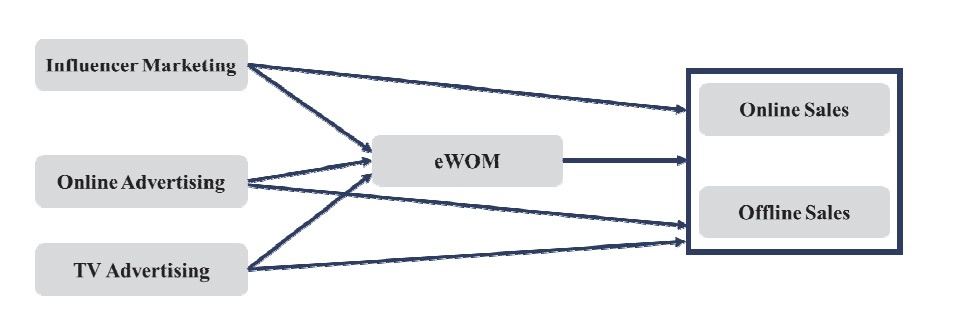
H1: Influencer marketing has a greater positive effect on online and offline sales than online and TV advertising.
Second, prior research shows that marketing can influence sales indirectly through eWOM, though traditional advertising studies often find weak or inconsistent mediation (Onishi and Manchanda, 2012; Feng and Papatla, 2011). Influencer marketing, by contrast, is particularly effective at stimulating peer-to-peer communication and sharing because influencers are perceived as credible and relatable (Djafarova and Rushworth, 2017; Lou, 2022). Empirical studies on engagement metrics and eWOM further support the idea that influencer content can amplify marketing messages through social networks (Leung et al., 2022; Lou and Yuan, 2019). These findings suggest that the impact of influencer marketing on sales is not purely direct but also operates indirectly via eWOM, particularly in digital channels where consumer conversations are concentrated. Consequently, we propose:
H2: Influencer marketing increases online sales both directly and indirectly through eWOM.
Third, the literature indicates that influencer marketing’s ability to generate eWOM and social amplification is especially pronounced in online environments, where content is easily shared and discussed (Leung et al., 2022; Lou and Yuan, 2019). Offline channels, in contrast, are less conducive to the propagation of digital social signals, limiting the indirect impact of influencer campaigns. Prior studies comparing channel-specific effects also highlight that influencer marketing is more effective in contexts that align with the medium of engagement (Cascio Rizzo et al., 2024; Beichert et al., 2024). Building on these insights, we expect that influencer marketing will have a stronger effect on sales in online channels relative to offline channels, due to the combined influence of direct exposure and eWOM-mediated amplification. Therefore, we hypothesize:H3: Influencer marketing has a greater positive effect on online sales than on offline sales.
Ⅳ. Data
To test the proposed hypotheses, we use proprietary data from a global cosmetics company, focusing on the South Korean market and the launch of a new cream product. The analysis covers the period from February 2020 to September 2021, beginning from the product release date in each channel. The product was introduced online one week prior to its offline release.
The company distributes the product through both company-owned and third-party retail channels. This study focuses on company-owned channels, which are categorized into online and offline formats. During the observation period, online sales accounted for 25.64% of total company-owned sales, while offline sales made up the remaining 74.36%.
To promote the product, the firm employed a mix of marketing instruments, including influencer marketing, online advertising, and TV advertising. The dataset includes daily-level information on sales, advertising expenditures, eWOM activity, and pricing. The dependent variable is daily sales volume, measured separately for online and offline channels.
eWOM is operationalized using search volume data obtained from Naver, the leading search engine in South Korea. We use Naver’s keyword tool to track the daily frequency of searches for the focal product name, which serves as a proxy for consumer interest and online conversation. The main independent variables are daily expenditures on influencer marketing, online advertising (e.g., display banners, video ads), and TV advertising for the focal product. These three categories collectively account for 92.43% of the brand’s total media spending during the study period—specifically, influencer marketing comprises 28.06%, online advertising 32.86%, and TV advertising 31.51%.
We do not have information on the specific content or individual characteristics of influencer marketing or advertisements. Consequently, while we can estimate the overall impact of influencer marketing on sales and eWOM, we cannot determine which specific influencer attributes (e.g., popularity, expertise, follower demographics) or campaign strategies are most effective. This limitation implies that the results reflect aggregate influencer effects rather than the performance of particular influencers or content types. Summary statistics for the key variables are provided in Table 2.
Table 2 Summary Statistics of Key Variables
| Variable | Mean | Standard Deviation |
|---|---|---|
| Online sales | 19.115 | 32.936 |
| Offline sales | 55.434 | 52.827 |
| Influencer marketing | 849,816.214 | 1,466,478 |
| Online advertising | 995,389.459 | 3,399,949 |
| TV advertising | 954,315.254 | 4,055,882 |
| eWOM | 7.354 | 10.226 |
| Online price | 16,120.292 | 2,213.035 |
| Offline price | 16,511.237 | 2,609.275 |
Note: The unit of all variables, except eWOM, is Korean won. As requested by the focal company, the data for sales, influencer marketing, advertising, and price have been rescaled using the same ratio.
Ⅴ. Model and Empirical Analysis
To empirically test our hypotheses, we develop models that estimate the own-and cross-channel effects of influencer marketing, online advertising, and TV advertising on sales, both directly and indirectly through eWOM. We employ log-log functional forms to estimate elasticities, which indicate the percentage change in outcomes associated with a 1% change in marketing expenditures. We use adstock variables to assess the effects of influencer marketing and advertising on each channel. Adstock captures their cumulative and long-term effect, which declines over time (Dinner et al. 2014). The eWOM model is specified as follows:
where subscript $t$ denotes the day. $InfluencerAd Stock_t$, $OnlineAd Stock_t$, and $TvAd Stock_t$ represent the adstock values for influencer marketing, online advertising, and TV advertising, respectively, on day $t$. $Price Total_t$ is the average product price across online and offline channels on day $t$. Weekday fixed effects are included through indicator variables $I(t=D)$ for each $D \in \{Mon, Tue, Wed, Thu, Fri, Sat\}$. Adstock variables are calculated using the following recursive specifications:
$InfluencerAd Stock_t = \lambda_{in} \cdot InfluencerAd Stock_{t-1} + (1 - \lambda_{in}) \cdot \ln(Influencer Marketing_t + 1),$ $OnlineAd Stock_t = \lambda_{on} \cdot OnlineAd Stock_{t-1} + (1 - \lambda_{on}) \cdot \ln(Online Advertising_t + 1),$
where $Influencer Marketing_t$, $Online Advertising_t$, and $TVAdvertising_t$ denote the daily expenditures on influencer marketing, online advertising, and TV advertising, respectively. While online advertising expenditures are available at the daily level, influencer marketing and TV advertising expenditures are reported monthly; these monthly values are converted to daily figures by dividing by the number of days in the corresponding month.
The parameters $\lambda_{In}$, $\lambda_{on}$, and $\lambda_{Tv}$ ($0 \le \lambda < 1$) represent the carryover rates of advertising effects for each respective channel. We determine the optimal combination of these carryover parameters using a grid search approach following Dinner et al. (2014). Specifically, we implement a three-variate grid search that varies each parameter from 0 to 0.99 in increments of 0.01, which requires estimating the model $100^3$ times. We select the combination that minimizes the residual sum of squares in ordinary least squares (OLS) regression. The sales model is specified as:
where $Sales_t$ and $Price_t$ represent sales volume and price, respectively, at day $t$ within each channel. Adstock variables are constructed as in the eWOM model above.
VI. Results
6.1 Impact on eWOM
Table 3 presents the results of the eWOM model. All key variables, except for a few weekday dummies, have statistically significant effects on eWOM volume. Influencer marketing, online advertising, and TV advertising each positively influence eWOM, with influencer marketing showing the strongest effect (coefficient = 0.560, p < 0.001), followed by TV advertising (coefficient = 0.391, p < 0.001) and online advertising. These results indicate that exposure to influencer content more effectively stimulates consumer interest and discussion compared to non-endorsed advertising formats.
The persistence of these effects differs across channels. The carryover parameter for influencer marketing is the highest ($\lambda_{In} = 0.98$), suggesting that the impact of influencer campaigns on eWOM is long-lasting. TV advertising also shows substantial persistence ($\lambda_{Tv} = 0.9$), whereas online advertising exhibits relatively short-lived effects ($\lambda_{on} = 0.2$). Price has a statistically significant negative effect on eWOM (coefficient = -0.442, p = 0.011), implying that higher prices dampen online discussion related to the product. Overall, these findings highlight both the strength and duration of influencer-driven eWOM, underscoring its role as a key channel for generating sustained consumer engagement.
Table 3 Estimation Results of the eWOM Model
| Variables | eWOM |
|---|---|
| Influencer marketing | 0.560*** (0.066) |
| Online advertising | 0.335*** (0.049) |
| TV advertising | 0.391*** (0.044) |
| Price | -0.442** (0.174) |
| Monday | 0.008 (0.041) |
| Tuesday | -0.024 (0.052) |
| Wednesday | -0.004 (0.050) |
| Thursday | -0.022 (0.048) |
| Friday | -0.107** (0.050) |
| Saturday | -0.086** (0.040) |
| Number of observations | 590 |
| F-statistic | 230.368*** |
| $R^2$ | 0.777 |
Note: Standard errors are in parentheses. Robust standard errors are used. *p < 0.1; **p < 0.05; ***p < 0.01
6.2 Impact on Sales
Table 4 presents the results of the sales models, estimated separately for online and offline channels. Influencer marketing has a positive effect on sales in both channels, with a stronger and statistically significant impact online (coefficient = 0.792, p < 0.001) compared to a marginally significant effect offline (coefficient = 0.761, p = 0.060). This pattern indicates that influencer campaigns are particularly effective in driving digital purchases, while still contributing to offline sales.
Online advertising significantly increases online sales (coefficient = 0.277, p = 0.002) but does not have a measurable impact on offline sales. In contrast, TV advertising primarily drives offline sales (coefficient = 0.330, p < 0.001) with no significant effect on online sales. These findings reflect a channel-specific pattern in which traditional and digital advertising are most effective within their own medium.
The eWOM variable has a significant positive effect on online sales (coefficient = 0.355, p < 0.001), but its effect on offline sales is not statistically significant, highlighting that consumer-driven discussion primarily amplifies digital purchases rather than offline transactions. Price negatively affects sales across both channels, with a larger magnitude offline (coefficient = -4.306, p < 0.001) than online (coefficient = -2.498, p < 0.001).
Table 4 Estimation Results of the Sales Model
| Variables | Online | Offline |
|---|---|---|
| Influencer marketing | 0.792*** (0.120) | 0.761* (0.403) |
| Online advertising | 0.277*** (0.091) | 0.427 (0.326) |
| TV advertising | 0.065 (0.114) | 0.330*** (0.090) |
| eWOM | 0.355*** (0.101) | 0.134 (0.403) |
| Price | -2.498*** (0.616) | -4.306*** (0.519) |
| Monday | 0.081 (0.090) | 0.234*** (0.064) |
| Tuesday | 0.028 (0.097) | 0.237*** (0.076) |
| Wednesday | 0.215** (0.087) | 0.347*** (0.072) |
| Thursday | 0.011 (0.100) | 0.358*** (0.085) |
| Friday | -0.116 (0.092) | 0.348*** (0.105) |
| Saturday | -0.050 (0.082) | 0.536*** (0.066) |
| Number of observations | 590 | 583 |
| F-statistic | 39.998*** | 66.724*** |
| $R^2$ | 0.488 | 0.541 |
Note: Standard errors are in parentheses. Robust standard errors are used. *p < 0.1; **p < 0.05; ***p < 0.01.
(< 0.001), consistent with stronger price sensitivity in physical retail.
Weekday effects are generally positive and significant for offline sales, indicating higher activity from Monday through Saturday relative to Sunday. Online sales, in contrast, show little variation across weekdays, suggesting that digital purchases are less affected by day-of-week patterns.
Table 5 reports carryover coefficients for influencer marketing and advertising expenditures within each sales channel. All three marketing instruments exhibit high carryover values, generally exceeding 0.9, which reflects the persistent impact of marketing activities on sales over time. It is worth noting that carryover coefficients estimated from daily data may be somewhat higher than those obtained from weekly observations, indicating that short-term persistence is captured more precisely at the daily level.
Table 5 Advertising Carryover Coefficients
| Online | Offline | |
|---|---|---|
| Influencer marketing | 0.99 | 0.99 |
| Online advertising | 0.87 | 0.99 |
| TV advertising | 0.92 | 0.93 |
6.3 Total Elasticities and Return on Investment
Table 6 summarizes the long-term total elasticities of each marketing instrument by sales channel, combining both direct and indirect effects. The direct effect reflects the immediate marginal impact of each marketing instrument on sales. Influencer marketing is the only instrument with significant direct effects in both online and offline channels, with a stronger impact on online sales (0.792) than offline sales (0.761). Online advertising exhibits a significant direct effect only on the online channel, whereas TV advertising’s direct effect is limited to offline sales. These patterns highlight that influencer marketing simultaneously drives sales across channels, while traditional advertising tends to be channel-specific.
Indirect effects, calculated as the product of the effect of each marketing instrument on eWOM and the effect of eWOM on sales, are observed exclusively for online sales. Influencer marketing has the largest indirect effect (0.199), followed by TV advertising (0.133) and online advertising (0.116). Notably, although TV ads do not directly affect online sales, their indirect effect through eWOM exceeds that of online advertising, indicating that traditional ads can still contribute to online demand via consumer discussion.
Considering total effects, which combine direct and indirect contributions, influencer marketing exhibits the greatest overall impact across both channels, with online sales (0.991) benefiting more than offline sales (0.761). Online advertising has a larger total effect than TV ads on online sales but remains negligible offline. Conversely, TV advertising demonstrates its strongest total effect on the offline channel, reinforcing the importance of media-channel fit.
To account for the relative contribution of each channel to overall sales, we compute weighed average elasticities based on the sales shares of online (25.64%) and offline (74.36%) channels. The resulting weighted elasticities are 0.820 for influencer marketing, 0.101 for online advertising, and 0.279 for TV advertising. The particularly high elasticity of influencer marketing reflects its substantial direct effect across both channels. In contrast, the overall elasticity of online advertising remains low because its effect is confined to the smaller online segment.
Table 6 Total Long-Term Elasticities
| Dependent Variable | Influencer marketing | Online ad | TV ad | |
|---|---|---|---|---|
| Online sales | Direct effect (a) | 0.792 | 0.277 | n.s. |
| Indirect effect (b) | 0.199 | 0.116 | 0.133 | |
| Total effect (a) + (b) | 0.991 | 0.393 | 0.133 | |
| Offline sales | Direct effect (c) | 0.761 | n.s. | 0.330 |
| Indirect effect (d) | n.s. | n.s. | n.s. | |
| Total effect (c) + (d) | 0.761 | n.s. | 0.330 | |
| Total sales | 0.820 | 0.101 | 0.279 |
These elasticity estimates are broadly consistent with prior research. For instance, the TV advertising elasticity of 0.279 closely aligns with the long-term elasticity of 0.24 reported in Sethuraman et al. (2011), which analyzed traditional media formats such as print as television. Overall, these results underscore that influencer marketing not only generates strong channel-specific sales effects but also provides significant cross-channel influence through eWOM.
Tables 7 and 8 present the estimated return on investment (ROI) for each marketing instrument, defined as the increase in profit generated by an additional unit (1 Korean won) of marketing expenditure. Profit is calculated as:
where m represents the profit margin for each sales channel, S denotes sales in each channel, and MI is the marketing investment. Profit margins were set at 0.6 for the online channel and 0.5 for the offline channel, based on data from another brand within the same company, and were adjusted via a linear transformation according to company requests. Marketing expenditures were scaled by 0.24 to reflect the proportion of total sales accounted for by company-owned channels, as estimated from a related product.
ROI was calculated for both short- and long-term periods. Short-term ROI accounts for the immediate effect of marketing expenditures, incorporating the carryover effect $(1 - \lambda)$ applied to the long-term elasticity $(\eta)$:
where $(1 - \lambda) * \eta$ represents the short-term elasticity for each channel. Long-term ROI reflects the total marginal impact of marketing expenditure over time, using the long-term elasticity $\eta$:
In the short term, all three marketing instruments exhibit negative ROI, with influencer marketing showing the largest immediate loss (-0.961 Korean won), likely due to substantial upfront investment during the product launch. Over the long term, influencer marketing achieves a positive ROI of 2.946, outperforming TV advertising (0.150) and online advertising, which yields a negative ROI (0.526).
The high long-term ROI for influencer marketing is partly driven by its cross-channel impact (2.545), which exceeds its own-channel contribution (1.401). Because offline sales account for a larger share of total sales, this cross-channel influence substantially enhances overall ROI. In contrast, online advertising’s effects are confined to the online channel, limiting its ROI, while TV advertising generates only moderate long-term returns, primarily through the offline channel.
These results support Hypothesis 1: influencer marketing generates larger positive effects on both online and offline sales than online and TV advertising. They also support Hypothesis 2, indicating that influencer marketing and other advertising methods exert both direct and indirect effects on online sales via eWOM. Consistent with Hypothesis 3, the effect of influencer marketing is more pronounced in the online channel than offline, reflecting the absence of indirect eWOM effects in offline sales.
Table 7 Short-Term ROI Analysis
| Online channel | Offline channel | Total ROI | |
|---|---|---|---|
| Influencer marketing | 0.014 | 0.026 | -0.961 |
| Online advertising | 0.062 | n.s. | -0.938 |
| TV advertising | 0.013 | 0.069 | -0.918 |
Table 8 Long-Term ROI Analysis
| Online channel | Offline channel | Total ROI | |
|---|---|---|---|
| Influencer marketing | 1.401 | 2.545 | 2.946 |
| Online advertising | 0.474 | n.s. | -0.526 |
| TV advertising | 0.167 | 0.983 | 0.150 |
6.4 Robustness check
To assess the robustness of our findings, we conducted a supplementary analysis using data from another newly launched product within the same brand, a cushion foundation. The sample covers July 2020 to October 2021 in the South Korean market, starting from the product’s release date. Sales data were obtained from a major external retailer operating both online and offline channels. During this period, the retailer’s online channel accounted for 71.34% of total sales, while the offline channel represented 28.66%. The retailer contributed roughly 33% of the product’s total sales.
We estimated the effects of influencer marketing and online advertising on both online and offline sales, with eWOM included as a mediating variable. The results, summarized in Tables 9 and 10, align with the main findings from the focal product analysis, providing additional support for the validity of our model. Specifically, total sales elasticity for influencer marketing (0.921) exceeds that of online advertising (0.697). Both marketing strategies achieve positive long-term ROI, with influencer marketing delivering a higher ROI relative to online advertising.
Notably, for this product, the ROI of influencer marketing is primarily driven by within-channel effects, reflecting the larger share of online sales compared to offline sales. This pattern contrasts with the focal product, where offline sales accounted for a larger proportion, highlighting how channel composition influences the relative contribution of own- versus cross-channel effects.
Table 9 Robustness Checks for Total Long-Term Elasticities
| Dependent Variable | Influencer marketing | Online ad | |
|---|---|---|---|
| Online sales | Direct effect (a) | 0.805 | 0.740 |
| Indirect effect (b) | 0.330 | 0.050 | |
| Total effect (a) + (b) | 1.135 | 0.790 | |
| Offline sales | Direct effect (c) | 0.391 | 0.463 |
| Indirect effect (d) | n.s. | n.s. | |
| Total effect (c) + (d) | 0.391 | 0.4623 | |
| Total sales elasticity | 0.921 | 0.697 |
Table 10 Robustness Checks for Long-Term ROI Analysis
| Online channel | Offline channel | Total ROI | |
|---|---|---|---|
| Influencer marketing | 5.556 | 4.064 | 8.620 |
| Online advertising | 3.050 | 3.787 | 5.837 |
Ⅶ. Discussion
7.1 Discussion of Key Findings
This study provides robust evidence that influencer marketing generates larger sales effects than conventional online and TV advertising across both online and offline channels. Influencer marketing exhibits higher direct sales elasticities and greater long-term ROI, highlighting its relative effectiveness as a promotional approach. Crucially, influencer marketing significantly stimulates electronic word of mouth (eWOM), which in turn boosts online sales. In contrast, the indirect, eWOM-mediated effect of traditional advertising is comparatively weaker, reflecting that standard ads primarily rely on direct exposure and do not leverage social networks as a core mechanism. The concentration of eWOM effects within online channels underscores the digital context in which social amplification predominantly occurs.
Our findings also clarify channel-specific dynamics. Both influencer marketing and traditional advertising produce stronger effects within their originating channels than across channels, emphasizing the importance of media-channel fit. Influencer marketing, however, demonstrates notable cross-channel effects, increasing offline sales despite being primarily digital. These results illustrate that influencer campaigns can overcome some of the inherent limitations of conventional advertising by transmitting influence through social networks, which justifies the study’s focus on modeling both direct and indirect pathways.
7.2 Theoretical Contribution
This study advances research on advertising and influencer marketing by addressing three key gaps identified in prior work. First, while traditional advertising studies often examine direct, own-channel effects, cross-channel spillovers have been rarely quantified. By documenting that influencer marketing can influence both online and offline sales, the study provides empirical evidence on the multichannel effects of digital promotions, addressing the limited understanding of cross-channel impacts.
Second, prior research on influencer marketing has largely focused on engagement metrics or purchase intentions, with the role of electronic word of mouth (eWOM) in mediating actual sales remaining underexplored. By explicitly modeling eWOM as a mediating mechanism and linking it to observed online sales, this study quantifies the indirect, social amplification effects that are unique to influencer campaigns.
Third, although psychological mechanisms such as influencer credibility, relatability, and parasocial relationships are theorized to enhance campaign effectiveness, prior work rarely connects these mechanisms to real-world sales outcomes or compares them to traditional advertising formats. By situating influencer marketing alongside online and TV advertising, the study clarifies where and how these mechanisms translate into measurable sales differences, providing evidence on the unique advantages of influencer marketing in driving both direct and eWOM-mediated effects.
Collectively, these contributions refine our understanding of advertising effectiveness in digital contexts by showing how influencer marketing operates differently from conventional ads across channels and through social amplification, grounded in both theoretical expectations and observed sales outcomes.
7.3 Practical Contribution
From a managerial perspective, these findings provide concrete guidance for designing and evaluating marketing strategies. Influencer marketing produces higher direct and eWOM-mediated ROI than conventional TV or online advertising, suggesting that firms should prioritize influencer campaigns when social amplification is critical, such as during product launches or campaigns targeting digitally active audiences.
The observed cross-channel effects indicate that digital campaigns can positively affect offline sales, highlighting the value of coordinating online influencer activity with in-store promotions or offline events to maximize total ROI. Moreover, because influencer effects operate through both direct exposure and eWOM, traditional engagement metrics alone are insufficient for evaluating effectiveness. Managers should implement integrated measurement systems capturing both consumer interactions and subsequent sales outcomes to ensure resource allocation reflects true marketing impact.
Finally, the study emphasizes the importance of influencer selection and campaign design. Selecting credible and relatable influencers who align with brand identity and target audience enhances both engagement and peer-to-peer sharing, reinforcing the campaign’s direct and indirect impact. By grounding these managerial implications in the observed data, the findings provide actionable guidance for firms operating in increasingly digital and socially connected marketplaces.
7.4 Limitations and Future Research
This study has several limitations. First, the dataset lacks detailed information on individual influencer posts or advertisement creatives, limiting the ability to analyze how specific content characteristics or influencer attributes influence performance. Future research could incorporate post-level data to examine the effect of messaging, tone, or influencer characteristics on sales outcomes.
Second, our analysis is restricted to company-owned sales channels and does not include third-party retailers or broader market data, which limits generalizability. Integrating multi-retailer or panel-level datasets could validate whether the observed effects extend across external platforms.
Third, although the adstock-adjusted OLS estimates provide useful evidence, advertising and influencer expenditures may still be endogenously determined with expected demand or concurrent promotions. For example, managers may increase advertising or influencer marketing expenditures for products that are expected to experience higher future demand. This raises the possibility of upward bias in ROI estimates, so the results should be interpreted with caution.
Fourth, we convert monthly influencer marketing and TV advertising expenditures into daily values by dividing by the number of days in each month. This procedure assumes an even distribution of spending across days, whereas in practice firms often concentrate posts or broadcasts on specific dates and time slots. As a result, the approach may smooth over the actual variation in campaign intensity, introducing measurement error and potentially biasing the estimation of short-term or lagged effects. Importantly, however, this limitation does not affect the accuracy of aggregate monthly expenditure levels. Future research with access to daily expenditure or posting data could address this issue and provide a more precise assessment of timing-related effects. Finally, our analysis is based on company-owned sales channels and does not capture outcomes in third-party retailers or the broader market. This restriction limits the generalizability of our findings to the total market environment. Future research should integrate multi-retailer or panel data to validate whether the observed effects extend across external platforms and distribution channels.
저자 약력
∙ The author Haeun Kim is a Ph.D. candidate at SNU Business School, Seoul National University. Her main research areas include digital marketing, retailing, and generative AI.
∙ The author Sungho Park is a tenured professor at SNU Business School, Seoul National University. His primary research areas include retail, AI and digital innovation.
∙ The author Juwon Hong is a Ph.D. candidate at SNU Business School, Seoul National University. Her main research areas include generative AI and AI agents.
∙ The author Sungeun Byun graduated from the Master’s program at SNU Business School, Seoul National University. Her primary research areas include digital marketing and generative AI.