
.jpeg)
Are Consumers Really Attracted to “Free”? The Token Promotional Pricing Effect Under Non-monetary Costs
1 Graduate School of Business Administration, Myongji University
2 College of Business Administration, Myongji University
*Corresponding author: Geonha Kim (ghkim@mju.ac.kr)
DOI: https://doi.org/10.17287/kmr.2026.55.4.1671
Abstract
Free trials are widely used to attract new customers, yet it is unclear whether consumers are consistently motivated by “free.” When trial participation requires meaningful non-monetary costs such as time and effort, the effectiveness of free trials becomes questionable. This study investigates whether token-price trials—minimal, negligible payments—generate stronger consumer responses than free trials. A 2 × 2 between-subjects experiment manipulating trial promotion type (token-price vs. free) and non-monetary cost level (high vs. low) was conducted with 200 participants. Results show a significant interaction: participation intention and perceived value decrease under high non-monetary costs in free trials but increase under high non-monetary costs in token-price trials. Across all conditions, token-price trials produced higher perceived value and participation intention than free trials, demonstrating a clear token promotional pricing effect. Regression results confirmed that perceived value strongly predicts participation intention. PROCESS macro model 8 further revealed a significant moderated mediating effect: the indirect effect of trial type on participation intention via perceived value was stronger under high non-monetary cost conditions. These findings identify when token-price trials outperform free trials and provide actionable implications for designing more effective experiential marketing strategies.
Ⅰ. Introduction
Companies employ a wide range of marketing strategies to promote their products and services. Among these, trial promotions have gained increasing attention for their ability to convey value through direct consumer experience. By allowing consumers to engage with an offering firsthand, trial promotions play a critical role in shaping favorable attitudes and facilitating conversion to purchase behavior (Berry et al., 2002; Schmitt, 1999). Reflecting their strategic importance, firms frequently use free trials, tasting events, and product demonstrations to reduce consumer uncertainty and strengthen engagement.
But are consumers truly drawn to “free”? Prior research suggests that free pricing does not always yield uniformly positive outcomes. Free trials may reduce perceived quality (Gorn et al., 1991; Raghubir, 2004/2005; Park et al., 2019), interfere with value assessment and lower willingness to pay (Munger and Grewal, 2001; Kamins et al., 2009), and even cannibalize subsequent paid purchases (Bawa and Shoemaker, 2004). These findings challenge the assumption that free offers are inherently advantageous and highlight the need to consider alternative approaches.
One promising alternative is token promotional pricing, in which consumers pay a nominal amount with negligible economic burden. A growing body of research shows that even a small payment can help consumers more readily perceive value and increase participation intention (Palmeira, 2011; Mao, 2016; Kim and Lee, 2020; Li and Kim, 2025/2026). This phenomenon―referred to as the token promotional pricing effect―suggests that minimal payment can act as a value cue, enhancing cognitive engagement with the promotion.
Trial participation, however, involves not only monetary factors but also non-monetary costs such as time, effort, and psychological burden. While prior research has traditionally conceptualized these non-monetary costs as barriers that hinder consumer participation (Lovelock, 1983; Berry, 1999), the present study proposes that they may also serve as a moderating factor that strengthens or weakens the influence of token promotional pricing. In particular, when non-monetary costs are high, token-price trials may provide stronger value justification than free trials, whereas free trials may heighten the salience of non-monetary burdens.
Accordingly, this study has three objectives. First, it compares token-price trials and free trials to evaluate the relative effectiveness of token promotional pricing. Second, it examines whether non-monetary costs moderate consumers’ responses to trial promotions. Third, it investigates the mediating role of perceived value in shaping participation intention. Through these analyses, the study seeks to elucidate how token promotional pricing and non-monetary costs interact to influence consumer behavior in trial marketing contexts.
This research contributes to the literature by jointly examining the roles of token-price trials and non-monetary costs―two factors that have rarely been studied together―in shaping consumer evaluation and participation. From a managerial standpoint, the findings offer practical guidance for developing more sophisticated experiential marketing strategies that move beyond traditional free trials and strategically leverage token-price trials in contexts involving meaningful non-monetary burden.
II. Theory and Hypotheses
2.1 Trial Promotion
A trial promotion is a marketing strategy that allows consumers to experience a product or service prior to purchase, helping them recognize its experiential value and reducing uncertainty. Free trials represent a common form of trial promotion, as they provide consumers with access to a portion of a product or service without monetary cost, thereby lowering entry barriers (Niu et al., 2019; Cheng and Liu, 2012). Online free sampling has been shown to increase brand awareness and conversion rates by offering consumers a low-risk opportunity to experience the product (Kuzma and Wright, 2015). Free trials can create positive first impressions, strengthen product trust, and enhance purchase intention, with potential spillover effects on loyalty formation (Laran and Tsiros,2013). These benefits can increase short-term conversion (Heiman et al., 2001) and contribute to longer-term brand loyalty and value creation (Villas-Boas, 2004).
However, free trials also have important limitations. Because they involve no monetary cost, consumers may perceive free offers as having lower value or may engage with them less seriously (Scott, 1976; Biswas et al., 2010). Moreover, free trials generally exhibit low conversion rates to paid usage (Koch and Benlian, 2017), raising concerns about cost efficiency. Providing free benefits to existing customers may also erode brand value or reduce profitability (Bawa and Shoemaker, 2004).
One key factor underlying these outcomes is the consumer’s reference point. Building on Prospect Theory (Kahneman and Tversky, 1979), Tversky and Kahneman (1991) argued that consumers evaluate outcomes relative to a reference point formed by expectations or social comparisons. Palmeira (2011) introduced the Zero-Comparison Effect, suggesting that when a price or attribute is set at zero, the absence of a comparison benchmark makes value evaluation more difficult, sometimes leading to unexpectedly lower perceived value.
This effect is relevant to price promotions. Research demonstrates that when consumers pay a token amount―imposing almost no economic burden―they can better assess relative value and become more motivated to participate in promotions compared with free offers. This phenomenon is known as the Token Promotional Pricing effect (Mao, 2016). Unlike the traditional economic assumption that price reductions straightforwardly increase demand, this effect illustrates that consumers reconstruct value based on comparative insights rather than absolute price. In digital subscription contexts, Kim and Lee (2020) found that low-cost token trials outperformed one-month free trials in boosting participation. Similarly, Li and Kim (2025) demonstrated that token-price trials for offline English conversation sessions generated more favorable attitudes and stronger participation intention than free trials. Extending this line of research, a dual mediation pathway was identified in which token pricing, compared to free trials, leads to more favorable attribution evaluations and enhanced perceptions of fairness, ultimately resulting in stronger participation intentions (Li, 2025; Li and Kim, 2026).
In summary, token-price trials encourage consumers to evaluate products or services more carefully and may overcome the inherent limitations of free trials. Based on this reasoning, we propose the following hypothesis:
H1-1. A token-price trial (vs. free trial) generates greater participation intention.
2.2 Non-monetary Costs
In value assessment, cost refers to what consumers must give up to obtain a product or service and is typically categorized into monetary and non-monetary costs (Zeithaml, 1988). Monetary costs include the explicit price and additional expenses such as taxes or shipping fees (Kim et al., 2007). Non-monetary costs encompass the time, effort, risk, and psychological burden associated with consumption (Li and Green, 2011; Miltgen, 2012).
A substantial body of research demonstrates that non-monetary costs strongly influence perceived value and consumer decision-making. Reducing time and effort can decrease perceived sacrifice and enhance overall perceived value (Zeithaml, 1988; Ahn et al., 2008; Sorebo, 2018). Non-monetary costs such as cognitive effort, time expenditure, and psychological discomfort have been shown to directly affect perceived value, satisfaction, and purchase intentions across various consumption contexts (Chang, 2023; Örgev and Bekar, 2013; Jeong and Kim, 2024).
Consumer decision theory suggests that individuals tend to evaluate monetary costs first―because price information is explicit―followed by an assessment of non-monetary costs (Bettman et al., 1998; Srinivasan and Ratchford, 1991). However, consumers’ cognitive capacity is limited (Kahneman, 1973). When people allocate cognitive resources to assessing the appropriateness of the price, their ability to consider non-monetary costs diminishes (Shiv and Fedorikhin, 1999; Payne et al., 1993). This aligns with cognitive load theory, which posits that individuals process only a limited amount of information simultaneously, prioritizing primary cues (e.g. price) over secondary ones (e.g. time, effort) as cognitive load increases (Sweller, 1988; Kahneman, 2011).
Beyond reducing attention to non-monetary costs, a token-price trial may also activate a value-justification process. According to Cognitive Dissonance Theory (Festinger, 1957), individuals are motivated to justify decisions that require the expenditure of resources such as money, time, or effort. One manifestation of this process is effort justification, whereby individuals tend to evaluate an outcome more positively when greater effort has been invested to obtain it (Aronson and Mills, 1959). Prior research further indicates that consumers often infer greater value from products, services, or experiences that require moderate levels of effort or resource investment (Inzlicht et al., 2018; Shenhav et al. 2021).
In the context of a token-price trial, consumers invest not only time and effort but also a small monetary payment. Although economically negligible, this payment may function as a symbolic investment that encourages consumers to justify their participation. Consequently, when non-monetary costs increase within a manageable range, consumers may perceive the trial as more worthwhile in order to justify the resources they have invested. This value-justification process can strengthen participation intention under a token-price trial condition.
H1-2. In the token-price trial condition, higher non-monetary costs will lead to higher Participation intention.
In contrast, when a trial is offered for free, consumers are not required to evaluate price appropriateness. Fan et al. (2022) demonstrated that zero-priced offers eliminate the need for monetary evaluation, allowing consumers to allocate more cognitive resources to assessing non-monetary costs. Therefore, time, effort, and psychological burden become more salient in the evaluation process. Prior studies indicate that heightened attention to such non-monetary costs tends to reduce perceived value and behavioral intention (Zeithaml, 1988; Ahn et al., 2008; Jeong and Kim, 2024).
Accordingly, in Free trial contexts, increases in non-monetary costs are likely to intensify consumers’ awareness of participation burden, thereby weakening their motivation to engage in the trial. Rather than facilitating participation, high non-monetary costs in Free trials may function as deterrents.
H1-3. In the free trial condition, higher non-monetary costs will lead to lower Participation intention.
2.3 Perceived Value
Perceived value refers to the overall assessment consumers make regarding the value they expect to obtain from a product or service (Zeithaml, 1988). As a central determinant of consumer choice and usage, perceived value has been widely examined as a key driver of behavioral responses such as attitudes, preferences, and intentions (Mazumdar and Monroe, 1990; Sweeney and Soutar, 2001). Consumers form perceived value by comparing the benefits they expect to receive with the costs they must incur (Anderson and Vincze, 2000; Lovelock and Patterson, 2015). Benefits can include functional, economic, psychological, and social value, whereas costs encompass not only monetary expenditures but also non-monetary costs such as time, effort, and psychological burden (Butz and Goodstein, 1996). From this cost–benefit perspective, perceived value increases when perceived benefits outweigh perceived costs (Dodds et al., 1991).
A central focus of this study is whether token promotional pricing enhances perceived value in trial promotions. According to the Zero-Comparison Effect, when a price is set at zero, consumers have difficulty forming meaningful comparison standards, which may weaken value evaluation (Palmeira, 2011). Building on this logic, Mao (2016) found that charging a token price rather than offering a free trial helps consumers evaluate benefits more readily and increases promotional responses. Consistent with these findings, recent studies have shown that token-price trials generate higher perceived transaction value, more favorable attitudes, and stronger participation intention than free trials (Kim and Lee, 2020; Li and Kim, 2025).
Although a token-price trial involves a small monetary cost, perceived value depends on the balance between perceived benefits and perceived sacrifices rather than on cost alone (Dodds et al., 1991; Zeithaml, 1988). While free trials eliminate monetary sacrifice, they may also reduce consumers’ ability to evaluate the value of the offer because no meaningful price reference is provided. In contrast, a token-price trial offers a comparison benchmark while imposing only a negligible economic burden. Furthermore, consumers often use price as an informational cue when evaluating products and services (Rao and Monroe, 1989). Even a very small payment may signal quality, credibility, and transaction value, thereby enhancing perceived benefits. Consequently, although token-price trials involve a slightly higher monetary sacrifice than free trials, they may generate greater perceived value by facilitating value assessment and strengthening positive inferences about the offer.
H2-1. Perceived value will be higher for the token-price trial than for the free trial.
Importantly, trial participation entails non-monetary costs such as time and effort, which are meaningful components of perceived sacrifice in value evaluation (Zeithaml 1988; Butz and Goodstein 1996). However, under a token-price trial, higher non-monetary costs may also strengthen perceived value through a value-justification process. As discussed above, Cognitive Dissonance Theory suggests that individuals justify decisions involving resource expenditure in order to maintain consistency between their actions and evaluations (Festinger, 1957). Thus, when consumers invest both non-monetary resources and a small amount of money, they may be motivated to view the trial as more worthwhile.
The token price may also function as a symbolic investment rather than merely a monetary cost. Even a negligible payment can shift consumers from passive recipients of a free offer to active participants who have intentionally committed resources. Such investments can foster psychological ownership and commitment, which enhance perceived value (Peck and Luangrath, 2018; Morewedge et al., 2021). Therefore, when non-monetary costs increase within a manageable range, consumers in the token-price trial condition may justify their overall investment more strongly, leading to higher perceived value.
H2-2. In the token-price trial condition, higher non-monetary costs will lead to higher perceived value.
In contrast, a Free trial eliminates monetary payment cues and may heighten consumers’ awareness of non-monetary burden. Fan et al. (2022) demonstrated that when an offer is priced at zero, consumers no longer need to evaluate price appropriateness and therefore allocate greater cognitive resources to assessing other costs associated with participation. As a result, time and effort become more salient in the evaluation process. Because non-monetary costs constitute an important component of perceived sacrifice (Zeithaml 1988), greater attention to such costs is likely to reduce consumers’ overall value assessments. Prior research has similarly shown that time expenditure, effort, and psychological burden negatively influence perceived value by increasing perceived sacrifice (Ahn et al. 2008; Jeong and Kim 2024). Consequently, as non-monetary costs increase, consumers may perceive the benefits-to-costs balance less favorably, resulting in lower perceived value (Dodds et al. 1991). Therefore, higher non-monetary costs should decrease perceived value in the Free trial condition.
H2-3. In the free trial condition, higher non-monetary costs will lead to lower Perceived value.
Prior research has consistently identified perceived value as a key antecedent of consumer attitudes, intentions, and behaviors (Dodds et al., 1991; Sweeney and Soutar, 2001). Higher perceived value enhances satisfaction and fosters positive evaluations, which in turn lead to stronger participation and purchase intentions. Recent studies have further confirmed this relationship across diverse consumption contexts, emphasizing perceived value as a critical driver of behavioral responses (Luo et al., 2021; Zhang et al., 2021; Manoj and Pradeep, 2023). Building on prior findings that consumer value influences subsequent behavioral intentions, such as continued use and recommendation intentions, this study extends the logic to trial promotion contexts by examining whether perceived value predicts participation intention (Ofori et al., 2023). Accordingly, the following hypothesis is proposed:
H3. Perceived value will have a significant positive effect on participation intention.
Beyond its direct influence, perceived value may also serve as the mediating mechanism through which trial promotion type shapes participation intention. If token-price trials enhance perceived value relative to free trials, then perceived value should function as a pathway linking trial type to behavioral intention.
However, the strength of this mediating effect is expected to depend on the level of non-monetary costs involved in participation. When consumers invest substantial time and effort, they engage in value justification processes to rationalize their actions (Festinger, 1957). A token-price trial can provide a minimal yet meaningful economic signal that strengthens perceived value under high non-monetary costs. In contrast, free trials offer no such signal, potentially increasing the salience of non-monetary burden and weakening value perceptions.
Thus, the interaction between trial promotion type and non-monetary costs is likely to amplify or attenuate the mediating role of perceived value. When non-monetary costs are high, the token-price trial should generate stronger perceived value and, consequently, a more pronounced indirect effect on participation intention. Based on this reasoning, the following hypothesis is proposed:
H4. Non-monetary costs will moderate the mediating effect of perceived value on participation intention, such that the indirect effect of trial promotion type on participation intention via perceived value will be stronger under high (vs. low) non-monetary cost conditions.
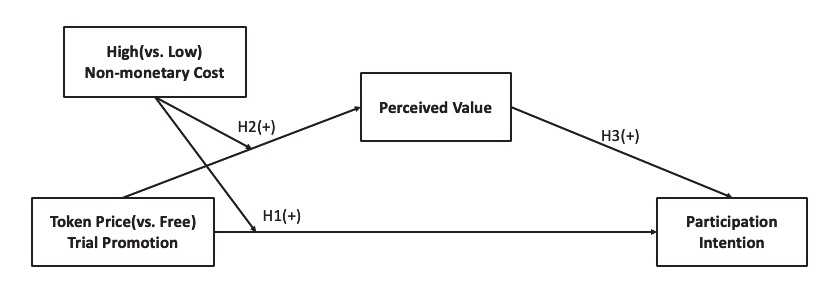
Based on prior research on trial promotions, token promotional pricing, and non-monetary costs, this study proposes an integrated research model that explains how trial promotion type influences consumers’ participation intention through perceived value, contingent upon the level of non-monetary costs. The conceptual framework is illustrated in Figure 1.
Ⅲ. Method
3.1 Preliminary Research
To determine an appropriate manipulation of non-monetary costs, a preliminary study was conducted to identify the level of travel distance at which consumers begin to perceive meaningful burden. The preliminary study involved 79 college students in their 20s (44.3% male; Mage = 20.2) enrolled at universities in Seoul. Participants were randomly assigned to either a free trial or a token-price trial condition and were presented with a scenario involving participation in an English conversation class. After reviewing the scenario, participants rated (1) perceived time and effort cost, (2) the importance of travel distance in deciding whether to participate in the trial, and (3) their interest in the English conversation class, each on a 5-point Likert scale.
The preliminary survey examined perceived travel burden associated with travel distance. No statistically significant differences emerged between the free trial and token-price trial groups in the perceived importance of travel distance for participation decisions (MFree = 4.11, MToken-price = 4.19, t=.494, p>.05) or interest in the English conversation class (MFree = 3.11, MToken-price = 3.38, t=1.162, p>.05). This indicates that the two groups were comparable in baseline perceptions and interest, supporting the validity of subsequent comparisons in the main experiment.
Next, perceived burden increased markedly around a 25-minute travel distance. Specifically, the mean perceived burden at 25 minutes was 4.24 in the free trial condition and 3.9167 in the token-price trial condition, suggesting that burden perceptions exceeded or approached the level at which burden becomes salient. The difference between the two conditions was not statistically significant, as the 95% confidence interval for the mean difference included zero (95% CI [−0.15412, 0.80728]), indicating comparable perceptions of travel burden across promotion types when distance is held constant(see table 1). Based on these results, the main experiment operationalized non-monetary costs using travel distance: distances of 25 minutes or more were classified as the high non-monetary cost condition, whereas distances below 25 minutes were classified as the low condition.
<Table 1> Independent-Samples Mean Comparison Results (t-test)
| Travel time | Group* | N | Mean | Std. Deviation | Std. Error | 95% CI for Mean Difference | |
|---|---|---|---|---|---|---|---|
| Lower | Upper | ||||||
| 5min | 1 | 37 | 1.3243 | .56784 | .09335 | -.49922 | .21930 |
| 2 | 42 | 1.4643 | .95887 | .14796 | |||
| 10min | 1 | 37 | 1.9730 | .94975 | .15614 | -.45058 | .44414 |
| 2 | 42 | 1.9762 | 1.03566 | .15981 | |||
| 15min | 1 | 37 | 2.8514 | 1.07280 | .17637 | -.29561 | .71260 |
| 2 | 42 | 2.6429 | 1.16496 | .17976 | |||
| 20min | 1 | 37 | 3.5270 | 1.09256 | .17962 | -.38039 | .67254 |
| 2 | 42 | 3.3810 | 1.23865 | .19113 | |||
| 25min | 1 | 37 | 4.2432 | 1.00431 | .16511 | -.15412 | .80728 |
| 2 | 42 | 3.9167 | 1.12573 | .17370 | |||
| 30min | 1 | 37 | 4.5000 | .92045 | .15132 | -.17069 | .74212 |
| 2 | 42 | 4.2143 | 1.09401 | .16881 | |||
| Over 30min | 1 | 37 | 4.6081 | .80911 | .13302 | -.37818 | .42773 |
| 2 | 42 | 4.5833 | .96851 | .14944 | |||
*Group: 1=free, 2=token-price
3.2 Participants
The experiment was conducted by Embrain, a professional marketing research firm, which recruited 200 college-aged participants in their 20s from across Korea. Participants were randomly assigned to one of four conditions in a 2 (trial type: token-price trial vs. free trial) × 2 (non-monetary cost level: high vs. low) between-subjects design. The experimental stimulus consisted of an advertisement for a one-time, 50-minute native English conversation trial session offered by a language academy. After excluding eight non-compliant responses, the final sample consisted of 192 participants (51% male; Mage = 22). Regarding prior experience, 45.9% of respondents reported previous participation in experiential trial events, while 54.1% had none. Additionally, 29.7% had prior experience taking English conversation classes, whereas 70.3% did not.
A homogeneity test was conducted to assess baseline equivalence across the four experimental groups. The analysis revealed no significant differences among groups with respect to age (F(3,188) = .089, p > .05), gender (χ2(3) = 2.805, p > .05), experience with trial promotion events (χ2(2) = 2.162, p > .05), or experience with English conversation classes (χ2(2) = 1.589, p > .05). No significant differences were found for the control variables either―attitude toward trial promotions (F(3,188) = 1.344, p > .05) or engagement with English conversation classes (F(3,188) = 2.68, p > .05). These results confirm sample homogeneity across experimental conditions, ensuring that differences observed in subsequent analyses can be attributed to the manipulated variables rather than to pre-existing differences in participant characteristics.
3.3 Procedure
Following Li and Kim (2025), who compared multiple price levels (0, 1, 5, 10, 50, 100, and 500 won) and identified 100 won as the most effective token price for generating favorable consumer responses among Korean consumers in their 20s, the token-price trial condition in this study was set at 100 won (approximately US $0.07). The level of non-monetary costs was manipulated through travel distance required to attend the trial session. Participants assigned to the low non-monetary cost condition were shown a scenario in which the English academy was located directly in front of their university’s main gate, whereas those in the high non-monetary cost condition were told that the academy was a 25-minute walk from the main gate.
Participants were first presented with a scenario in which they encountered an English academy’s promotional message while walking down the street. The scenario described a one-time, 50-minute trial class offering opportunities to practice real-life English expressions and conversations with a native instructor. Depending on the assigned condition, participants were informed that they could attend the trial either for free (free trial condition) or for 100 won (token-price trial condition). They were also told that the trial session would be held either at MJ English Academy located in front of the school (low non-monetary cost) or at a branch requiring a 25-minute walk (high non-monetary cost). Finally, the scenario emphasized that participants could freely decide whether to enroll in regular classes afterward.
Participation intention was measured using a 7-point Likert scale adapted from Tan and Wu (2016) and Fan et al. (2022), with the item “I intend to participate in this trial event.” Perceived non-monetary costs were measured with three 7-point Likert items based on Kleijnen et al. (2007) and Baker et al. (2002): “Travel time to the trial location is burdensome,” “Travel effort is cumbersome,” and “The effort required to visit is bothersome.” Perceived value was assessed on a 7-point scale using four items adapted from Jung and Kim (2022), Pandža Bajs (2015), and Kim et al. (2007), including “The value gained will outweigh the cost, time, and effort required to participate” and “Overall, the experience will be worthwhile.”
Because attitudes toward experiential promotions and involvement in English conversation may influence evaluations of the trial, these variables were measured as potential covariates. Attitudes toward experiential promotions were assessed using modified items from Mittal (1994): “I like participating in experiential events,” “I think experiential events are useful,” and “I think participating in experiential events is wise.” Involvement in native English conversation classes was measured using a 7-point Likert scale adapted from Cho et al. (2001) and Zaichkowsky (1985), using the items: “I am interested in it,” “It is important to me,” and “It is relevant to me.”
Ⅳ. Results and Discussion
4.1 Manipulation Check
To verify the effectiveness of the experimental manipulations, we conducted manipulation checks for participation cost and travel distance. Participation cost was assessed using a single item, “The discounted promotional price for the trial feels economically burdensome,” rated on a 7-point scale. Travel distance burden was measured with the item, “Traveling to the trial location feels burdensome,” also on a 7-point scale.
The manipulation check for participation cost showed no statistically significant difference between the free trial and token-price trial conditions (MFree=1.39, MToken-price=1.38, t=.104, p>.05). This indicates that participants perceived the token-price as economically negligible and essentially equivalent to the free condition. In contrast, the manipulation check for travel distance revealed a significant difference between conditions. Participants assigned to the high non-monetary cost condition (25-minute walk) reported substantially higher travel distance burden than those assigned to the low non-monetary cost condition (in front of the school) (MLow=1.8, MHigh=4.74, t=18.17, p<.001). This confirms that the 25-minute walk successfully induced a stronger perception of non-monetary burden compared to the nearby location.
4.2 Hypothesis 1 Tests: Participation Intention by Trial Promotion Type
To examine the effects of trial promotion type (token-price trial vs. free trial) and non-monetary cost level (high vs. low) on participation intention, a two-way ANOVA was conducted with attitudes toward promotions (α = .881) and involvement in English conversation (α = .911) included as covariates.
As shown in Table 2, there was a significant main effect of trial promotion type (F(1,186) = 134.53, p < .001, η2 = .42). Participants in the token-price trial condition reported significantly higher participation intention than those in the free trial condition. The main effect of non-monetary cost was not significant (F(1,186) = 2.98, p > .05). However, the interaction between trial promotion type and non-monetary cost level was significant (F(1,186) = 23.60, p < .001, η2 = .11), supporting Hypothesis 1.
<Table 2> Results of Two-way ANOVA
| Token-price Trial | Free Trial | Main Effect(F) | Interaction(F) | ||||
|---|---|---|---|---|---|---|---|
| Non-monetary Cost | (a)Trial Type | (b) Non-monetary Cost | (a) X (b) | ||||
| High | Low | High | Low | ||||
| Participation Intention | 5.63 (0.11) | 4.49 (0.16) | 2.78 (0.17) | 3.32 (0.24) | 134.53** | 2.88 | 23.60*** |
| t=5.88*** | t=2.01* | ||||||
| Perceived Value | 5.46 (0.12) | 4.57 (0.14) | 3.26 (0.16) | 4.23 (0.18) | 68.12*** | .170 | 37.05*** |
| t=4.91*** | t=4.09*** | ||||||
Results: Mean. SEs are in parentheses. ***p<.001, ** <.01, * <.05
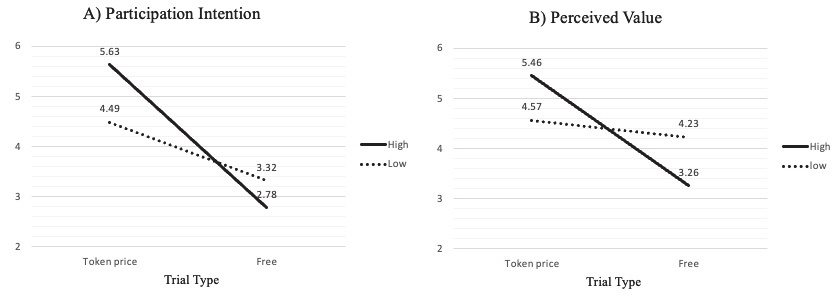
Simple-effects analyses further clarified this interaction. Under the token-price trial condition, participants facing high non-monetary costs reported significantly higher participation intention than those in the low-cost condition (Mhigh=5.63, Mlow=4.49, t=5.88, p<.001). Under the free trial condition, however, high non-monetary costs were associated with significantly lower participation intention relative to low costs (Mhigh=2.78, Mlow=3.32, t=2.01, p<.05). Across both cost conditions, participation intention was substantially higher in the token-price trial than in the free trial (MToken-price=5.07, MFree=3.04, t=11.012, p<.01).
These results are visually supported by Fig. 2. Participation intention decreased sharply as non-monetary costs increased in the free trial condition, whereas it increased in the token-price trial condition. This pattern challenges the common assumption that “free offers encourage greater participation,” demonstrating instead that when participation requires meaningful time or effort, token-price trials can elicit stronger behavioral motivation than free trials.
4.3 Hypothesis 2 Tests: Perceived Value by Trial Promotion Type
Similarly, A two-way ANOVA was conducted to examine the effects of trial promotion type (token-price trial vs. free trial) and non-monetary cost level (high vs. low) on perceived value (see Table 2). The analysis revealed a significant main effect of trial promotion type (F(1,186) = 68.13, p < .001, η2 = .27), indicating that participants in the token-price trial condition reported substantially higher perceived value than those in the free trial condition. The main effect of non-monetary cost level was not significant (F(1,186) = .17, p > .05), suggesting that non-monetary cost alone did not directly alter consumers’ perceived value of the trial promotion. However, the interaction between trial type and non-monetary cost level was significant (F(1,186) = 37.05, p < .001, η2 = .17), supporting Hypothesis 2 and indicating that the effect of trial type on perceived value depends on the level of non-monetary costs.
Simple-effects analyses further clarified this interaction. Within the token-price trial condition, participants assigned to the high non-monetary cost condition reported significantly higher perceived value than those in the low-cost cost (Mhigh=5.46, Mlow=4.57, t=4.91, p<.001). In contrast, within the free trial condition, participants in the high non-monetary cost condition reported significantly lower perceived value than those in the low-cost condition (Mhigh=3.26, Mlow=4.23, t=4.09, p<.001). Across both levels of non-monetary cost, perceived value was consistently higher for the token-price trial than for the free (MToken-price=5.02, MFree=3.73, t=7.918, p<.05).
As illustrated in Figure 2, perceived value decreased sharply as non-monetary costs increased under the free trial condition, whereas it increased under the token-price trial condition. These findings demonstrate that a token-price can effectively enhance consumers’ perceived value of trial promotions and that this advantage becomes more pronounced when participation requires substantial time or effort. In such contexts, non-monetary costs act not merely as barriers but as factors that can amplify or dampen consumers’ psychological evaluations depending on the pricing structure of the trial.
4.4 Hypothesis 3 Tests: Perceived Value and Participation Intention
To examine the relationship between perceived value and participation intention, a simple regression analysis was conducted. The results showed that perceived value significantly predicted participation intention in a positive direction (β=.888, t=13.753, p<.001). This finding supports Hypothesis 3, which proposes that perceived value positively influences participation intention in experiential promotions. In other words, the greater the value consumers perceive from a trial promotion, the stronger their intention to engage in the experience.
4.5 Hypothesis 4 Tests: Moderated Mediation of Perceived Value
To examine the moderated mediating effect of perceived value, PROCESS Macro Model 8 (Hayes et al. 2013) was employed, in which perceived value served as the mediator and perceived non-monetary cost as the moderator. Participation intention was specified as the dependent variable (Y), trial promotion type as the independent variable (X; token-price trial = 1, free trial = 0), perceived value as the mediating variable (M), and perceived non-monetary cost as the moderating variable (W). Mediation analyses were conducted using bootstrapping with 95% confidence intervals (CI) (Preacher and Hayes 2008).
As shown in Figure 3 trial promotion type had a significant positive effect on both perceived value ((β=.2623, SE=.3463, 95% CI [.4209, .9455], p<.05) and participation intention (β=1.4438, SE=.3298, 95% CI [.7932, 2.0944], p<.001). Importantly, the interaction between trial promotion type and non-monetary cost was significant for both perceived value (β = .2788, SE = .0863, 95% CI [.1085, .4491], p < .01) and participation intention (β = .5366, SE = .3252, 95% CI [.0520, 1.3970], p < .05). These results indicate that higher non-monetary costs amplify the effects of token-price trials on perceived value and participation intention, supporting Hypothesis 4.
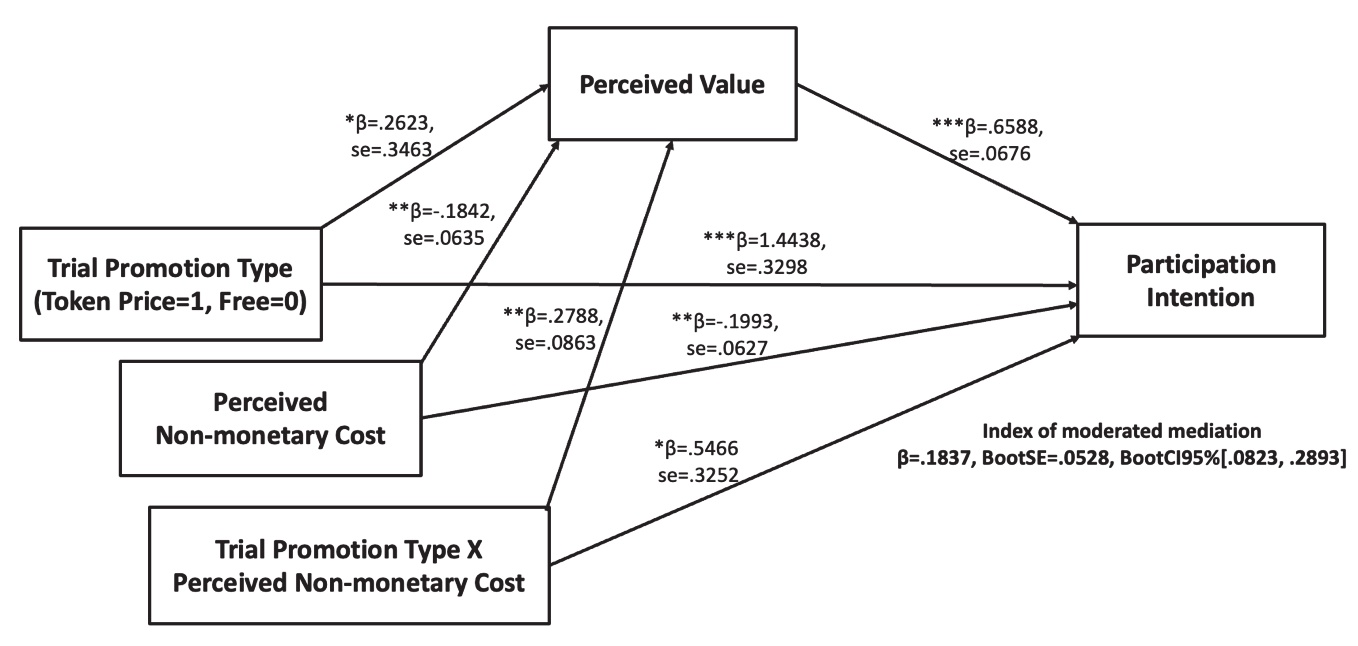
Furthermore, the moderated mediating effect was significant. The indirect effect of perceived value on participation intention―mediated by the interaction between trial promotion type and perceived non-monetary cost―was positive and statistically significant (β = .1837, BootSE = .0528, BootCI 95% [.0823, .2893]). This demonstrates that non-monetary cost strengthens the mediating role of perceived value, such that the psychological impact of token-price trials becomes more pronounced when consumers expend greater time and effort.
Ⅴ. General Discussion and Conclusions
This study examined how trial promotion type (token-price trial vs. free trial) and non-monetary costs jointly influence consumers’ participation intention and perceived value. The results showed that token-price trials generated significantly higher participation intention and perceived value than free trials. More importantly, the effectiveness of trial promotions depended on the level of non-monetary costs. Under the token-price trial condition, higher non-monetary costs increased both perceived value and participation intention, whereas under the free trial condition, higher non-monetary costs reduced these outcomes. In addition, perceived value positively influenced participation intention, and the moderated mediation analysis revealed that the mediating role of perceived value became stronger when non-monetary costs were high.
The findings offer several important theoretical implications. First, this study extends prior research on trial promotions by challenging the conventional assumption that free trials are always the most effective means of encouraging consumer participation. While previous studies have emphasized the benefits of free trials in reducing uncertainty and lowering participation barriers, the present findings demonstrate that token-price trials can generate higher perceived value and participation intention than free trials. Furthermore, the results identify non-monetary costs as an important boundary condition influencing the effectiveness of trial promotions. Specifically, when consumers invest greater time and effort, the persuasive advantage of free trials diminishes, whereas the effectiveness of token-price trials becomes stronger.
Second, this study advances research on the token promotional pricing effect by incorporating non-monetary costs as a critical contextual factor. Previous studies have primarily focused on monetary comparisons between free offers and low-priced offers. By contrast, the present study demonstrates that non-monetary costs do not merely function as participation barriers. Rather, when combined with a token-price trial, non-monetary costs can activate value-justification processes that enhance both perceived value and participation intention. This finding broadens the theoretical understanding of token promotional pricing by demonstrating that its effectiveness depends not only on monetary considerations but also on consumers’ investments of time and effort.
Third, this study contributes to the consumer behavior literature by identifying perceived value as a key psychological mechanism underlying the token promotional pricing effect. The results show that perceived value serves as a strong antecedent of participation intention and that its mediating effect becomes stronger under conditions of high non-monetary costs. By jointly examining the mediating role of perceived value and the moderating role of non-monetary costs, this study provides new insight into how consumers evaluate and respond to low-cost paid trial promotions.
The findings also provide several managerial implications. First, managers should not assume that free trials always maximize consumer participation. When participation requires meaningful non-monetary costs such as travel, waiting time, effort, or procedural burden, consumers may focus more strongly on these costs, reducing the attractiveness of free trials. In such situations, token-price trials may be more effective because they encourage consumers to perceive participation as a purposeful and worthwhile investment.
Second, firms can utilize token-price trials as an effective mechanism for enhancing perceived value without imposing substantial financial burdens on consumers. Although the token price is economically negligible, it provides a meaningful price cue that can strengthen consumers’ engagement with the trial experience and encourage more favorable evaluations. This strategy may be particularly beneficial in service industries such as education, fitness, beauty services, and other experience-based businesses where participation often requires considerable time and effort.
Third, marketers should carefully consider the level and nature of non-monetary costs when designing trial promotions. The present findings suggest that non-monetary costs can either hinder or enhance promotional effectiveness depending on the pricing format. Therefore, managers should evaluate not only the monetary aspects of promotional pricing but also the non-monetary costs embedded within the consumer experience when selecting between free and token-price trial strategies.
Despite these contributions, several limitations should be acknowledged. First, non-monetary costs were operationalized through travel distance. Although travel distance was appropriate for the present context because it directly captures the time and effort required for offline participation and a preliminary study confirmed that a 25-minute distance was perceived as meaningfully burdensome, non-monetary costs are multidimensional and may also include psychological burden, uncertainty, social discomfort, waiting time, and procedural complexity. Future research should examine whether the present findings generalize across other forms of non-monetary costs.
Second, although perceived value was identified as a key mediating mechanism, other psychological processes may also contribute to the token promotional pricing effect. Future research should investigate alternative mediators such as value justification, commitment, psychological ownership, and cost justification to provide a more comprehensive understanding of the underlying mechanisms.
Third, the sample consisted exclusively of college students in their twenties. Although this demographic represents an important target market for many experiential promotions, consumers in different age groups may differ in their price sensitivity, perceived value formation, willingness to invest time and effort, and responses to token-price promotions. Future research should therefore examine more diverse consumer populations, including older consumers, working professionals, and individuals with different income levels and consumption experiences.
Finally, the present study measured participation intention rather than actual participation behavior. This choice was appropriate for the present research because the study focused on the psychological mechanism linking token-price trials to consumer responses through perceived value, and participation intention is closely related to perceived value as a proximal indicator of behavioral motivation. Nevertheless, participation intention does not necessarily guarantee actual trial registration, attendance, purchase conversion, or continued usage. Future research should therefore examine behavioral outcomes such as actual trial participation, payment conversion, and long-term usage. Such work would provide stronger evidence of whether the token promotional pricing effect observed in this study translates into actual consumer behavior in real market settings.