
.jpeg)
라이브 스트리밍에서의 충동구매: 소비자 영감 관점에서의 맥락적 요인과 제품 유형의 영향
Impulsive Buying in Live Streaming: The Influence of Contextual Factors and Product Type from the Perspective of Consumer Inspiration
* 경희대학교, 무역학과 (Kyung Hee University, Department of International Business and Trade)
**교신저자: 무가옥 (1185033408@khu.ac.kr)
DOI: https://doi.org/10.17287/kmr.2026.55.3.1215
Abstract
This study examines how marketing cues in live-streaming shopping shape impulsive buying through consumer inspiration. In addition, we investigate whether product type moderates the process through which browsing translates into an urge to buy. Using survey data from 501 Chinese consumers with live-stream shopping experience, we test a structural equation model linking transactional cues (scarcity messages and deal proneness), experiential cues (social interaction and telepresence), browsing orientations (utilitarian and hedonic), urge to buy, and impulsive buying. The results show that experiential cues more strongly stimulate hedonic browsing, whereas transactional cues primarily drive utilitarian browsing. Product type further moderates the relationship between browsing and the urge to buy. Specifically, utilitarian browsing is more strongly associated with the urge to buy for habitual-directed products, whereas hedonic browsing is more strongly associated with the urge to buy for goal-directed products. By extending the consumer inspiration framework to impulsive buying and introducing product type as a boundary condition, this study clarifies how live-streaming stimuli convert browsing into purchase impulses and provides guidance for designing cue combinations that align with consumers’ browsing motivations and product characteristics.
Ⅰ. Introduction
The rapid proliferation of live-streaming commerce has fundamentally reshaped digital retail by integrating real-time interaction, entertainment, and transactional exchanges into a highly immersive consumption environment. This phenomenon is particularly prominent in China, where live streaming has emerged as a dominant e-commerce format, engaging 54.7% of all internet users (CNNIC, 2024). Beyond its scale, live-streaming commerce is characterized by its ability to generate immediate purchase conversions. Unlike traditional e-commerce platforms that rely primarily on static information, live-streaming environments integrate vivid demonstrations, persuasive hosts, social interaction, and time-sensitive promotions, thereby creating an emotionally charged and socially embedded marketplace (Kong et al., 2023). These features collectively intensify urgency and lower cognitive resistance, rendering impulsive buying a central mechanism of value creation in this context.
In this sense, impulsive buying behavior in live-streaming commerce has increasingly attracted scholarly attention. Existing research on impulsive buying in live commerce has primarily focused on identifying its antecedents. Coelho et al. (2023) found that streamers’ credibility, authenticity, and para-social interaction drive consumers’ impulsive purchases in live commerce, while Qu et al. (2023) demonstrated that scarcity messages evoke impulsive buying urges. In addition, several studies have examined the underlying psychological mechanisms, suggesting that emotional arousal and immersion in the online channel lead to impulsive buying behavior (Biraglia et al., 2021; Cui et al., 2022). Although these studies provide meaningful insights into impulsive buying in live commerce, further research needs to concentrate on the following aspects:
First
Impulsive buying has traditionally been viewed as a self-control failure in which immediate hedonic rewards override long-term goals (Baumeister, 2002; Iyer et al., 2020). However, contemporary research increasingly recognizes that impulsive buying reflects the joint operation of affective arousal and cognitive evaluation rather than pure irrationality. In digitally immersive environments such as live-streaming commerce, external cues are unlikely to trigger impulsive buying directly; instead, they first shape consumers' browsing orientations, through which arousal and evaluation are translated into urge to buy and subsequent behavior. Accordingly, this study distinguishes between utilitarian and hedonic browsing as transitional psychological states that convert external stimuli into action tendencies (Park et al., 2012), adopting a dual-route perspective that acknowledges even seemingly spontaneous purchases may involve structured cognitive processing alongside heuristic shortcuts (Chen et al., 2019; Li et al., 2025; Zheng et al., 2019).
Second
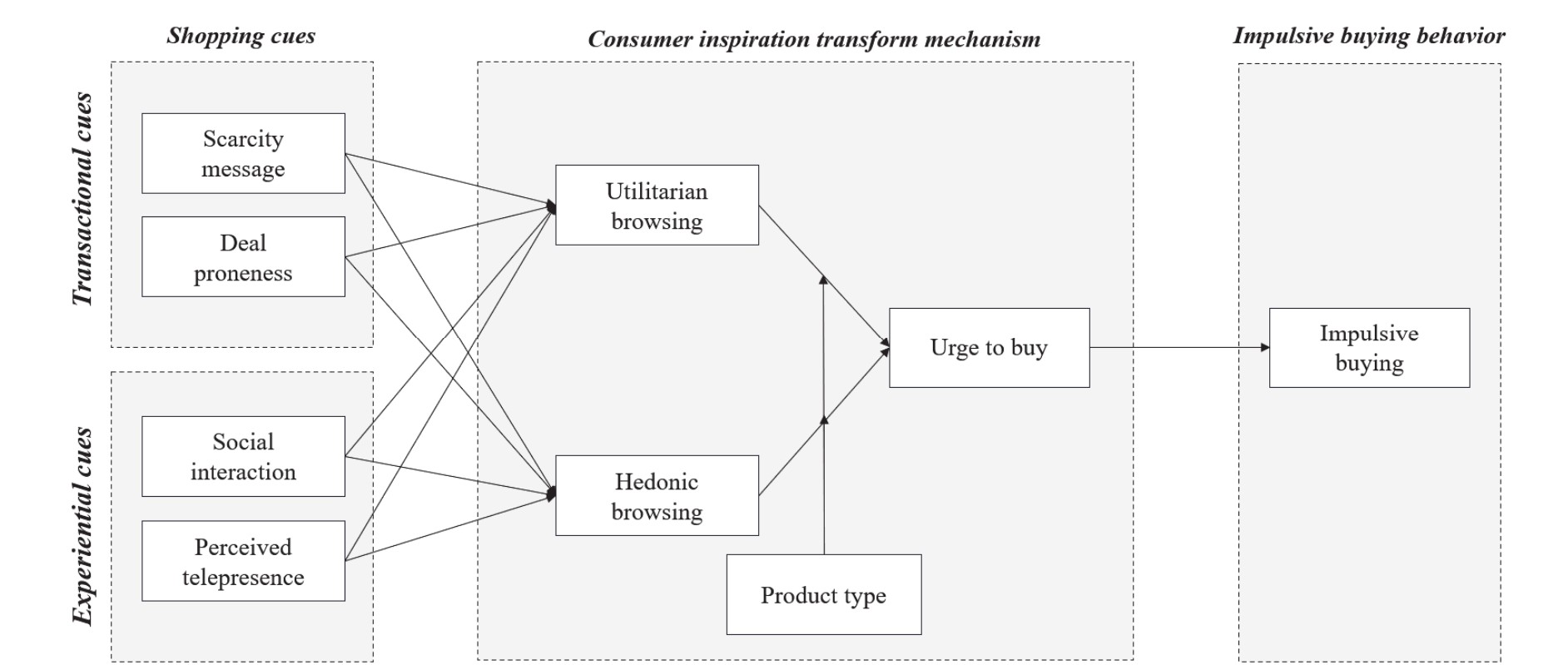
prior live-streaming studies have examined a variety of stimuli leading consumers’ impulsive buying. However, these stimuli have often been treated as broad environmental features (Chen et al., 2019; Coelho et al., 2023; Li et al., 2025; Qu et al., 2023). This limits the understanding of whether different categories of cues orient consumers toward distinct browsing modes. To address this issue, the present study conceptualizes live-streaming stimuli as two theoretically distinct but complementary categories of cues: transactional cues and experiential cues. Transactional cues foreground instrumental value and potential loss, thereby orienting consumers toward more goal-directed and evaluative browsing, whereas experiential cues foster immersion and affective engagement, thereby encouraging more hedonic and experientially oriented browsing.
Finally
cue effects are unlikely to be uniform across product contexts. Because consumers rely on different evaluative scripts when purchasing habitual-directed versus goal-directed products, identifying theoretically grounded boundary conditions is essential for explaining when and how impulse pathways unfold. To this end, we introduce a process-based conceptualization of product type as habitual-directed versus goal-directed, departing from traditional classifications such as search versus experience goods or hedonic versus utilitarian products (Hao and Huang, 2023; Huang et al., 2009). This distinction captures differences in consumers’ decision scripts and motivational readiness, thereby shaping which browsing orientation becomes dominant in impulse formation (Bae and U, 2003).
Building on these insights, this research makes three primary contributions. First, it advances the impulsive buying literature by showing that impulsive buying in live-streaming commerce does not arise in a purely direct manner but unfolds through distinct browsing orientations. Second, it reconceptualizes live-streaming stimuli as dual-dimensional cues by distinguishing between transactional cues and experiential cues, thereby showing that live-streaming stimuli are not limited to broad environmental features but also include socially embedded interpersonal signals that shape different browsing modes. Third, it highlights product type as a key boundary condition by demonstrating that impulse pathways vary systematically across habitual-directed and goal-directed products, thereby offering a more dynamic and context-sensitive account of impulsive buying in digitally immersive environments.
Ⅱ. Literature Review
2.1 Impulsive buying behavior
Impulsive buying has generally been understood as an unplanned form of purchasing behavior. Rook and Gardner (1993) defined it as a purchase characterized by rapid decision-making and an immediate tendency to acquire a product. Similarly, Beatty and Ferrell (1998) described impulse buying as an immediate purchase made without a prior shopping objective, either for a specific product category or to satisfy a particular need. E-commerce has emerged as an innovative retail channel for both modern merchants and consumers. In recent years, online impulsive buying has received growing attention from scholars. Previous research has mainly examined the factors influencing online impulsive buying. Generally, the factors influencing online impulsive buying can be categorized into product type (Liao et al., 2016), product price (Park et al., 2012), the visual appeal of websites (Park et al., 2012), marketing stimuli such as time pressure and quantity scarcity (Badgaiyan and Verma, 2015; Wu et al., 2021), and individual traits (Chung et al., 2017).
These effects may become even more salient in live-streaming commerce, where real-time interaction, immersive product demonstrations, and social persuasion are integrated into the shopping experience (Miranda et al., 2024). Prior research suggests that live-streaming commerce intensifies impulsive behavior by combining vivid product presentation with social and emotional stimulation. Coelho et al. (2023) demonstrated that streamer-related features including credibility, authenticity, and para-social interaction also increase impulse tendencies. Also, Chen et al. (2019) and Li et al. (2025) suggested that live streaming strengthens hedonic gratification and persuasion effects, making impulsive buying more prevalent than in traditional e-commerce settings. In this context, prior studies have frequently adopted the stimulus–organism–response (SOR) framework to explain impulsive behavior. For example, external stimuli such as scarcity cues and social proof can heighten consumers’ sense of urgency and emotional arousal, which in turn increases impulsive buying tendencies (Biraglia et al., 2021; Joo and Yang, 2023). Similarly, Cui et al. (2022) and Fu and Hsu (2023) demonstrated that cognitive and perceptive factors influence consumers’ urge to buy impulsively through the mediating role of flow experience.
Prior studies have identified various antecedent cues of impulsive behavior in live-streaming commerce; however, the psychological process underlying this behavior remains only partially understood. Previous research has mainly examined organism variables in terms of affective or immersive states, such as emotional arousal and flow experience, while relatively limited attention has been paid to how consumers actively process live-streaming cues through their browsing experiences.
However, in online shopping, including live commerce channels, consumers are not merely passive recipients of external stimuli. Rather, they actively browse the platform, and this browsing process functions as a key mediating route linking shopping stimuli to consumers’ internal responses (Ono et al., 2012). Browsing may take the form of utilitarian browsing, in which consumers compare price and quality information, but it may also operate as hedonic browsing, through which consumers derive enjoyment and entertainment from shopping itself even when they do not have a clear information-acquisition goal. For example, consumers may browse to escape from reality, lose track of time, and scroll through shopping screens as a form of play or leisure rather than carefully evaluating products. Prior research suggests that both utilitarian and hedonic browsing can serve as key psychological mechanisms leading to impulsive buying. In particular, in live commerce environments, positive emotions, immersion, and deal sensitivity formed through browsing have been shown to strengthen spontaneous purchase intentions (Zheng et al., 2019).
Nevertheless, most prior studies on live streaming have not sufficiently reflected the process through which consumers’ browsing experiences arouse impulsiveness and lead to impulsive buying. Accordingly, this study conceptualizes the browsing experience in live-streaming commerce as a key intermediate mechanism linking shopping cues to urge to buy and impulsive buying behavior and empirically investigates this process.
2.2 Shopping cues
We conceptualize shopping cues in live-streaming commerce as two theoretically distinct but complementary types of cues: transactional cues and experiential cues. Drawing on a cue-diagnostic perspective, different cues signal different types of value and therefore orient consumers toward distinct modes of information processing (Byun et al., 2021).
2.2.1 Transactional cues
In this study, transactional cues are defined as transaction-oriented signals that emphasize economic value, scarcity, and purchase feasibility, thereby encouraging consumers to focus on price, benefits, and the practical advantages of acting on a purchase. Accordingly, we operationalize transactional cues using two elements: scarcity messages and deal proneness (Böttger et al., 2017; Chen et al., 2024; Husnain et al., 2025).
Scarcity messages are typically conveyed through time-limited or quantity-limited offers (Lee et al., 2012). Scarcity marketing increases perceived value by highlighting resource constraints, thereby triggering competitive arousal and urgency (Hmurovic et al., 2023; Nguyen et al., 2023). According to commodity theory, scarcity increases perceived value and can trigger competitive arousal, encouraging less deliberative responses (Shi et al., 2020). Social scarcity additionally leverages fear of missing out (FOMO), shifting attention from cognitive evaluation to affective urgency (Chen et al., 2019). Consequently, scarcity cues can increase purchase intentions by evoking both anxiety and hedonic gratification (e.g., the satisfaction of feeling like a “smart shopper”) (Biraglia et al., 2021). Meanwhile, deal proneness reflects consumers’ tendency to respond favorably to promotional deals such as discounts, sales, and special offers. Consumers high in deal proneness are more likely to perceive such offers as opportunities to maximize value, and their attraction to discounts and savings can generate both economic utility and psychological gratification (Bandyopadhyay et al., 2021). In live-streaming commerce, this orientation encourages consumers to pay closer attention to price advantages, deal feasibility, and purchase value. By foregrounding instrumental value and potential loss, transactional cues orient consumers toward goal-directed and outcome-focused browsing.
2.2.2 Experiential cues
Experiential cues refer to socially and sensorially rich signals embedded in live-streaming commerce that enhance consumers’ sense of immersion, enjoyment, and relational engagement during the shopping process. Unlike transactional cues, which emphasize economic value and purchase feasibility, experiential cues make the shopping experience itself more vivid, interactive, and emotionally engaging. In this context, we conceptualized two key experiential cues: social interaction and perceived telepresence.
Social interaction refers to the extent to which consumers can communicate directly and immediately with streamers and other viewers during a live-streaming session. Through real-time comments, responses, and interactive exchanges, social interaction fosters immediacy, reduces psychological distance, and helps consumers feel more actively involved in the shopping process (Liu and Shrum, 2002; Yan et al., 2023). Prior research suggests that such interaction can enhance credibility in both the product and the streamer, reduce decision uncertainty, and create a more engaging and enjoyable shopping experience (Chen et al., 2019; Lu and Chen, 2021).
Perceived telepresence refers to the extent to which consumers feel as if they are physically present in the live-streaming environment despite interacting remotely. In live commerce, high-resolution video, real-time product demonstrations, immediate comment feedback, and the streamer’s direct acknowledgment of viewers can all strengthen this sense of presence (Gao et al., 2023; Lim and Ayyagari, 2018). When perceived telepresence is high, consumers are more likely to feel immersed in the live-streaming environment, emotionally engaged in the shopping experience, and more confident in the presented product information. As a result, shopping may feel less like searching for information but more like an interactive and enjoyable consumption experience.
2.2.3 From cues to outcomes: the role of browsing
Consumer inspiration represents a short-term motivational state that transforms passive exposure into active goal pursuit (Böttger et al., 2017). Prior research conceptualizes consumer inspiration as a two-stage process. The first stage, “inspired-by”, refers to a state in which consumers become mentally receptive and emotionally elevated in response to external stimuli. The second stage is “inspired-to” which refers to a state in which this heightened motivation is translated into an intention to act or pursue a goal (Chen et al., 2024). This perspective suggests that external shopping stimuli don’t necessarily lead directly to purchase behavior but instead may first activate an intermediate psychological process that gradually develops into purchase motivation.
This logic is especially relevant in live-streaming commerce, where external cues are unlikely to be translated into action in a purely direct manner. Rather, consumers actively respond to live-streaming stimuli while browsing the platform (Zheng et al., 2019). Importantly, browsing can take two distinct forms: utilitarian browsing, which is driven by functional evaluation, information search, and value comparison, and hedonic browsing, which is driven by enjoyment, curiosity, immersion, and experiential engagement (Huang, 2016; Zheng et al., 2019). These two routes suggest that consumers may respond to shopping cues through either cognitive-functional processing or affective-experiential processing. In this sense, browsing can be understood as an “inspired-by” state, as it reflects consumers’ receptivity and engagement with live-streaming stimuli. As consumers remain engaged and immersed in browsing, continued exposure to live-stream stimuli may intensify purchase-oriented motivation and strengthen the urge to buy (Leong et al., 2018). This suggests that live-streaming environments can facilitate the transition from browsing-based inspiration to purchase readiness, particularly through real-time persuasion and social feedback (Belanche et al., 2021; Shamim et al., 2024). Therefore, urge to buy can be viewed as a more action-oriented “inspired-to” state, in which this heightened motivation becomes directed toward purchase.
Ⅲ. Research Hypotheses
3.1 Transactional cues and browsing
Utilitarian browsing refers to a form of browsing driven by functional evaluation, information search, and value comparison, in which consumers focus on product usefulness, price advantages, and purchase feasibility (Huang, 2016; Zheng et al., 2019). In live-streaming commerce, transactional cues in live streaming, particularly scarcity reminders and discounts, are likely to strengthen utilitarian browsing because they make value, availability, and feasibility information more relevant to decisions. Transactional cues increase the diagnosticity of economic and availability information for the focal decision (Hmurovic et al., 2023). Scarcity messages highlight limited quantity or time and make availability salient (Zhu et al., 2018). Perceived rarity increases subjective value and makes the offer feel more important (Shi et al., 2020). Under time pressure, consumers tend to focus on key attributes, compare options, and assess deal feasibility, thereby engaging in evaluation-oriented browsing (Miranda et al., 2024; Zheng et al., 2019).
In addition, deal proneness tends to strengthen utilitarian browsing. Deal-prone consumers actively seek out discounts and justify purchase decisions through price comparisons and value-for-money evaluations (Eisenbeiss et al., 2015). Discounts may also provide psychological rewards (e.g., feeling like a “smart shopper”), which can sustain continued comparison efforts during browsing (Valentini et al., 2011). Based on the above reasoning, the following hypotheses are proposed:
H1a: Scarcity message positively influences utilitarian browsing. H1b: Deal proneness positively influences utilitarian browsing.
Hedonic browsing refers to a form of browsing driven by enjoyment, curiosity, immersion, and experiential engagement, in which consumers browse not only to obtain information but also to enjoy the shopping process itself (Zheng et al., 2019). Transactional cues can also stimulate hedonic browsing by increasing arousal and creating a more exciting shopping experience. Scarcity messages may be experienced as positive stress and excitement, which heightens engagement and browsing enjoyment (Hollebeek et al., 2023). Under such conditions, consumers may remain on the platform not only to evaluate the purchase opportunity but also to sustain the excitement generated by limited-time or limited-quantity offers. This heightened arousal can make browsing itself feel more enjoyable and entertaining, rather than purely instrumental.
Deal proneness can likewise support hedonic browsing through the enjoyment of deal discovery. Finding an attractive bargain can resemble a “treasure hunt,” eliciting positive emotions and a sense of accomplishment (Bandyopadhyay et al., 2021). In this way, promotional value is not only evaluated cognitively but also experienced affectively, which can prolong browsing and encourage enjoyment-oriented exploration. These positive feelings can spill over into hedonic browsing during the shopping process. Based on the above reasoning, the following hypotheses are proposed:
H2a: Scarcity message positively influences hedonic browsing. H2b: Deal proneness positively influences hedonic browsing.
3.2 Experiential cues and browsing
Experiential cues in live streaming are also expected to increase utilitarian browsing because they can reduce uncertainty and make product information more diagnostic. In particular, live streaming enables real-time, two-way communication with streamers and other viewers (Wongkitrungrueng and Assarut, 2020). Such social interaction allows consumers to ask questions, obtain clarifications, and observe other viewers’ reactions, which reduces information ambiguity and increases the credibility of product claims (Byun et al., 2021). Higher intimacy and connectedness can further enhance the perceived trustworthiness of messages in the live session (Lu and Chen, 2021).
Perceived telepresence can also strengthen utilitarian browsing by increasing the vividness and diagnosticity of product information. Real-time demonstrations clarify product features and usage scenarios, thereby reducing product-related uncertainty and supporting goal clarity during evaluation (Fu and Hsu, 2023). As uncertainty decreases and information becomes more diagnostic, consumers become more willing to verify attributes and compare options during browsing, which reinforces utilitarian browsing (Zheng et al., 2019). Based on the above reasoning, the following hypotheses are proposed:
H3a: Social interaction positively influences utilitarian browsing. H3b: Perceived telepresence positively influences utilitarian browsing.
Experiential cues in live streaming are also expected to increase hedonic browsing because they enhance enjoyment and immersion. Social interaction can promote hedonic browsing by enabling real-time exchanges of opinions and reactions between consumers, streamers, and other viewers. Such interaction increases emotional participation by allowing consumers to share excitement, respond to others in the moment, and become more actively involved in the shopping process. As a result, browsing may be experienced not merely as information search, but as a more engaging and enjoyable activity (Joo and Yang, 2023).
Perceived telepresence further strengthens hedonic browsing by making consumers feel immersed in the live-stream environment and by increasing intrinsic enjoyment. High telepresence can make consumers feel deeply absorbed in the stream and experience browsing as vivid and entertaining rather than purely informational. As attention shifts from strict evaluation to enjoyment-oriented exploration, hedonic browsing is likely to be reinforced (Han et al., 2020). Based on the above reasoning, the following hypotheses are proposed:
H4a: Social interaction positively influences hedonic browsing. H4b: Perceived telepresence positively influences hedonic browsing.
3.3 Browsing and urge to buy
Drawing on the consumer inspiration perspective, browsing in live-streaming commerce can be understood as a transitional stage through which externally triggered interest and engagement gradually develop into an urge to buy. Consistent with this view, prior research suggests that both utilitarian and hedonic browsing can function as important drivers of purchase-related motivation (Gilal et al., 2024).
Utilitarian browsing may contribute to this transition by helping consumers justify immediate purchase through value-oriented evaluation. During utilitarian browsing, consumers typically assess product benefits, costs, and practical value. In conventional retail settings, such evaluation may foreground rational considerations and potentially dampen impulsive tendencies. In live-streaming commerce, however, utilitarian browsing may operate differently. Real-time demonstrations and instant explanations can make product information clearer and more diagnostic, thereby reducing perceived uncertainty. As uncertainty decreases, consumers may develop greater confidence and more positive feelings toward the purchase. Given that positive emotions play a significant role in unplanned buying (Verhagen and van Dolen, 2011), such affective responses may make immediate purchase seem more justified, efficient, and advantageous. Under these conditions, utilitarian browsing does not merely involve careful deliberation; it can also strengthen the urge to buy by transforming value evaluation into action justification (Zhang et al., 2018).
By contrast, hedonic browsing is driven more by enjoyment and experiential engagement than by systematic evaluation. In this mode of browsing, consumers are less concerned with carefully verifying product attributes and more focused on sustaining enjoyment and experiential stimulation during the shopping process. Impulse formation generally involves reduced cognitive effort and intensified affective responses (Iyer et al., 2020; Miranda et al., 2024). Accordingly, hedonic browsing may strengthen urge to buy by heightening pleasure, emotional immersion, and the desire for immediate gratification. As consumers become more absorbed in enjoyable browsing, purchase may come to feel like a natural extension of the positive shopping experience itself. Based on the above reasoning, the following hypotheses are proposed:
H5: Utilitarian browsing positively influences urge to buy. H6: Hedonic browsing positively influences urge to buy.
3.4 Urge to buy and impulsive buying behavior
Impulse buying is commonly defined as an unplanned purchase that arises from an immediate, emotion-driven surge or arousal triggered by environmental cues (Beatty and Ferrell, 1998; Rook and Gardner, 1993). From this perspective, the urge to buy represents a proximal motivational state that links environmental stimulation to the eventual impulsive act. Herzallah et al. (2022) define the urge to buy as the “desire state experienced when encountering an item in the environment.” Shamim et al. (2024) also define the urge to buy as an immediate, strong, and affectively driven desire to purchase a product triggered by promotional or social cues in a digital commerce context. Conceptually, impulsive buying can therefore be understood as a two-stage process in which consumers first experience an urge to buy and subsequently enact impulsive buying behavior, which typically occurs after this urge has emerged (Zheng et al., 2019).
Prior research has confirmed that this urge state positively predicts subsequent impulsive buying behavior (Yan et al., 2023). Akram et al. (2018) argued that impulse buying occurs when strong emotions lead consumers to make purchases without prior planning. Bandyopadhyay et al. (2021) identified the urge to buy impulsively as a significant antecedent of impulsive buying behavior. More recent research similarly confirms that urge states positively predict subsequent impulsive buying behavior (Yan et al., 2023). Taken together, these studies suggest that impulsive buying is better understood as a behavioral outcome that follows the formation of an urge to buy. Based on the above reasoning, we propose the following hypothesis:
H7: Urge to buy positively influences impulsive buying.
3.5 The moderating effect of product types
Previous research suggests that product category shapes consumers’ decision processes and can condition the effects of marketing stimuli such as promotions, time scarcity, and personal traits (Eisenbeiss et al., 2015; Zhang et al., 2024). In the present study, product type is conceptualized in process terms as either habitual-directed or goal-directed, depending on the decision mode typically associated with the purchase situation. Habitual-directed products refer to those purchased frequently and repeatedly, for which purchase behavior is largely driven by routine rather than extensive deliberation (Labrecque et al., 2017). In contrast, goal-directed products are more often associated with purposeful, plan-based decisions, in which consumers evaluate options to achieve currently activated goals (Van Osselaer and Janiszewski, 2012).
Product type is expected to moderate the relationship between browsing and the urge to buy because it shapes what consumers consider most for forming purchase readiness in live-streaming shopping (Byun et al., 2021). In other words, product type changes which browsing route is more diagnostic for translating browsing experiences into urge to buy. For habitual-directed products, consumers typically have well-established product knowledge and clear evaluative criteria (Labrecque et al., 2017). Accordingly, utilitarian information such as price, key attributes, discount availability, and delivery conditions is more likely to function as a diagnostic basis for rapid purchase verification. Thus, for habitual-directed products, utilitarian browsing is more likely to exert a stronger effect on the urge to buy because it reduces residual uncertainty and facilitates immediate purchase (Murray and Häubl, 2007).
By contrast, goal-directed purchases require consumers to determine which option best fits their current goal, making choice evaluation less fixed and more context-dependent than in habitual-directed purchases (Faraji-Rad and Pham, 2017; Lu and Chen, 2021; Otto et al., 2022). In such contexts, hedonic browsing may play a more influential role in strengthening the urge to buy because enjoyment, curiosity, and immersive exploration increase engagement with a focal option and make purchase desire more salient (Shin and Sohn, 2024). Therefore, for goal-directed products, hedonic browsing is more likely to have a stronger effect on the urge to buy (Wongkitrungrueng and Assarut, 2020). Based on this reasoning, we propose: H8a: Product type moderates the relationship between utilitarian browsing and urge to buy, such that the effect is stronger for habitual-directed products than for goal-directed products. H8b: Product type moderates the relationship between hedonic browsing and urge to buy, such that the effect is stronger for goal-directed products than for habitual-directed products.
Ⅳ. Research Methodology
4.1 Sampling
Data were collected via an online survey administered to consumers with prior experience in live-streaming shopping in China. Participants were recruited from three major live-streaming shopping platforms in China (i.e., Taobao, Douyin, and Kwai) with quotas to ensure adequate coverage across platforms (Statista, 2025). To be eligible, respondents needed to have watched at least one live-streaming shopping session in the past month and made at least one purchase during that period (or at minimum in their most recent live-stream shopping session). These screening criteria ensured that respondents could reliably recall relevant shopping experiences and evaluate the focal constructs in the model.
Respondents were instructed to recall their most recent live-streaming shopping episode (or a live-streaming session within the past week) on one of the focal platforms. They were asked to report the product category purchased (or intended to purchase) and the platform used. Respondents then completed survey measures for each construct in the proposed model. These included exposure to transactional cues (scarcity messages and deal proneness), exposure to experiential cues (social interaction and perceived telepresence), browsing orientations (utilitarian and hedonic browsing), urge to buy, and impulsive buying behavior. We also collected demographic information (e.g., age, gender) and live-stream shopping frequency as control variables. In total, 520 questionnaires were collected, of which 501 valid responses were retained for analysis after data screening. The final sample encompassed a wide range of demographic and regional backgrounds, thereby ensuring sample heterogeneity and enhancing the generalizability of the findings.
4.2 Constructs and measurement items
All constructs in this study were clearly defined and measured using established items from prior literature. The questionnaire used a 5-point Likert scale (1 = “strongly disagree”, 5 = “strongly agree”) for all items and included 32 measurement items across 8 constructs, as well as demographic questions. Details are shown in Table 1.
Table 1 Measurement items
| Construct | Measurement items |
|---|---|
| Scarcity message (Hmurovic et al., 2023) | Based on the product type you selected and the platform you used during the shopping experience I worry that the promotion will end soon and that I will miss out. I worry that the product is limited and that I may not be able to purchase it in time. I worry that I will miss the opportunity to take advantage of the promotion. I worry that the product will sell out before I can buy it. |
| Deal proneness (Bandyopadhyay et al. 2021) | I am more likely to buy a product when it is on sale. If a product is on sale, I may buy it even if I did not initially intend to purchase it. Compared with most people, I am more proactive in seeking out discounts and offers. When I encounter discounts, I feel an urge to act quickly. |
| Social interaction (Huang et al. 2024) | I can communicate directly with the streamer during the live stream. I can interact with the streamer through various functions (e.g., comments, likes). I can communicate with other viewers in real time through live-stream comments. I actively participate in interactions in the live stream (e.g. commenting, liking, saving products). |
| Perceived telepresence (Deng et al. 2023) | I feel deeply immersed in the live-streaming content. I feel as if the streamer and products are physically in front of me. I feel as though I am experiencing the products in person. The live-streaming room feels vivid and holds my full attention. |
| Utilitarian browsing (Zheng et al. 2019) | I can find products with better prices or quality by watching live streams. I can collect useful information about products by watching live streams. I can gain additional value (e.g., coupons, tips) by browsing live streams. I think watching live streams is an efficient way to shop. |
| Hedonic browsing (Kimiagari et al. 2021) | I can forget my original shopping purpose and feel very relaxed while browsing the live stream. I become so immersed in the live stream that I temporarily forget about time. I feel very excited and entertained, as if I am playing. The entertaining atmosphere of the live stream makes me less strict in evaluating products. |
| Urge to buy (Huang 2016) | I often experience sudden urges to buy products being shown in live streams. I sometimes feel a strong impulse to purchase products beyond my initial shopping goals. I tend to make purchase decisions that are unrelated to my original shopping intentions. I occasionally feel compelled to buy products spontaneously during the live stream. |
| Impulsive buying (Li et al., 2024) | My purchases in live-streaming shopping are spontaneous. My purchases in live-streaming shopping are often unplanned. My purchases in live-streaming shopping are sometimes unexpected. In live-streaming shopping, I often find it difficult to resist making purchases. |
Ⅴ. Results and Analysis
5.1 Descriptive statistics
A total of 501 active live-streaming shopping consumers participated in the study. They were primarily users of Taobao (27.94%), Douyin (31.54%), and Kwai (28.14%). The sample reflects key demographics of Chinese live-stream shoppers: women comprised 57.49% of respondents, and the majority (63.67%) were young adults aged 20-40. Product preferences were almost evenly split between goal-directed and habitual-directed purchases, allowing meaningful comparisons of behavioral patterns across product types. Detailed demographic characteristics are provided in Table 2.
Table 2 Demographic characteristics
| Item | Characteristics | Frequency | Ratio |
|---|---|---|---|
| Gender | Male | 213 | 42.51% |
| Female | 288 | 57.49% | |
| Age | Under 20 | 103 | 20.56% |
| 20-30 | 209 | 41.72% | |
| 30-40 | 110 | 21.95% | |
| Over 40 | 79 | 15.77% | |
| Main platform | Taobao | 140 | 27.94% |
| Douyin | 158 | 31.54% | |
| Kwai | 141 | 28.14% | |
| Others | 62 | 12.38% | |
| Product type | Habitual-directed products | 243 | 48.50% |
| Goal-directed products | 258 | 51.50% |
Table 3 presents the means, standard deviations, and inter-construct correlations (with the square root of each construct’s AVE on the diagonal). Mean scores ranged from 3.46 to 3.58 on the five-point scale, indicating moderate agreement levels among respondents. Standard deviations ranged from 0.81 to 0.92, showing sufficient variability in responses. All pairwise correlations were significant at the 0.01 level and, importantly, each correlation was lower than the corresponding construct’s AVE square root, supporting discriminant validity. Together, these results suggest that the data exhibit adequate variance and meet the assumptions for subsequent SEM analysis.
Table 3 Correlations and square roots of AVE
| Construct | SM | DP | SI | PT | HB | UB | UT | IB |
|---|---|---|---|---|---|---|---|---|
| Scarcity message (SM) | .716 | |||||||
| Deal proneness (DP) | .295** | .713 | ||||||
| Social interaction (SI) | .285** | .216** | .721 | |||||
| Perceived telepresence (PT) | .168** | .193** | .277** | .734 | ||||
| Hedonic browsing (HB) | .272** | .280** | .395** | .324** | .719 | |||
| Utilitarian browsing (UB) | .330** | .337** | .290** | .225** | .352** | .718 | ||
| Urge to buy (UT) | .285** | .225** | .306** | .254** | .296** | .287** | .715 | |
| Impulsive buying (IB) | .265** | .202** | .310** | .280** | .334** | .298** | .282** | .731 |
| Mean | 3.544 | 3.507 | 3.503 | 3.543 | 3.583 | 3.516 | 3.566 | 3.460 |
| S.D. | .846 | .830 | .884 | .889 | .826 | .815 | .820 | .922 |
Notes: 1. The diagonal values indicate the square roots of AVE, 2. **Correlation is significant at the 0.01 level (2-tailed).
5.2 Measurement validation
As shown in Table 4, confirmatory factor analysis (CFA) showed that all factor loadings were significant (t-values > 12.66), with composite reliability (CR) values above 0.70 and average variance extracted (AVE) above 0.50 for every construct, indicating satisfactory convergent validity and reliability. Discriminant validity was also confirmed: for each construct, the square root of its AVE exceeded its correlations with all other constructs.
Table 4 CFA results
| Constructs | Items | Std. loading | S.E. | t-value | CR | AVE | α |
|---|---|---|---|---|---|---|---|
| Scarcity message | SM4 | .814 | .024 | 34.188 | .806 | .512 | .807 |
| SM3 | .631 | .033 | 19.226 | ||||
| SM2 | .748 | .026 | 28.300 | ||||
| SM1 | .655 | .031 | 21.028 | ||||
| Deal proneness | DP4 | .726 | .028 | 25.513 | .805 | .508 | .804 |
| DP3 | .754 | .027 | 27.770 | ||||
| DP2 | .697 | .030 | 23.356 | ||||
| DP1 | .670 | .031 | 21.573 | ||||
| Social interaction | SI4 | .753 | .026 | 28.882 | .812 | .519 | .812 |
| SI3 | .675 | .030 | 22.394 | ||||
| SI2 | .766 | .026 | 30.008 | ||||
| SI1 | .684 | .030 | 23.029 | ||||
| Perceived telepresence | PT4 | .746 | .026 | 28.205 | .823 | .538 | .823 |
| PT3 | .726 | .027 | 26.510 | ||||
| PT2 | .703 | .029 | 24.516 | ||||
| PT1 | .759 | .026 | 29.599 | ||||
| Utilitarian browsing | UB4 | .723 | .028 | 26.002 | .810 | .517 | .810 |
| UB3 | .696 | .029 | 23.693 | ||||
| UB2 | .709 | .029 | 24.728 | ||||
| UB1 | .746 | .027 | 27.799 | ||||
| Hedonic browsing | HB4 | .740 | .027 | 27.442 | .809 | .515 | .809 |
| HB3 | .724 | .028 | 26.018 | ||||
| HB2 | .693 | .029 | 23.579 | ||||
| HB1 | .713 | .028 | 25.258 | ||||
| Urge to buy | UT4 | .739 | .028 | 26.851 | .807 | .511 | .807 |
| UT3 | .713 | .029 | 24.985 | ||||
| UT2 | .711 | .030 | 24.863 | ||||
| UT1 | .683 | .030 | 23.231 | ||||
| Impulsive buying | IB4 | .733 | .027 | 27.203 | .821 | .534 | .819 |
| IB3 | .722 | .028 | 26.222 | ||||
| IB2 | .763 | .026 | 29.806 | ||||
| IB1 | .703 | .029 | 24.419 |
To assess common method bias, we conducted Harman’s single-factor test. An exploratory factor analysis (using unrotated principal components) extracted eight distinct factors with eigenvalues > 1, accounting for a total of 64.94% of the variance; the largest single factor explained only 23.87% of the variance. A CFA for common method bias likewise indicated that no single factor accounted for most of the covariance among items. These findings indicate that common method bias does not pose a significant threat to the validity of the results.
5.3 Empirical results
Before testing the hypotheses, we evaluated the overall goodness of fit of the structural equation model using AMOS software. The model demonstrated a good fit to the data, with all indices meeting their recommended thresholds. We therefore proceeded to examine the path coefficients for the hypothesized relationships.
Table 5 Goodness-of-fit summary for the structural model
| Model | df | χ2 | χ2/df | GFI | AGFI | CFI | IFI | RMSEA | RMR |
|---|---|---|---|---|---|---|---|---|---|
| Standard | - | - | ≤ 3 | ≥ .90 | ≥ .80 | ≥ .90 | ≥ .90 | ≤ .05 | ≤ .05 |
| Result | 436 | 660.526 | 1.515 | .925 | .909 | .962 | .962 | .032 | .042 |
Note: We adopted commonly used cutoff criteria based on prior SEM guidelines (Gefen et al., 2000).
5.3.1 Dual-dimensional cues and browsing
As shown in Figure 2, all four antecedent factors had significant positive effects on utilitarian browsing. Overall, transactional cues exerted stronger effects on utilitarian browsing than experiential engagement cues, consistent with the view that scarcity messages and deal proneness heighten the instrumental relevance of product information and prompt consumers to devote more cognitive resources to evaluating deal attractiveness and feasibility. This is because transactional cues directly foreground value comparison and purchase justification, which are more central to utilitarian browsing than the enjoyment- and immersion-oriented qualities emphasized by experiential cues. Specifically, deal proneness showed the largest impact on utilitarian browsing ($\beta = .26, p < .01$), aligning with the idea that promotion-oriented motives intensify deal evaluation and comparison, thereby reinforcing utilitarian browsing (Eisenbeiss et al., 2015). Scarcity messages were the second strongest predictor ($\beta = .25, p < .01$), suggesting that urgency-related signals can shift consumers toward action-oriented information processing rather than open-ended exploration (Hmurovic et al., 2023; Zhu et al., 2018). Although weaker in magnitude, social interaction ($\beta = .19, p < .01$) and perceived telepresence ($\beta = .12, p < .05$) also significantly influenced utilitarian browsing. This pattern suggests that socially rich live-streaming environments can support utilitarian browsing by making product information clearer and more credible, thereby reducing perceived uncertainty and helping consumers verify value, key attributes, and purchase feasibility more efficiently (Wongkitrungrueng and Assarut, 2020). Collectively, these results suggest that utilitarian browsing in live-streaming commerce is primarily driven by cues that heighten value verification and deal assessment, while experiential cues play a complementary role by improving informational clarity and facilitating confidence in evaluation.
Turning to hedonic browsing, all antecedent variables again demonstrated significant positive effects. In contrast to the utilitarian route, experiential engagement cues exhibited stronger associations with hedonic browsing. This suggests that experiential cues more directly stimulate enjoyment, immersion, and emotionally engaging exploration, which are central to hedonic browsing. Social interaction emerged as the most influential predictor ($\beta = .35, p < .01$), followed by perceived telepresence ($\beta = .22, p < .01$), suggesting that immersive and socially embedded environments foster affective absorption and enjoyment-driven exploration (Han et al., 2020; Smith and Rose, 2020). More specifically, real-time interaction may make consumers feel actively involved in a shared shopping experience, while perceived telepresence may make the live stream feel immersive. Together, these cues can make browsing feel less like product evaluation and more like an enjoyable and engaging activity.
Perceived telepresence can strengthen hedonic browsing by increasing immersion, intrinsic enjoyment, and flow-like engagement, thereby encouraging pleasure-oriented exploration rather than purely instrumental search (Han et al., 2020). Among transactional cues, deal proneness also significantly stimulated hedonic browsing ($\beta = .17, p < .01$), whereas scarcity messages showed the smallest yet significant effect ($\beta = .13, p < .05$). This pattern suggests that although transactional cues add excitement to the shopping experience, hedonic browsing in live-streaming commerce is shaped more strongly by experiential cues that make the browsing process feel more engaging and enjoyable.
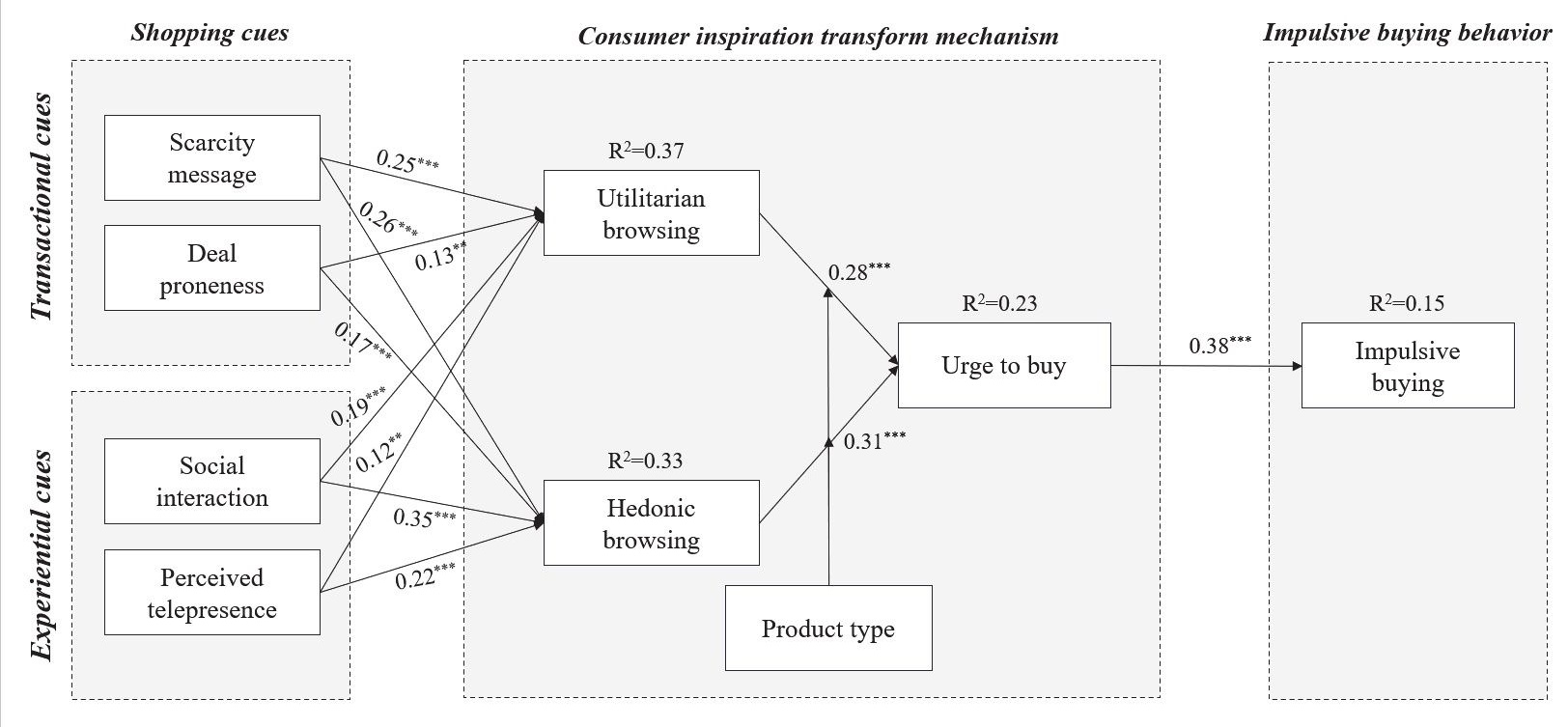
Note: **p<0.05, ***p<0.01.
5.3.2 Consumer inspiration: browsing and urge to buy
Both utilitarian browsing ($\beta = .28, p < .01$) and hedonic browsing ($\beta = .31, p < .01$) had significant positive effects on consumers’ urge to buy. These results suggest that browsing orientations function as motivational transformation stages in the development of impulsive buying. Rather than representing mere information search, browsing channels external cues into internally amplified desire states (Herzallah et al., 2022; Zheng et al., 2019). From the perspective of consumer inspiration, browsing may be interpreted as an inspired-by-like stage in which consumers become cognitively and affectively engaged with live-streaming stimuli, whereas urge to buy reflects an inspired-to-like state.
Notably, hedonic browsing exerted a slightly stronger effect on the urge to buy, suggesting that enjoyment, immersion, and entertainment-oriented exploration may more readily develop into immediate purchase desire. When browsing is experienced as enjoyable and emotionally absorbing, consumers may become less focused on careful product evaluation and more inclined to sustain the positive experience through immediate purchase. By contrast, utilitarian browsing also contributed significantly, suggesting that information-oriented and value-seeking exploration can strengthen the urge to buy by reducing uncertainty, increasing confidence and positive feelings, and making immediate purchase seem more justified. Overall, these findings indicate that both affective and evaluative browsing can play meaningful roles in the formation of urge to buy.
5.3.3 Urge to buy and behavioral outcomes
The urge to buy significantly predicted impulsive buying behavior ($\beta = .38, p < .01$), confirming its role as a proximal antecedent of spontaneous purchase action. This result suggests that once motivational intensity reaches the level of an urge, the likelihood of immediate purchase substantially increases (Herzallah et al., 2022; Yan et al., 2023). Consistent with self-regulation perspectives, heightened desire states may temporarily attenuate deliberative control, thereby facilitating impulsive action (Baumeister, 2002; Iyer et al., 2020). Taken together, these findings support a sequential process in which browsing orientations strengthen urge to buy, which then translates into realized impulsive buying behavior.
5.3.4 The moderating effect of product type
A multi-group SEM analysis was employed to examine whether product type (habitual-directed vs. goal-directed) moderates the effects of browsing orientations on the urge to buy. As shown in Table 6, the chi-square difference test between the unconstrained and equality-constrained models indicates a significant cross-group difference in the focal paths (Δχ² = 4.91, p < .10), supporting the presence of moderation. For habitual-directed products, utilitarian browsing exhibited a substantially stronger effect on urge to buy (β = .38, p < .01) than for goal-directed products (β = .16, p < .10). Habitual-directed products tend to involve more routinized and familiar decision patterns, allowing consumers to rely on well-learned evaluative rules rather than extensive deliberation (Labrecque et al., 2017; Murray and Häubl, 2007). Because such purchases are often made in familiar and repetitive contexts, consumers are likely to face relatively lower perceived risk and uncertainty and to rely on established evaluative scripts. In such contexts, utilitarian browsing functions primarily as a rapid verification process rather than extended evaluation. It helps consumers confirm useful product information, compare value, check key attributes, and quickly judge whether the deal is worth acting on immediately rather than engaging in extended evaluation. Under these conditions, verifying practical benefits, necessity, and deal value can serve as an immediate purchase trigger, thereby translating evaluation-oriented browsing into an urge to buy more readily (Van Osselaer and Janiszewski, 2012; Zheng et al., 2019). In other words, for habitual-directed products, utilitarian browsing tends to reduce residual uncertainty and reinforce purchase readiness, thereby accelerating the transition from verification to action (Lu and Chen, 2021).
Table 6 Multi-group results according to product type
| Equality constraint model: Δχ2 = 1421.21 (df = 894), χ2crit = 4.91 (p < .10) | |||
|---|---|---|---|
| Path | Cross-group path coefficient | Result | |
| Habitual-directed products | Goal-directed products | ||
| Utilitarian browsing → Urge to buy | .38*** | .16* | Supported |
| Hedonic browsing → Urge to buy | .16* | .45*** | Supported |
Note: *p<0.10, ***p<0.01.
In contrast, for goal-directed products, hedonic browsing showed a significantly stronger effect on urge to buy ($\beta = .45, p < .01$) than in the habitual-directed group ($\beta = .16, p < .10$). This result suggests that when purchases are more purpose-driven and potentially higher-stakes, consumers’ motivational escalation in live-streaming environments depends more on experiential engagement. In such contexts, consumers face greater uncertainty regarding which option best fits their current goal, making the evaluative basis for choice more context-dependent (Otto et al., 2022). Thus, enjoyable and curiosity-driven browsing can heighten engagement with a focal option and make purchase desire more salient, thereby strengthening consumers’ urge to buy (Han et al., 2020; Wongkitrungrueng and Assarut, 2020). Taken together, these findings indicate that product type shifts the dominant route through which live-streaming browsing translates into purchase impulses. Specifically, utilitarian browsing is more decisive for habitual-directed products, whereas hedonic browsing is more decisive for goal-directed products (Faraji-Rad and Pham, 2017).
Ⅵ. Conclusion and discussion
6.1 Conclusions
In sum, this study addresses the central research question by explaining how transactional and experiential live-streaming cues translate into impulsive purchases through distinct browsing orientations and a subsequent motivational process. The results show that transactional cues more strongly activate utilitarian browsing, whereas experiential cues more strongly activate hedonic browsing. Both browsing orientations increase consumers’ urge to buy, and this urge in turn predicts impulsive purchasing behavior. The findings also demonstrate that product type shapes these pathways. Utilitarian browsing plays a stronger role for habitual-directed products, whereas hedonic browsing becomes more influential for goal-directed products. Together, these results validate the proposed process model and reinforce the study’s theoretical contributions to live-streaming research, consumer inspiration, and boundary condition identification.
6.2 Theoretical implications
This study advances research on impulsive buying in digital commerce by clarifying the process mechanisms through which livestreaming cues translate into spontaneous purchasing. First, it extends the impulsive buying literature by showing that impulsive buying in live-streaming commerce unfolds through a staged motivational process rather than arising directly from external stimuli. Specifically, our findings suggest that browsing orientations (hedonic or utilitarian) function as a transitional psychological state through which external cues are converted into urge to buy (Yang et al., 2024), which then culminate in impulsive buying. In this sense, browsing reflects a critical situational context in which cognitive and affective dynamics jointly operate, thereby reframing impulsive buying as an emergent motivational process rather than a purely immediate reaction.
Second, this study extends the consumer inspiration literature by showing that live-streaming cues can be meaningfully understood as two theoretically distinct but complementary categories: transactional cues and experiential cues (Böttger et al., 2017; Frasquet et al., 2024; Izogo et al., 2020). Our findings suggest that transactional and experiential cues trigger different browsing orientations, thereby shaping distinct motivational routes toward impulsive buying.
Third, this study contributes to product classification research by introducing the distinction between habitual-directed and goal-directed products as a process-relevant boundary condition. Unlike traditional product dichotomies (e.g., hedonic vs. utilitarian goods, search vs. experience goods, or necessities vs. luxuries), our results show that product type systematically moderates the relationship between browsing and urge to buy, suggesting that impulsive tendencies are more likely to emerge when browsing motivation aligns with the decision script implied by the product type. This provides a more flexible, process-oriented lens for explaining impulse formation across product categories in live-streaming contexts.
6.3 Practical implications
This study offers several practical implications for managers seeking to enhance purchase conversion in live-streaming commerce. First, marketers should align cue strategies with consumers’ browsing motivations. When the goal is to support utilitarian browsing, streamers should provide clear demonstrations, concise diagnostic information, and transparent, time-limited offers. When the goal is to foster hedonic browsing, sessions should emphasize interaction, entertainment, and emotional engagement.
Second, managers should adapt live-stream content to product type. Habitual-directed products are likely to benefit from fast-paced and convenience-focused streams with brief demonstrations, quick reviews, and clear price information. Goal-directed products, by contrast, require richer storytelling, scenario-based presentations, and more interactive question-and-answer sessions.
Finally, managers should recognize browsing as a strategic stage in purchase conversion. Live-streaming content should be designed to first encourage engagement and product discovery and then gradually strengthen purchase readiness. Storytelling, authentic streamer-viewer interaction, and community excitement may help translate browsing into immediate conversion while also supporting longer-term consumer engagement.
6.4 Limitations and future research
Despite its contributions, this study has several limitations that suggest avenues for future research. First, our conceptualization of impulsive buying could be further refined. Impulsive purchasing reflects a self-regulatory conflict; however, our cross-sectional design did not allow us to disentangle impulsive urges driven by short-term emotional arousal from those that emerge through gradual self-control depletion. Future research could employ longitudinal, experience-sampling, or process-tracing approaches to capture how urges evolve over time as emotional and cognitive states fluctuate (Nyrhinen et al., 2024). Second, our model considered only a limited set of antecedents. However, impulsive buying is also shaped by individual dispositions, social dynamics, and situational contexts (Iyer et al., 2020; Redine et al., 2023). Future studies could incorporate additional predictors (e.g., personality traits, mood, peer influence, platform features) and test their roles using extended SEM frameworks, moderated-mediation models, or multi-group comparisons across different user segments. Finally, since this study was based on data collected from a single country, future research is needed to verify whether the proposed model holds across countries with different cultural backgrounds and consumption environments. Such efforts would contribute to extending the generalizability of the findings (Kaur and Sharma, 2024).
저자 약력
∙ The author Inwon Kang is a Professor in the Department of International Business and Trade at Kyung Hee University. His research focuses on consumer behavior, international consumer marketing, and digital innovation. He is recognized globally for his influential Fear of Missing Out (FoMO) research, ranked among top consumer behavior scholars worldwide (Multidisciplinary Reviews 8(3), 2025). His studies have been published in leading international journals including IEEE Transactions on Engineering Management, Journal of Retailing and Consumer Services, and International Journal of Market Research, among others.
∙ The author Jiayu Wu is a graduate of the Department of International Business and Trade at Kyung Hee University. Her research focuses on consumer behavior and digital marketing. Her recent study about blind box hedonic consumption is published in GBFR.
∙ The author Minkyeong Kim is an undergraduate student in the Department of International Business and Trade at Kyung Hee University. Her research interests include consumer behavior in international market, digital marketing, and generative AI.