
.jpeg)
Modeling the Distribution of Store Switching Behaviors under Same-brand Store Entry
1 서울대학교, 경영대학 (Seoul National University, College of Business Administration)
DOI: https://doi.org/10.17287/kmr.2026.55.3.1193
Abstract
We investigate incumbent customers’ store switching behaviors following new store entry in a retail franchise setting. Using customer-level transaction and store characteristics data from a retail franchise in a major urban district, we model switching behavior using a zero-one inflated beta (ZOIB) regression with Bayesian estimation. This approach distinguishes customers who do not switch, partially switch, or completely switch to new stores. We find that new store entry generates more partial switchers than complete switchers. Among pre-entry behavioral variables, purchase frequency and purchase quantity are the strongest predictors of non-switching, suggesting the roles of travel costs and inventory optimization. Conversely, bulk purchasers are most vulnerable to complete switching, as their infrequent, large-quantity trips may imply high travel costs which a nearby new entrant may reduce. Multi-category shoppers are prone to partial switching, likely optimizing category-level purchases across stores. Among store characteristics, greater inter-store distance helps retain incumbent customers. Our findings reframe franchise encroachment as a share-of-visit or share-of-purchase problem rather than a customer-loss problem, offering franchisees a segmentation framework for targeting efforts after new store entry.
Ⅰ. Introduction
Retail competition intensifies when new stores enter the same geographical markets. Responding to competitive entry requires incumbent retailers to understand post-entry behaviors of their customer base: who will switch and who will stay. Based on such understanding, incumbent stores can plan and execute targeted marketing programs. Yet understanding customer-level responses to new store entry in a franchise retail setting remains challenging because customers do not simply switch or stay, as they may divide their purchases across both incumbent and new stores. Past research, many based on aggregate or store-level data, struggled to address complex switching patterns among franchise customers. In this research, we utilize customer-level transaction data from a set of retail franchise stores, adopt and estimate zero-one inflated beta (ZOIB) regression model, and explore how we can use customer and store characteristics data to predict heterogeneous post-entry responses: non-switching, complete switching and partial switching.
We conduct our empirical analysis in the context of retail franchise encroachment, where a new store enters in proximity to an existing location within same franchise. Franchise encroachment represents a particularly consequential and contentious form of retail competition. Unlike inter-brand competition where customers choose between differentiated offerings, customers facing franchise encroachment need to choose between nearly identical stores primarily differentiated by locations and convenience. As such, new units usually cannibalize existing franchisees’ revenues (Kalnins 2004), creating a conflict between franchisors seeking better market coverage and franchisees seeking territorial protection (Kaufmann and Rangan 1996). Despite the prevalence and importance of franchise encroachment, little is known about how individual customers respond to new franchise store entry. Do they switch entirely, remain loyal, or split purchases across both locations? If so, what customer and store characteristics predict their post-entry switching behaviors? Understanding the heterogeneity in their responses and the associated customer characteristics will provide valuable insights to franchisors evaluating expansion decisions and to franchisees assessing vulnerability and threat. Without such intelligence, an incumbent retailer cannot efficiently design and execute their marketing programs: whether to deploy loyalty rewards to prevent customer switching or basket-building promotions to achieve higher share among those who may split their purchases between incumbent and new stores.
Consumer response to retail options has attracted substantial amount of research in the past. Bell, Ho, and Tang (1998) formulate a store choice as an optimization problem to minimize total shopping costs. Research on multi-store choice proposed that many consumers systematically patronize multiple stores either to exploit promotions or to capture complementary values (Gijsbrechts et al., 2008). The franchise encroachment literature has documented significant revenue cannibalization. Kalnins (2004) provides one of the first systematic empirical evidence using aggregate-level data from the franchise lodging industry. Kim and Jap (2020) find that encroachment effects are context-dependent, with potential benefits to incumbent stores in low-density markets, but with generally negative impacts on incumbent locations. Despite the large volume of research in franchise encroachment, prior research has important limitations of failing to characterize customer-level responses to franchise encroachment. This limitation, mainly due to limited data availability, is particularly consequential from a managerial perspective as each segment may require different managerial responses.
We complement previous research by modeling and characterizing the full distribution of switching outcomes across incumbent customers after franchise encroachment using a zero-one inflated beta (ZOIB) regression framework. ZOIB accommodates the bounded nature of switching rates, which range from non-switching through partial switching to complete switching, while simultaneously accounting for excess mass at the two boundary values through a discrete-continuous mixture model. Because the ZOIB model decomposes customer responses into three components including conditional and unconditional probabilities, we use Bayesian posterior simulation to compute average marginal effects (AMEs) on the unconditional switching outcome. Bayesian posterior simulation draws samples from the joint posterior distribution of base model parameters, from which we compute average marginal effects. We apply this framework to customer-level transaction data from a set of retail franchise stores under franchise encroachment. We construct and use pre-entry behavioral variables: purchase amount, purchase frequency, number of categories purchased, and basket size. We augment the behavioral data with store characteristics data including store size, distance to public transportation, and the spatial relationship between incumbent and entrant stores.
Our empirical setting is observational, and our key variables including pre-entry purchase behaviors and store characteristics are potentially endogenous to any unobserved customer and location factors. Our model is also conditional in nature: it describes how customers’ switching behavior varies with observed customer and store characteristics, rather than jointly identifying those characteristics and switching. For this reason, our empirical findings document associations rather than isolate causality. However, to provide pragmatic managerial guidance, we interpret our empirical findings through a causal lens, with due caution, for more intuitive understanding and better narrative.
Our model estimates show that customers’ pre-entry purchase behaviors and store characteristics are informative of their post-entry responses. First, after franchise encroachment, less than 6% of incumbent customers are complete switchers and about 21% of them are partial switchers, a finding that reframes franchise encroachment as a case of shared customers rather than that of lost customers. Second, among purchase-related covariates, purchase frequency and purchase quantity are strong predictors of non- switching. These shopping behaviors may imply low travel costs and inventory-minimizing behavior. Infrequent bulk purchasers are significantly more likely to completely switch, presumably reflecting substantial travel cost savings from the new entry. Multi-category shoppers are prone to partial switching, as the new entry enables them to reallocate specific categories across locations. Third, geographic separation matters: customers are less likely to switch when stores are far apart. Proximity facilitates multi-store shopping, enabling incumbent customers to patronize both stores and resulting in partial switching. Customers from large incumbent stores are also more likely to partially switch than completely switch, reallocating some of their purchases to the entrant while retaining others at the incumbent.
These findings carry important managerial implications for franchise stakeholders under franchise encroachment. The sizable partial switching segment indicates that new units should expect revenue sharing with incumbent stores without fully cannibalizing incumbent revenues. For incumbent franchisees facing encroachment, our results suggest defensive strategies based on the behavioral profiles of their customer base. Bulk buyers merit particular attention since they are more likely to fully switch, potentially due to lower travel costs to the new store. Conversely, frequent and small quantity shoppers represent a loyal base that requires less intensive retention investment. For new franchisees, large store formats and convenient locations encourage multi-store shopping, allowing them to capture share-of-visits or share-of-wallet1 incrementally.
The remainder of this paper proceeds as follows. The next section reviews relevant literature on store choice, multi-store shopping, franchise encroachment, and customer loyalty. The subsequent sections describe our empirical context and data, and the ZOIB regression model and estimation. The results section presents our estimates, interprets the effects of pre-entry purchase behaviors and store characteristics on each component of the switching response, and offers managerial implications. We conclude with a discussion on limitations and directions for future research.
Ⅱ. Related Literature
Understanding how customers respond to new store entry is a central concern for both marketing researchers and practitioners. Although our empirical setting is franchise encroachment, we review prior research on store choice, multi-store shopping, and retail competition that informs our understanding of customers’ switching behavior in this context.1
We first review past literature on store choice and spatial competition. The foundational framework for understanding store choice originates from an earlier work by Huff (1963) who posits that consumers choose stores based on a trade-off between store attractiveness and distance. Bell et al. (1998) extended this framework by conceptualizing store choice as a cost minimization problem where consumers choose stores to minimize their total shopping costs comprising both fixed costs such as travel time and variable costs such as basket prices. Their work established that household characteristics systematically predict preferences for different store formats. Briesch et al. (2009) extended the prior work and showed that store attributes including location, price, and assortment variety differentially affect store choice, with location emerging as a dominant factor for frequently purchased goods. Fotheringham (1988) advanced the understanding of spatial choice and showed that consumers often employ hierarchical decision processes: consumers first evaluate clusters of alternatives before selecting a specific store. González-Benito et al. (2005) further investigate asymmetric spatial competitive effects across different store formats and find that intra-format competition is more intense than inter-format competition, which implies a hierarchical organization in consumer store choice.
Research on multi-store shopping and switching behavior often focuses on travel cost, purchase cost, and consumer heterogeneity. Early research characterized store switching primarily as promotional cherry-picking, where consumers opportunistically visit multiple stores to exploit temporary price reductions. Fox and Hoch (2005) analyzed cherry-picking in the context of grocery shopping and found that eight percent of shoppers who visit two stores on the same day save over five percent per item while purchasing systematically larger market baskets. Talukdar et al. (2010), extending this work by examining extreme cherry pickers, found that this segment comprises approximately two percent of shoppers and manifests such behavior only at secondary stores. Sinha and Banerjee (2004) further explored multi-purpose shopping, focused on travel cost, and demonstrated that the presence of retail agglomerations influences store choice by providing opportunities for one-stop shopping. Gijsbrechts et al. (2008) combined these perspectives and presume that multi-store shopping arises from two sources of complementarity: cost complementarity, where consumers alternate between high and low fixed-cost stores, and category-preference complementarity, where different stores offer better values for different product categories. These findings collectively shifted the conceptual focus from share-of-customers competition to share-of-wallet competition among retailers.
The impact of new store entry on incumbent retailers has received substantial attention in both marketing and economics. Popkowski-Leszczyc and Timmermans (1997) examined store switching in the context of new market entry and found that the size of the switcher segment depends on the degree of competitive differentiation and the variety of strategies new entrants adopt to compete in the market. Lal and Rao (1997) developed a theoretical framework distinguishing between time-constrained shoppers and cherry pickers, providing a basis for understanding heterogeneity in shopping strategies among consumers. Shriver and Bollinger (2022) develop a structural model to separately identify demand expansion and cannibalization effects from retail store entry. They find that reduced distance to stores increases brand consideration and retail utility, even as the offline entry cannibalizes online sales and diminishes the firm’s capacity for channel-based price discrimination. In the context of discount store entry, Chenarides et al. (2023) found that hard-discounter entry reduced incumbent markups by seven percent, suggesting significant competitive pricing pressure on existing retailers. Zhu et al. (2011) examined spatial competition and entry decisions, demonstrating that competitive effects are strongest in proximity and diminish with distance, implying substantial returns to spatial differentiation.
The past literature has examined franchise encroachment effect. Kalnins (2004) provided the first systematic empirical evidence of encroachment effect using revenue data from the Texas lodging industry and demonstrated that franchise encroachment cannibalizes incumbents’ revenues. Kim and Jap (2020) extended this work by exploring conditions under which encroachment might benefit franchisees. They found that, while encroachment generally hurts incumbent locations, it can modestly benefit same-brand franchisees in markets with low brand density. Past research shows that conflict during franchise expansion is inevitable and must be strategically managed through governance, territorial rules, and compensation mechanisms that align franchisee incentives with system-wide growth (e.g., Jo and Jeon, 2003, Kaufmann and Rangan, 1990).
Lastly, we review the literature on customer loyalty and behavioral characteristics, as they provide insights into which customers are most likely to switch following new store entry (e.g., Lee et al., 2002). Guadagni and Little’s (1983) seminal work established that brand loyalty, measured through past purchase behavior, strongly predicts future choice, a finding that may be extended to store-level loyalty. Dick and Basu (1994) proposed an influential conceptual framework, viewing customer loyalty as the relationship between relative attitude and repeat patronage, mediated by social norms and situational factors. Their taxonomy identified cognitive, affective, and conative antecedents of loyalty, establishing that true loyalty requires both favorable attitudes and consistent behavior. Buckinx and Van den Poel (2005) specifically examined partial defection among behaviorally loyal customers in non-contractual retail settings. They demonstrate that recency, frequency, and monetary value metrics effectively predict the extent to which customers reduce their patronage. Mägi (2003) examined share of wallet in grocery retailing, finding that customer satisfaction, loyalty card membership, and shopper characteristics such as shopping enjoyment differentially affect patronage concentration across retailers. Liu (2007) investigated the long-term impact of loyalty programs on consumer purchase behavior, showing that light and moderate buyers gradually increased purchases and became more loyal over time, while it did not change behaviors among heavy buyers. This finding suggests that pre-entry purchase intensity may predict post-entry switching responses. As such, Neslin et al. (2006) evaluated the predictive accuracy of customer churn models, establishing that behavioral variables including purchase recency and frequency consistently outperform demographic characteristics in predicting defection.
The extant literature provides substantial insight into store choice determinants, the nature of multi-store shopping, and the competitive effects of retail entry. However, prior research on franchise encroachment has focused on aggregate sales impacts at the store level rather than individual level switching behaviors. Our research contributes to the franchise encroachment literature by modeling heterogeneous customer responses within a zero-one inflated beta regression framework, explicitly capturing the full distribution of switching behaviors and by offering managerial implications.
Ⅲ. Data
The data for our empirical analysis come from a popular bakery franchise in Korea2. Its product assortment comprises more than 40 product categories, including bread, beverages, and dairy products.
Our data come from 49 outlets all co-located in one of the most densely populated urban areas. We use two data sets of customer-level transactions and store characteristics. We observe transactions for 15 months from April 2017 to June 2018. The data contain customers’ transaction information such as customer ID, store ID (the store where the transaction was made), timestamps, products, quantities, stores, and sales amounts. The other data file contains store characteristics such as opening date, address, and zone information. This file also contains information on the number of competing brands’ outlets for each store across time. Key pieces of information for our empirical analysis are the opening date and the location of all the stores. From this information, we can identify the spatial configuration of incumbent and new stores during the time of entry. Since we observe when, where, what, and how much incumbent customers buy, we can closely track their transactions across stores and time before and after the new store entry. A careful analysis of such data will allow us to study the store choice and switching behaviors among incumbent customers.
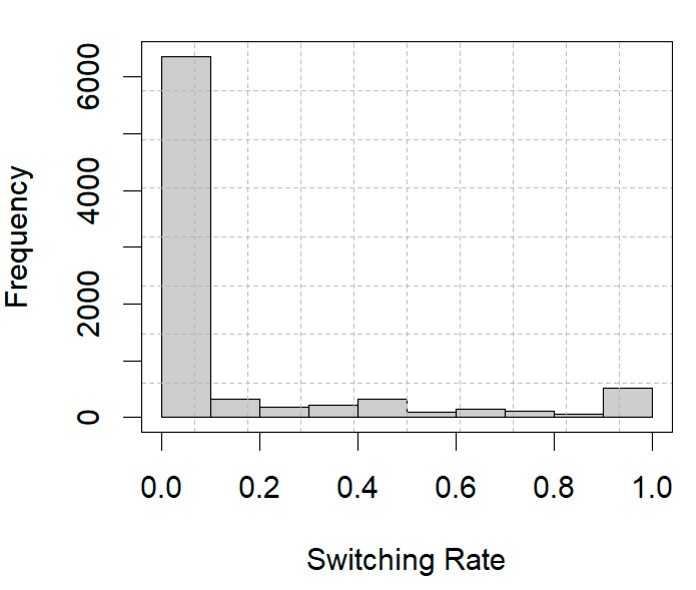
We define switching rate as the ratio of customers' purchase frequency at the new store to combined purchase frequency at both incumbent and new stores after the new store entry. Therefore, switching rate of 1 means that, incumbent customers only visit new stores while that of 0 means that they keep visiting incumbent stores only after new store entry. The switching rate between 0 and 1 means partial switching where they split store visits between incumbent and new stores. Figure 1 shows the distribution of switching rates among the incumbent customers in our data. There is a concentration of mass at extreme values of 0 and 1 with their shares at 73.7% and 5.6%, respectively. The rest are partial switchers. The distribution shows concentrated mass at both boundary values, justifying the use of a zero-one inflated beta model. Table 1 shows the summary statistics of our data. First, the switching rate has a mean of 0.14 with substantial variation (s.d. = 0.29), indicating that an average customer allocates 14% of their purchase incidence to the new store, although this varies considerably across customers. Pre-entry customer purchase behavior shows considerable heterogeneity: monthly purchase amounts average 7.90 USD with high variability (s.d. = 9.56), ranging from 0.35 to 139.11 USD. Purchase frequency averages approximately once per month (mean = 1.03, s.d. = 1.10) with some customers visiting as frequently as fourteen times a month. Monthly quantity purchased similarly demonstrates substantial variation with a mean of 2.99 items (s.d = 3.91). Customers purchase from an average of 6.54 unique product categories on a monthly basis (s.d. = 3.83). Store characteristics reveal that new stores are substantially larger than existing ones (179.86 m2 versus 93.82 m2 on average), with new stores also exhibiting greater size variation. The spatial variables indicate that incumbent stores are located an average of 358 meters away from the nearest subway station, with normalized daily subway traffic averaging 0.68. The normalized inter-store distance between incumbent and nearest new stores averages 0.79 (s.d. = 0.17), indicating some variation between new stores and existing locations.
Table 1 Summary statistics of the customer purchase behaviors and store characteristics. The local currency values were converted into USD based on the average exchange rate in 2018.3
| Variable | Mean | SD | Min | Max |
|---|---|---|---|---|
| Switching Rate | 0.14 | 0.29 | 0.00 | 1.00 |
| Monthly Purchase | 7.90 | 9.60 | 0.27 | 139.11 |
| Monthly Frequency | 1.03 | 1.10 | 0.30 | 14.18 |
| Basket Size | 8.40 | 6.96 | 0.94 | 105.23 |
| Monthly Quantity | 2.99 | 3.91 | 0.30 | 56.14 |
| Number of Categories | 6.54 | 3.83 | 1.00 | 29.00 |
| Store Size: Existing | 93.82 | 22.76 | 66.00 | 122.31 |
| Distance to Nearest Subway Station (m): Existing | 357.58 | 510.43 | 30 | 1,300 |
| Daily Traffic at Nearest Subway Station (normalized): Existing | 0.68 | 0.30 | 0.23 | 1 |
| Inter-store distance to nearest existing store (normalized): Existing | 0.79 | 0.17 | 0.51 | 1 |
| Store Size: New | 179.86 | 94.50 | 99.11 | 295.67 |
Table 2 presents descriptive profiles of the three customer segments, offering initial insights into how non-switchers, partial switchers, and complete switchers differ in their pre-entry purchase behaviors and store characteristics. For instance, complete switchers exhibit markedly lower purchase frequency (0.61) compared to non-switchers (1.02), while partial switchers shop across more categories (6.83) and purchase larger quantities (3.70) than other segments. We will model and examine these patterns more rigorously using regression analysis in the next section.
Table 2 Segment profiles: Mean (SD) of customer purchase behaviors and store characteristics. The local currency values were converted into USD based on the average exchange rate in 2018. Store characteristic variables are all standardized.
| Variables | Non-switchers | Partial switchers | Complete Switchers |
|---|---|---|---|
| Amount | 7.83 (9.52) | 9.05 (10.47) | 4.61 (4.43) |
| Frequency | 1.02 (1.12) | 1.16 (1.10) | 0.61 (0.46) |
| Basket Size | 8.48 (7.02) | 8.22 (6.81) | 8.00 (6.62) |
| Quantity | 2.88 (3.80) | 3.70 (4.48) | 1.84 (2.29) |
| Number of Category | 6.53 (3.82) | 6.83 (3.94) | 5.56 (3.39) |
| Store Size | 0.09 (0.99) | -0.32 (0.98) | 0.00 (0.91) |
| Distance to Subway Station | -0.13 (0.90) | 0.52 (1.19) | -0.18 (0.89) |
| Subway Station Traffic | 0.12 (0.96) | -0.43 (1.07) | -0.01 (0.87) |
| Inter-distance | 0.14 (0.94) | -0.49 (1.10) | 0.03 (0.85) |
| Store Size | -0.11 (0.98) | 0.43 (0.97) | -0.10 (0.98) |
Ⅳ. Model
Zero-one inflated beta (ZOIB) regression is a statistical model designed to handle dependent variables that are bounded between 0 and 1, with large masses of observations at exactly 0 and 1 (Ferrari and Cribari-Neto, 2004; Ospina and Ferrari, 2012; Liu and Eugenio, 2018). ZOIB model addresses the large mass at boundary values through a flexible mixture specification that decomposes the data-generating process into three distinct components. We denote the switching rate as r, where r=0 means non-switching, r=1 complete switching, and fractional value of r (0 < r < 1) as partial switching. The ZOIB model decomposes incumbent customers’ behaviors into three sub-models:
the zero-one inflation (ZOI) sub-model, capturing the probability of extreme behaviors (r ∈ {0, 1}) versus partial switching (0 < r < 1);
the conditional one-inflation (COI) sub-model, modeling the direction of behavior conditional on extreme behaviors (r=1 | r ∈ {0, 1}); and
the μ sub-model characterizing the expected switching intensity among partial switching behavior, E[r | 0 < r < 1].
The probability density function for zero-one inflated beta distribution is,4
where, X is a vector of covariates, and θz, θc, and θβ are sets of parameters. I(·) is an indicator variable. πE(·) is ZOI-component or probability that r takes extreme values of 0 or 1 and π1|E(·) is COI-component or the conditional probability that r=1 given r takes extreme values. fβ is the probability density function for beta distribution,
where θβ = {μ, φ}, μ = (θβ; X) is mean, φ is precision parameter, and Γ(·) is a gamma function. We use logit link functions for πE(·), π1|E(·), and μ. For instance, πE(·) is expressed as,
where θz = {αz; βz}, where αz is a scalar and βz is a parameter vector. These are model parameters to estimate. π1|E(·) is expressed as,
where θc = {αc; βc}, where αc is a scalar and βc is a parameter vector. Lastly, we also parametrize μ using logit function as,
where θμ = {αμ; βμ}.
Covariate vector X includes two sets of variables. First, we presume that the depth and breadth of customer engagement with the incumbent stores should predict how incumbent customers respond to new store entry (e.g., Neslin et al., 2006). They measure the extent of customers’ monthly purchase behavior at the incumbent store prior to new store entry: purchase amount, purchase frequency, basket size, purchase quantity, and number of categories purchased. These variables extend the classic RFM (Recency, Frequency, Monetary) framework widely used in marketing to segment customers based on their transactional relationship (e.g., Buckinx and Van den Poel, 2005; Fader et al., 2005). Next, we include variables that capture the characteristics of the existing stores: store size, distance to the nearest subway station, and subway station foot traffic volume. Our choice of store variables is guided by the retail literature on customers’ retail patronage decisions (e.g., Cho and Park, 1999, Briesch et al., 2009; Zhu et al., 2011). They reflect the incumbent’s capacity and accessibility, which may be associated with customer preference and travel costs. We also use characteristics of the new store and its spatial relationship to the incumbent store: new store size and inter-store distance. We expect the inter-store distance plays a key role in incumbent customers’ post-entry purchase behaviors (e.g., Briesch et al., 2009). We use identical set of covariates across three components in ZOIB regression, allowing us to examine how the same factors differentially influence three model components. We standardize all covariates (mean = 0, s.d. = 1) for intuitive interpretation of the parameter estimates across covariates and models.
Ⅴ. Results
5.1 Estimation Results
We estimate the proposed ZOIB model using Bayesian estimation framework. We estimate the model using Markov Chain Monte Carlo (MCMC) with 4,000 iterations (2,000 burn-ins). After the completion of the iterations, all the parameter estimates show satisfactory convergence ($\hat{R} \approx 1.00$). Figure 2 shows the posterior distributions and MCMC trace plots for some of the coefficient estimates in $\mu$-component. Trace plots indicate good convergence and mixing across iterations for parameter estimation.
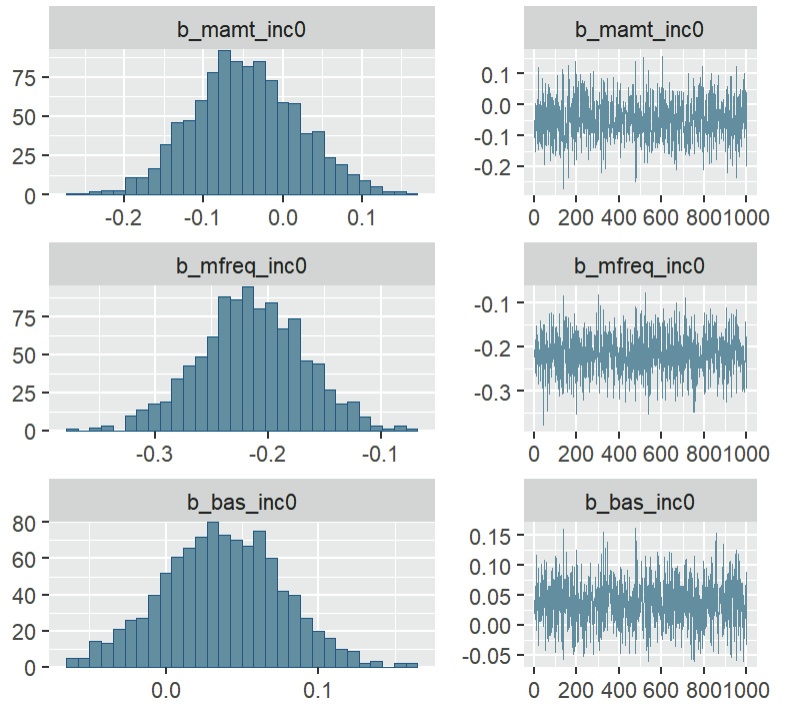
Table 3 presents the estimation results for ZOIB regression model. There is one limitation of the estimation results. Because the COI and μ sub-models are conditional, their coefficients cannot be directly interpreted as unconditional marginal effects. We therefore derive three unconditional values from the three components in ZOIB model as follows,
Pr(r = 0) = ZOI × (1 − COI) for non-switching,
Pr(r = 1) = ZOI × COI for complete switching, and,
E[r·1(0 < r < 1)] = (1 − ZOI) × expected switching intensity for partial switching rate,
Table 3 Estimation results for ZOIB regression. “r” is switching rate, where r = 0 means that non-switching while r = 1 means full switching. μ component represents the estimation for beta regression while ZOI component a logistic regression result for extreme values (where r = 0 or r = 1), and COI, a logistic regression result for (r = 1 conditional on r being extreme values).
| Variable | μ component (0 < r < 1) | ZOI component (r ∈ {0, 1}) | COI component (r = 1 ∣ r ∈ {0, 1}) |
|---|---|---|---|
| Intercept | -0.36*** (-0.41, -0.31) | 1.53*** (1.46, 1.59) | -2.94*** (-3.09, -2.80) |
| Amount | -0.05 (-0.18, 0.09) | 0.07 (-0.09, 0.22) | -0.98*** (-1.59, -0.36) |
| Frequency | -0.22*** (-0.31, -0.13) | 0.12* (0.01, 0.22) | -0.76*** (-1.24, -0.35) |
| Basket Size | 0.04 (-0.04, 0.11) | 0.07 (-0.02, 0.16) | 0.15 (-0.07, 0.36) |
| Quantity | -0.02 (-0.13, 0.07) | -0.17** (-0.29, -0.05) | 0.48*** (0.19, 0.76) |
| Number of Category | -0.07* (-0.13, -0.00) | -0.22*** (-0.29, -0.14) | -0.07 (-0.22, 0.08) |
| Store Size | 0.20* (0.01, 0.39) | -1.72*** (-1.94, -1.50) | 0.76*** (0.41, 1.11) |
| Distance to Subway Station | -0.25*** (-0.36, -0.15) | 0.18** (0.05, 0.32) | -0.70*** (-0.94, -0.45) |
| Subway Station Traffic | -0.28** (-0.52, -0.05) | 0.27 (-0.01, 0.56) | -0.72*** (-1.16, -0.29) |
| Inter-distance | -0.04 (-0.27, 0.18) | 1.37*** (1.09, 1.64) | -0.63** (-1.12, -0.17) |
| Precision (φ) | 3.57*** (3.35, 3.77) |
where Pr(r = 0) is non-switching probability, Pr(r = 1) is full switching probability. The last component, which we call the partial switching rate, combines the conditional probability of partial switching (= 1 - ZOI) and the expected switching intensity (μ sub-model), capturing both the prevalence and extent of partial switching in a single metric.5 Because these probabilities and switching rate are nonlinear functions of multiple parameters from ZOIB model, we employ Bayesian posterior simulation method to compute average marginal effects (AMEs). Bayesian posterior simulation draws thousands of samples from the joint distribution of original model parameters during the Bayesian sweep, allowing us to compute any derived quantity (such as unconditional probabilities) from each draw and then summarize them for the resulting distribution (Gelman et al., 2013; Bürkner 2017). This approach naturally propagates uncertainty from all sub-model components without requiring analytical derivations of standard errors for the derived quantity. Table 4 shows the estimation results based on Bayesian posterior simulation. Since all covariates were standardized, the estimates are interpreted as the change in the derived quantity associated with one standard deviation increase in each covariate, allowing us to directly compare effect sizes across variables.
Table 4 Average marginal effects on unconditional non-switching probability, partial switching rate, and complete switching probability. Partial switching rate combines both the probability of partial switching and the expected switching intensity. Asterisk(*) indicates 95% credible interval that excludes zero.
| Variable | Non-switching probability ($r=0$) | Partial switching rate ($0 < r < 1$) | Complete switching probability ($r=1$) |
|---|---|---|---|
| Intercept | 0.780* [0.769, 0.790] | 0.074* [0.069, 0.078] | 0.041* [0.036, 0.047] |
| Customer Purchase Behaviors | |||
| Amount | 0.042* [0.015, 0.067] | -0.006 [-0.016, 0.005] | -0.032* [-0.044, -0.016] |
| Frequency | 0.044* [0.024, 0.062] | -0.016* [-0.022, -0.009] | -0.027* [-0.039, -0.014] |
| Basket Size | 0.001 [-0.016, 0.018] | -0.003 [-0.008, 0.004] | 0.009 [-0.003, 0.022] |
| Quantity | -0.053* [-0.082, -0.028] | 0.009 [-0.000, 0.019] | 0.027* [0.008, 0.049] |
| Number of Category | -0.028* [-0.041, -0.015] | 0.010* [0.004, 0.015] | -0.053 [-0.012, 0.002] |
| Store Characteristics | |||
| Store Size: Incumbent | -0.337* [-0.379, -0.291] | 0.162* [0.129, 0.196] | 0.007 [-0.009, 0.029] |
| Distance to Subway Station: Incumbent | 0.051* [0.032, 0.068] | -0.021* [-0.028, -0.013] | -0.026* [-0.033, -0.018] |
| Subway Station Traffic: Incumbent | 0.061* [0.022, 0.098] | -0.025* [-0.039, -0.010] | -0.025* [-0.037, -0.011] |
| Inter-distance | 0.156* [0.131, 0.177] | -0.056* [-0.063, -0.047] | -0.019* [-0.033, -0.000] |
| Store Size: Entrant | -0.141* [-0.161, -0.121] | 0.0616* [0.052, 0.073] | -0.0025 [-0.012, 0.007] |
5.2 Interpretation
We discuss and compare how each covariate is differentially associated with heterogeneous post-entry responses among incumbent customers. Before presenting our results, we discuss the limitations in interpreting our empirical results. As pre-entry purchase behaviors may themselves reflect unobserved spatial constraints across customers, our estimation results represent predictive associations rather than causal effects. While this limits strict causal interpretation of our model, introducing economic primitives such as travel cost enhances the narrative of our empirical findings. It also lends greater managerial relevance to our framework, as observable purchase patterns can be used to identify and predict different customer segments. With this caveat in mind, we present our interpretation of the empirical findings below.
First, at the mean values of all covariates, customers have estimated baseline probabilities of 78% for non-switching, 18% for partial switching, and 4% for complete switching. These baseline probabilities underscore that the share of complete customer loss is relatively small and the primary competitive risk from same-brand entry is the erosion of share-of-visits through partial switching.
We discuss the association between customer and store characteristics, and post-switching behaviors. Before discussing our parameter estimates, two points warrant attention. First, in a retail franchise setting where brand-level attributes are relatively constant across stores, we expect travel costs to play a central role in switching decisions among customers (Briesch et al., 2009). Accordingly, our discussion focuses on how each covariate signals customers’ underlying travel costs or shopping motivations. Second, all parameter estimates are interpreted as marginal effects and the effect sizes represent percentage point changes from baseline quantities, while holding all other covariates constant.
Higher purchase amount is a strong predictor of loyalty to the incumbent store as it significantly increases non-switching probability (+4.2%) but decreases complete switching probability (-3.2%), with no effect on partial switching. Purchase frequency emerges as the most robust post-entry predictor for non-switching, significantly increasing non-switching probability (+4.4%) while reducing both partial switching intensity (-1.6%) and complete switching probability (-2.7%) from the respective baseline probabilities. Purchase frequency may reflect both customer preference and spatial convenience as frequent store visits may reveal a preference for the franchise brand or signal proximity to the store. Although customer locations are unobserved, frequent shoppers are likely to live or work nearby and thus would not experience substantial travel cost savings from switching. Such customers may also minimize inventory-holding costs by treating the nearby store as an extension of their pantry, a strategy predicated on low travel costs (Bell et al., 1998).
Holding all else constant, purchase quantity is an important predictor for partial switching: customers with large purchase quantities are less likely to be loyal (-5.3%) but more likely to completely switch (+2.7%). The bulk purchase behavior may signal higher unobserved travel costs, as customers consolidate purchases into fewer trips with large quantities to save travel costs. When a new store opens nearby, complete switching may offer substantial travel cost savings.
Multi-category shoppers are less likely to remain loyal (-2.8%) and marginally more likely to partially switch (+1.0%), with no effect on complete switching. They may possess an optimization mindset, seeking the best alternative for each purchase occasion rather than consolidating purchases at a single location (Messinger and Narasimhan, 1997; Fox and Hoch, 2005). Prior to entry, travel costs may have constrained them to the incumbent. These partial switchers may be geographically positioned between the incumbent and new stores, making both locations reasonably accessible. This explains why category breadth predicts partial switching as they redistribute purchases across stores rather than abandon the incumbent stores entirely.
As prior research predicts, store characteristics affect customers’ post-entry responses primarily through their influence on travel costs and the relative attractiveness of new stores. Among them, we focus on three store variables that exhibit the largest and most managerially relevant effects. Customers from larger incumbent stores are less likely to remain loyal (-33.7%) and exhibit substantially higher partial switching intensity (+16.2%), with no effect on complete switching. Larger stores serve customers with diverse needs and heterogeneous purchase occasions such as stock-up trips, fill-in trips and browsing (Walters and Jamil, 2003). When a new store opens nearby, customers from large incumbent stores can reallocate specific trips across locations. For instance, they may direct convenience-oriented fill-in trips to the entrant while retaining assortment-dependent stock-up trips at the incumbent (Briesch et al., 2009).
Consistent with previous aggregate-level research (e.g., Zhu et al., 2011), the distance between incumbent and new stores has a large impact on customers’ switching behavior as inter-store distance directly determines the travel cost of multi-store shopping. When new stores open farther from incumbent stores, incumbent customers are significantly more likely to remain loyal (+15.6%), exhibit lower partial switching intensity (−5.6%), and are less likely to completely switch (−1.9%). Greater separation therefore reduces complete switching, as a distant entrant is unlikely to offer substantial travel cost savings over the incumbent for customers.
Holding all else constant, incumbent customers facing larger entrant stores in terms of footprint are significantly more likely to switch (-14.1%) and exhibit higher partial switching intensity (+6.2%), with no effect on complete switching. Larger entrants may offer broader assortment and attract customers seeking variety or specialized products (Briesch, Chintagunta, and Fox, 2009). Therefore, the entrants’ scale creates shared customers rather than complete switchers among the incumbent customers.
5.3 Managerial Implications
We now synthesize our empirical findings and offer managerial guidance for incumbent franchisees facing new store entry. Note that the primary application of our model is to help incumbents predict post-entry customer switching behaviors and respond accordingly. The first insight is that franchise encroachment primarily creates shared customers rather than complete loss because the baseline probabilities of partial switchers and complete switchers are 7.4% and 4.1%, respectively. Therefore, the primary competitive risk for incumbent store is lower share-of-visits through partial switching and the retention strategies should focus on preserving purchase shares rather than preventing complete defection.
Second, to retain a higher share-of-wallet among partial switchers, incumbent stores should focus on planned, high-value trip types where habitual behavior and assortment depth favor the incumbent, while accepting the possibility that other occasional trips may shift to new stores. For example, tiered loyalty programs that reward monthly spending thresholds can incentivize customers to consolidate purchases at the incumbent, and stock-up promotions offering bulk discounts can anchor routine, high-value trips among partial switchers. Third, we characterized complete switchers as “bulk” customers with infrequent visits and large quantity purchases at incumbent stores. Their infrequent, large-quantity pattern signals that they may be located at the periphery of the incumbent’s catchment area. Therefore, bulk buying may be a coping strategy for high travel costs and customers accept higher household inventory costs in exchange for fewer trips. The incumbent stores can devise multiple marketing strategies to keep the bulk buyers: volume discounts or bulk-buy loyalty programs can create monetary switching costs that may offset the entrant's travel cost advantage.
Lastly, spatial configuration between incumbent and entering stores critically affects switching behaviors among incumbent customers. Inter-store distance suppresses both partial and complete switching among incumbent customers, as greater separation increases the travel cost of multi-store shopping. Incumbent store size amplifies partial switching as larger incumbent stores originally attracted customers from wider catchment areas, and distant customers may benefit more when a new store opens closer to their locations. Location characteristics also matter: incumbent stores in high-traffic or transit-accessible locations enjoy natural protection because their customers face near-zero marginal travel costs for shopping trips.
In summary, incumbent stores should prioritize identifying and retaining vulnerable bulk buyers while protecting multi-category shoppers from complete defection. Responses should be calibrated based on proximity to the entrant, leveraging location-based advantages in customer engagement. The goal is damage control: retain valuable customers and maintain visit frequency, accepting that some wallet sharing is inevitable.
Ⅵ. Conclusion and Future Research
6.1 Summary
This study examines incumbent customers’ store switching behaviors following new store entries in a retail franchise setting. To that end, we model heterogeneous store switching behaviors using a zero-one inflated beta (ZOIB) regression framework. This approach accommodates the mixed discrete-continuous nature of the switching probabilities, distinguishing among incumbent customers who do not switch, who partially switch, and who completely switch. By deriving unconditional quantities of interest from the sub-model estimates and computing average marginal effects through Bayesian posterior simulation, we provide a unified framework for characterizing how customer and store characteristics predict post-entry response among incumbent customers. We apply our model to customer-level transaction data where a new same-brand stores enter in proximity to incumbent stores. Our study makes two key contributions. First, we demonstrate that same-brand entry induces more partial switching rather than complete switching, reframing franchise entry as a share-of-wallet problem. Second, we discuss the association between customer and store characteristics, and heterogeneous switching behaviors, and draw managerial implications from the estimation results.
6.2 Future Research
We discuss potential avenues for future research. First, our ZOIB model captures whether incumbent customers partially switch, but not how much they reallocate. Among partial switchers, what proportion of spending shifts to the new store? And does multi-store shopping expand total spending, or simply redistribute a fixed budget across locations? Addressing these questions would deepen our understanding of demand expansion versus substitution. Therefore, future work could examine how individual customers’ purchase behaviors change following new store entry. If pre-entry purchase patterns were shaped by spatial constraints rather than stable preferences, we would expect these patterns to shift after entry, particularly among partial switchers, whose dramatic demand expansion suggests their prior behavior was suppressed. In contrast, stable purchase patterns across segments would indicate that purchase behaviors reflect enduring consumer preferences rather than spatial constraints. Documenting these changes would provide direct evidence on whether pre-entry behaviors are best understood as consumer characteristics or as symptoms of constrained access caused by travel cost.
Second, while customer locations are unobserved in our data, new store entry provides quasi-experimental variation that may enable structural identification of travel costs. A structural model that treats customer spatial position as a latent factor driving both pre-entry purchase behaviors and post-entry switching could jointly recover travel cost parameters and preference heterogeneity, and support counterfactual analyses of alternative entry locations. Until such methods are applied, our findings are best interpreted as documenting which observable customer profiles predict switching, rather than identifying the causal mechanisms underlying these associations.
Author Biographies
∙ Jun B. Kim graduated from Seoul National University with a degree in aerospace engineering, earned a PhD in mechanical engineering from MIT, and worked as a software engineer in Silicon Valley for over five years. He then received a PhD in quantitative marketing from UCLA Anderson, and spent nine years in research and teaching at Georgia Tech and HKUST business schools before joining SNU Business School. His research focuses on quantitative marketing and econometrics, and he has received INFORMS' Frank Bass Award (2011), John D. Little Award (2016), and Long Term Impact Award (2020).