
.jpeg)
기업의 과거 성과와 비관련 M&A: CEO의 위험 선호 취미의 조절 효과
Prior Firm Performance and Unrelated M&A: The Moderating Effect of CEO Risk Hobby*
1 한국정보통신진흥협회, AI 산업기반팀 (Korea Association for AI&ICT Promotion (KAIT), AI Industry Infrastructure Team)
2 고려대학교, 경영대학 (Korea University, Business School)
2교신저자: 남대일 (namdaeil@korea.ac.kr)
DOI: https://doi.org/10.17287/kmr.2026.55.2.851
초록
본 연구는 기업의 성과가 산업 내 기대 수준에 미치지 못할 때 비관련 인수합병(M&A)을 추진할 가능성이 어떻게 변화하는지, 그리고 이러한 관계가 CEO의 위험 선호 성향(개인적 취미로 반영됨)에 의해 어떻게 조절되는지를 분석한다. 전망 이론(prospect theory)에 근거하여, 기대 수준 이하의 성과를 내는 기업은 위험을 감수하는 전략을 추구할 가능성이 높으며, 특히 위험 선호 성향이 강한 CEO 하에서 이러한 경향이 두드러짐을 주장한다. S&P 500 기업의 2014년부터 2023년까지 2,245개 기업-연도 관측치를 사용하여 Heckman 2단계 모델과 로지스틱 회귀분석을 수행하였다. 분석 결과, 성과 부진은 비관련 M&A 가능성을 유의미하게 증가시키며, CEO가 고위험 취미를 가질 경우 이러한 효과가 증폭되는 것으로 나타났다. 본 연구는 기대 수준 비교와 경영자의 여가 활동을 전략적 위험 감수와 연결함으로써 행동 전략 연구를 확장한다. 실무적으로는 CEO의 취미와 같은 관찰 가능한 행동적 단서가 성과 압박 하에 있는 기업의 전략적 태도를 평가하는 이사회와 투자자들에게 중요한 신호를 제공함을 시사한다.
Abstract
This study examines how firms’ under-performance relative to industry-based aspiration levels influences their likelihood of engaging in unrelated mergers and acquisitions (M&A), and how this relationship is moderated by CEOs’ risk-taking tendencies, as reflected in their personal hobbies. Drawing on prospect theory, we argue that firms below aspiration levels are more likely to pursue risk-seeking strategies, particularly under risk-tolerant CEOs. Using 2,245 firm-year observations from S&P 500 firms (2014–2023), we employ Heckman two-step models and logistic regression to test our hypotheses. Results show that performance shortfalls significantly increase the likelihood of unrelated M&As, and this effect is amplified when CEOs engage in high-risk hobbies. These findings extend behavioral strategy research by linking aspiration-level comparisons and executive leisure activities to strategic risk-taking. Practically, the study suggests that observable behavioral cues, such as CEO hobbies, offer valuable signals for boards and investors evaluating firms’ strategic posture under performance pressure.
Ⅰ. Introduction
Mergers and Acquisitions (M&A) are strategic tools that firms use to achieve growth, enhance competitiveness, and reconfigure resources in response to evolving market conditions. For firms facing limited internal growth opportunities or deteriorating core business performance, M&A can serve as a vital mechanism for survival and strategic renewal (Malik et al., 2014). Among the various types of acquisitions, unrelated M&A defined as diversification into industries outside a firm’s primary domain involves greater operational complexity and strategic uncertainty compared to related M&A, which typically leverages existing capabilities and market familiarity (Gupta et al., 2012). Despite these challenges, firms often pursue unrelated M&A to achieve financial synergies, reduce firm-specific risks, improve governance structures, or reposition themselves in response to stagnating or declining markets (Chatterjee, 1986; Singh and Montgomery, 1987; Salter and Weinhold, 1978).
While traditional strategy research has emphasized economic rationality in M&A decisions, behavioral perspectives offer complementary insights, especially under adverse conditions. Prospect theory (Kahneman and Tversky, 1979) posits that decision-makers evaluate outcomes relative to aspiration levels rather than in absolute terms. When performance falls below these reference points, firms are more likely to exhibit risk-seeking behavior to recover perceived losses. From this behavioral logic, unrelated M&A can be understood not only as a forward-looking repositioning strategy but also as a reactive response to underperformance an attempt to reverse losses through bold moves into unfamiliar domains (Shimizu, 2007).
Prior research has examined the performance implications of corporate diversification, distinguishing between related and unrelated diversification (Hong and Hwang, 1997). In parallel, studies on executive characteristics suggest that CEO attributes systematically influence firms’ strategic decisions (Baek et al., 2015; Park et al., 2017).
However, firms do not respond uniformly to performance shortfalls. Even when facing similar challenges, some display a greater willingness to take strategic risks. A key source of this variation lies in the psychological characteristics of top executives. Recent research highlights that CEOs’ personal risk preferences shape how firms react to prior performance. For instance, Song et al. (2021) find that CEOs who are licensed pilots tend to lead firms that engage in more frequent M&A activity. The pilot certification serves as a behavioral proxy for risk tolerance, suggesting that CEOs with a greater appetite for risk may be more inclined to pursue aggressive and uncertain strategies. These findings support the view that CEO-level behavioral traits influence strategic decision-making.
This study investigates how firms’ performance relative to industry peers affects their likelihood of engaging in unrelated M&A, and how this relationship is moderated by CEOs’ individual risk-taking propensities, as captured through their engagement in observable high-risk hobbies. Drawing on prospect theory, this study analyzes firm-year panel data from S&P 500 companies between 2014 and 2023 to examine how prior firm performance and executive traits interact to shape diversification strategies.
Empirically, our results show that performance shortfalls relative to industry-based aspiration levels significantly increase the likelihood that firms pursue unrelated M&A. More importantly, this tendency is systematically stronger when the CEO engages in high-risk hobbies, suggesting that executive-level risk tolerance shapes how firms interpret and respond to negative performance feedback. These findings indicate that strategic risk-taking under the loss domain is not merely a function of firm-level conditions; it is contingent on the behavioral disposition of the executive who frames the situation and endorses (or resists) scope-expanding moves.
These results yield several implications that motivate the present study. Theoretically, they strengthen a behavioral strategy account of diversification by integrating aspiration-level comparisons with observable CEO behavior, thereby offering a multi-level explanation for why some underperforming firms pursue bold, unfamiliar acquisitions while others do not. Practically, the findings suggest that boards and investors may benefit from attending to CEOs’ non-work behavioral cues—such as risk-oriented hobbies—when evaluating a firm’s strategic posture under performance pressure, particularly in contexts where unrelated acquisitions can represent an aggressive attempt at recovery.
Accordingly, the study addresses the following research questions: First, how does a prior firm’s performance relative to industry-based aspiration levels influence its likelihood of engaging in unrelated M&A? Second, to what extent do CEOs’ personal risk preferences, as reflected in their engagement in risk hobby, moderate the relationship between prior firm performance and unrelated M&A decisions?
Ⅱ. Theory and Hypotheses
2.1 M&A as a Risky Strategic Choice
Firms pursue M&A to achieve growth, enhance competitiveness, and secure valuable resources in dynamic markets (Angwin et al., 2022; Hitt, Harrison, and Ireland, 2001). For firms experiencing stagnation or declining profitability, M&A often represents a viable path to renewal and survival (Malik et al., 2014).
M&As are generally categorized as related or unrelated. Related M&As occur within the firm’s existing or adjacent industries, while unrelated M&As entail diversification into sectors that are substantially different from a firm’s current business (Gupta et al., 2012). Related M&As tend to generate value through economies of scale, scope, and enhanced market power (Shepherd and Dewey, 1970; Singh and Montgomery, 1987). In contrast, unrelated M&As are typically riskier, as they involve integration challenges, information asymmetries, and limited synergy realization (Bergh, 1997). Despite these risks, firms may adopt unrelated diversification as a means to improve financial performance or strategically reposition themselves (Christensen and Montgomery, 1981; Park, 2003).
Importantly, M&A decisions are widely recognized as archetypal risky strategic actions characterized by high uncertainty and substantial managerial discretion. Prior research highlights that such decisions are significantly shaped by CEOs’ psychological characteristics and behavioral tendencies (Hennig et al., 2026; Malhotra et al., 2018). For instance, Malhotra et al. (2018) demonstrate that extraverted CEOs―those exhibiting positive affect, decisive thinking, and a strong desire for social engagement―tend to generate greater value through M&As, even while conducting more frequent and larger deals. Similarly, Devers et al. (2020) emphasize that CEO attributes not only affect the overall success of M&A transactions but also influence decisions throughout different stages of the acquisition process. Collectively, these studies underscore that M&A represents a high-stakes strategic context in which CEOs’ personal traits, values, and risk preferences play a critical role in shaping corporate choices.
2.2 Prospect Theory and Firm Performance
Prospect theory (Kahneman and Tversky, 1979) offers a behavioral framework for understanding strategic decision-making under risk. Individuals judge outcomes based on how they compare to a certain reference point, not by their absolute value, and tend to avoid risk when they perceive themselves to be in the gains domain but take on more risk when they are in the losses domain. When outcomes fall below the reference point, decision-makers are more likely to engage in risk-seeking behaviors to recover from perceived losses (Tversky and Kahneman, 1992; Bowman, 1982).
At the firm level, decision-makers exhibit similar behavioral tendencies. Firms performing below their aspiration levels tend to pursue bold and risky strategies, whereas firms performing above such levels prefer conservative actions (Fiegenbaum and Thomas, 1988; Jegers, 1991). The magnitude of underperformance also matters. Building on prospect theory, Shimizu (2007) argued that when firms’ performance declines moderately below the reference point, managers are inclined to engage in risk-seeking actions to recover losses. However, when performance deteriorates to an extreme level, decision-makers tend to shift toward more conservative, risk-averse responses to protect organizational stability and reputation (March and Shapira, 1987; Shimizu, 2007).
From this perspective, M&A serves as a strategic context in which risk-seeking tendencies are expressed. Related acquisitions are relatively safer, while unrelated M&As involve higher uncertainty and risk (Sitkin and Pablo, 1992). Firms that underperform relative to their peers or internal targets may thus explore unrelated M&A as a potential means of performance recovery (Park, 2003).
Hypothesis 1 (H1): Firms with performance below their aspiration levels are more likely to engage in unrelated M&A.
2.3 CEO Risk Hobby and Strategic Risk-Taking
Top executives play the important role in shaping organizational strategy and risk orientation (Finkelstein and Hambrick, 1996). Recent studies emphasize that CEOs’ personal characteristics—not only demographic traits such as age or tenure, but also psychological tendencies reflected in leisure activities—can meaningfully influence strategic outcomes (Stebbins, 2017; Zuckerman, 1994).
Hobbies are voluntarily chosen activities that reflect intrinsic psychological needs and therefore provide an authentic lens into an individual’s risk tolerance (Tinsley and Eldredge, 1995). CEOs who pursue high-risk hobbies such as aviation, mountaineering, or motorsports, tend to exhibit stronger sensation-seeking tendencies and greater comfort with uncertainty (Song et al., 2021). Empirical evidence shows that such CEOs are associated with higher innovation intensity, greater capital investment, and a stronger propensity to engage in M&A activity (Cain and Mc Keon, 2016; Sunder et al., 2017).
Drawing on prospect theory, a CEO’s inclination toward risk becomes more pronounced when the firm experiences performance downturns. Those with high risk-taking propensities may view poor performance less as a danger and more as a chance to pursue bold strategic changes. In such cases, they are more likely to support bold initiatives such as unrelated M&A. Thus, this study examines whether CEOs’ risk-related hobbies strengthen the relationship between performance below aspiration and the likelihood of unrelated M&A.
Hypothesis 2 (H2): The higher the risk level of a CEO’s hobbies, the stronger the positive relationship between performance below aspiration and the likelihood of unrelated M&A.
Ⅲ. Methods
3.1 Data and Sample
The sample for this study comprises firms listed in the S&P 500 between 2014 and 2023. M&A transaction data were obtained from Thomson Financial’s SDC Platinum database. We excluded firms in the financial sector, as their acquisition motivations and regulatory environments often differ substantially from those of non-financial firms (Faccio and Lang, 2002; La Porta et al., 1999). CEO-level data at the time of each transaction were sourced from Execu Comp, and firm-level financial data were obtained from CRSP.
The construction of the CEO hobby variable is grounded in the level of risk associated with active participation in sports. However, not all self-reported sports hobbies reflect actual participation. For example, a CEO who lists football as a hobby may merely enjoy watching the sport rather than actively engaging in it (Luo et al., 2022). To ensure conceptual consistency, such cases were excluded from the final dataset.
CEO hobby information was collected through multiple sources, including Business Insider, Press Farm, public CEO social media accounts, and manual searches via Google. Only instances where a CEO explicitly stated their hobby in an interview or on social media, or where a credible news article directly referenced the CEO’s personal hobby, were included.
Out of a total of 680 CEOs who served in S&P 500 firms during the study period, hobby information was successfully identified for 206 individuals. After excluding one CEO who explicitly reported having no hobbies, the final sample includes 205 CEOs. These CEOs were involved in 2,245 M&A transactions over the 10-year period, which constitutes the primary dataset used for this study. For descriptive comparison, the broader dataset―including all CEOs regardless of hobby information availability―comprises 6,654 M&A transactions.
3.2 Measure
3.2.1 Dependent Variable
Unrelated M&A is measured by comparing the Standard Industrial Classification (SIC) codes of the acquiring and target firms. Specifically, when the two-digit SIC code of the acquiring firm is identical to that of the target firm, the transaction is classified as a related M&A and coded as 0. Conversely, if the two-digit SIC codes differ, the transaction is classified as an unrelated M&A and coded as 1. This binary classification follows established methodologies in prior research (Berger and Ofek, 1995; Nejadmalayeri, Iyer, and Singh, 2017; Anderson, Stowe, and Xing, 2011).
3.2.2 Independent Variable
Following Greve (2003), we operationalize prior firm performance relative to aspiration levels using a spline function that captures deviations between a firm’s actual performance and a relevant reference point. This specification enables us to distinguish the effects of performance shortfalls on the likelihood of engaging in unrelated M&A. Consistent with prior research (Greve, 2003; Harris and Bromiley, 2007; Mishina et al., 2010), we use return on assets (ROA) as the primary measure of firm performance, calculated for the fiscal year immediately preceding each M&A transaction (Mishina et al., 2010).
We construct the variable as follows:
This formulation captures only negative performance gaps—situations in which a firm’s performance falls short of its reference point. While some studies consider both historical aspirations (based on a firm’s own prior performance) and social aspirations (based on peer performance) (Greve, 2003; Harris and Bromiley, 2007), we follow Mishina et al. (2010) and adopt the social aspiration approach.
Accordingly, each firm’s aspiration level is benchmarked against its peers within the same two-digit SIC industry classification. Consistent with prior research, firms treat industry peers—defined by two-digit SIC codes—as salient and relevant benchmarks (Porac et al., 1999). For each focal firm, we define its peer group as all other S&P 500 firms within the same two-digit SIC category in the same year (excluding the focal firm itself). The aspiration level for firm $i$ in year $t$ is calculated as the average ROA of its peer firms:
where $j$ belongs to the peer group of firm $i$, and $N$ is the number of peer firms in the same two-digit SIC code in year $t$ (excluding the focal firm itself).
3.2.3 Moderate Variable
CEO’s Risk Hobby is measured using a risk-based hobby classification framework adapted from Song et al. (2021), which builds on Stebbins’ (2017) typology of serious leisure and psychological traits. Following Song et al., we classify hobbies into four levels (Table 1).
Table 1 Risk Level of Hobbies
| Level | Hobbies |
|---|---|
| The lowest-risk level hobbies (1) | gardening, singing, piano, chess, calligraphy and painting, pets, etc |
| The low-risk level hobbies (2) | photography, walking, billiards, table tennis, fishing, etc. |
| The middle-risk level hobbies (3) | running, swimming, long-distance travel, fencing and other competitive sports |
| The high-risk level hobbies (4) | racing, skydiving, bungee jumping, surfing, adventure and other extreme sports |
Levels of risk intensity (1 = lowest-risk to 4 = high-risk) based on the extent of physical, psychological, or social risk involved in the activity.
CEO hobby information was manually collected from media interviews, press coverage, and company disclosures, and each hobby was coded according to this scale. If a CEO reported multiple hobbies, the highest risk-level hobby was used as the representative score for that individual (Song et al., 2021).
3.2.4 Control Variable
With respect to control variables, this study incorporates several CEO characteristic measures, Firm characteristics in the model. In line with prior studies on risk hobby (Cain and Mckeon, 2016; Sunder et al, 2017; Song et al, 2021), we incorporate several control variables into our model.
The variables of CEO’ characteristics include: (1) Age (2) Gender (3) Tenure. Gender is coded as a dummy (male = 0, female = 1). Tenure is calculated in years from the CEO’s appointment date to year-end (Boeker, 1997).
The variables of firm characteristics include: (1) Firm Age (2) Firm Size (3) R&D Expenditures. Firm age is measured as the number of calendar years elapsed since the firm’s founding. Firm size is operationalized as the natural log of total assets (Hennart et al., 1998). R&D expenditure is calculated as the natural logarithm of Research and Development Expense.
The variables of Deal characteristics include: (1) Entropy (2) prior deal experience. Entropy is measured by entropy index of diversification. Calculating the weighted balance of a firm’s sales across its business segments, with each segment’s share of total sales informing the overall dispersion score (Jacquemin and Berry, 1979). Prior deal experience was measured with the number of firms acquired in the preceding three years (Hayward, 2002; Stettner and Lavie, 2013).
3.3 Analytical Strategy
This study employs a logistic regression model to examine the effect of prior firm performance on the likelihood of engaging in unrelated M&A. Logistic regression is appropriate given the binary nature of the dependent variable, which captures whether or not a firm undertakes an unrelated M&A. To mitigate potential confounding influences, we include year and industry fixed effects. Year fixed effects account for time-specific macroeconomic fluctuations that may affect M&A activity (Petersen, 2009), while industry effects are controlled using two-digit SIC code dummies. All models include both year and industry fixed effects via dummy variable specification.
To address potential sample-selection bias—stemming from the fact that CEO hobby data are available only for a subset of firms—we implement a Heckman two-step selection model (Heckman, 1979). In the first stage, we estimate a probit model predicting the likelihood that a firm has observable CEO hobby data, using CEO compensation. The rationale is that CEOs with higher compensation tend to receive greater media exposure and public attention, increasing the probability that personal information such as hobbies becomes publicly available through interviews or press coverage. This is consistent with prior research showing that CEO compensation is positively associated with media appearances and visibility (Kang and Kim, 2017). Because our hobby dataset is compiled primarily from CEO interviews and media sources, compensation provides a theoretically and empirically justified instrument—it affects the likelihood of observation but does not directly influence the probability of unrelated M&A once firm- and CEO-level controls are included.
From this model, we calculate the Inverse Mills Ratio (IMR), which is then included as a control variable in the second-stage logistic regression that models the probability of unrelated M&A. Additionally, to reduce multicollinearity between main effects and interaction terms, all continuous variables are mean-centered prior to constructing interaction terms, following Aiken and West (1991).
Ⅳ. Results
4.1 Main Results
Table 2 summarizes the descriptive statistics of the variables and provides their correlation matrix. The dependent variable, Unrelated M&A, has a mean of 0.52, indicating that approximately 52% of firms in the sample engaged in unrelated acquisition activities. The independent variable, Performance Below Aspiration, have means of 0.03, indicating that firms generally exhibited only small deviations from their aspiration levels. The moderating variable Risk Hobby has a mean of 2.71 (SD = 0.95), suggesting that most CEOs in the sample tend to pursue moderately risky or competitive leisure activities.
Table 2 Descriptive Statistics and Correlation Matrix
| Variables | M | S.D | (1) | (2) | (3) | (4) | (5) | (6) | (7) | (8) | (9) | (10) | (11) | |
|---|---|---|---|---|---|---|---|---|---|---|---|---|---|---|
| (1) Unrelated M&A | 0.52 | 0.50 | 1 | |||||||||||
| (2) Performance Below Aspiration | 0.03 | 0.06 | 0.021 | 1 | ||||||||||
| (3) Risk hobby | 2.71 | 0.95 | 0.104* | -0.048* | 1 | |||||||||
| (4) CEO Age | 53.90 | 10.99 | 0.046* | 0.049* | -0.123* | 1 | ||||||||
| (5) CEO Gender | 0.06 | 0.25 | 0.024 | -0.038* | 0.032 | 0.034* | 1 | |||||||
| (6) CEO Tenure | 7.25 | 6.50 | 0.055* | 0.040* | 0.100* | 0.331* | -0.131* | 1 | ||||||
| (7) Firm Age | 27.29 | 16.90 | 0.056* | -0.105* | -0.062* | 0.364* | 0.221* | -0.090 | 1 | |||||
| (8) log (Asset) | 10.37 | 1.74 | 0.100* | -0.054* | 0.286* | -0.067* | 0.079* | -0.076* | 0.348 | 1 | ||||
| (9) log (R&D Expenditure) | 4.87 | 3.90 | 0.077* | 0.103* | 0.281* | -0.101* | 0.041* | 0.032* | 0.101* | 0.206* | 1 | |||
| (10) Entropy | 1.72 | 1.10 | 0.085* | 0.097* | 0.019 | 0.116* | -0.039* | 0.095* | 0.104* | 0.140* | 0.010* | 1 | ||
| (11) Prior Deal experience | 10.58 | 10.82 | 0.055* | -0.104* | 0.220* | -0.010* | 0.016* | -0.107* | 0.234* | 0.491* | 0.562* | 0.011* | 1 |
However, some variable pairs display relatively high correlations, so we additionally examined the variance inflation factors (VIFs). The VIF values ranged from 1.08 to 1.78, with a mean of 1.33, all well below the conventional threshold of 10, indicating that multicollinearity is not a concern.
Table 3 presents the frequency distribution of CEO risk hobby levels. Among the 205 CEOs with observable hobby data, the most common category was Level 3 (moderate-risk hobbies), representing 53.17% of the sample. These hobbies include competitive physical activities such as golf, basketball, running, and tennis. The second most common categories were Level 1 (lowest-risk hobbies) at 21.95% and Level 2 (low-risk hobbies) at 14.63%, comprising leisure-oriented pursuits such as gardening, photography, and walking. Only 10.24% of CEOs reported Level 4 (high-risk hobbies), including extreme sports such as racing, skydiving, and surfing. This distribution suggests that while most CEOs are comfortable engaging in moderately challenging activities, few pursue highly risky recreational activities.
Table 3 Risk hobby Frequency
| Risk hobby | Freq | Percent |
|---|---|---|
| 1 | 45 | 21.95 |
| 2 | 30 | 14.63 |
| 3 | 109 | 53.17 |
| 4 | 21 | 10.24 |
| Total | 205 | 100.00 |
To correct for potential sample selection bias—arising from hobby data availability only for a subset of CEOs—we implement a Heckman two-step selection model (Heckman, 1979). In the first stage, we estimate a probit model predicting the likelihood that a firm has observable CEO hobby data. Following the visibility logic suggested by Kang and Kim (2017), we include Log (Total Compensation) as a key explanatory variable, as highly compensated CEOs tend to receive greater media exposure, which increases the likelihood that personal information such as hobbies becomes publicly accessible through interviews or press coverage.
Table 4 reports the first-stage results based on the full sample of 6,654 firm-year observations. We find that Log (Total Compensation) is positively and significantly associated with hobby observability (β = 0.126, p < 0.01), indicating that the model performs as expected. The year and industry fixed effects are both significant, confirming model validity. The IMR derived from the first-step model is then included in the second-stage regression predicting unrelated M&A; however, the IMR is not statistically significant, suggesting that selection bias is minimal and that the baseline and corrected results are consistent.
Table 4 Heckman first-step probit model
| Likelihood for Hobby data | |
|---|---|
| Log (Total Compensation) | 0.126(0.015) *** |
| Year fixed effect | Included |
| Industry fixed effect | Included |
| Observations | 6,654 |
| Log-likelihood | -3072.83 |
Standard errors in parentheses; ***p<0.01, **p<0.05, *p<0.1
Table 5 reports the second-stage logit regression results. Model 1 includes only control variables. As expected, CEO Tenure is positively and significantly associated with unrelated M&A likelihood (β = 0.029, p < 0.001), while Firm Age is negatively significant (β = -0.012, p < 0.001). Additionally, both Entropy and Prior Deal Experience are positive and significant predictors.
Table 5 Heckman 2-Step Regression Results
| Model 1 (Control) | Model 2 (H1) | Model 3 (H2) | |
|---|---|---|---|
| Control variable | |||
| CEO Age | 0.003 (0.006) | 0.006 (0.006) | 0.006 (0.006) |
| Gender | 0.524** (0.257) | 0.514** (0.260) | 0.455* (0.261) |
| CEO Tenure | 0.029*** (0.009) | 0.028*** (0.009) | 0.026*** (0.010) |
| Firm Age | -0.012*** (0.004) | -0.008* (0.004) | -0.006 (0.004) |
| Log (Asset) | 0.041 (0.046) | 0.066 (0.046) | 0.059 (0.049) |
| Log (R&D Expenditure) | 0.033 (0.057) | 0.051 (0.057) | 0.047 (0.057) |
| Entropy | 0.327** (0.141) | 0.317** (0.142) | 0.286** (0.143) |
| Prior Deal experience | 0.012* (0.007) | 0.018** (0.007) | 0.017** (0.007) |
| Risk Hobby | 0.095 (0.066) | ||
| Main effect | |||
| Performance Below Aspiration | 5.296*** (0.943) | 5.131*** (0.934) | |
| Interaction effect | |||
| Performance Below x Risk hobby | 2.391** (1.105) | ||
| IMR | 2.237 (2.286) | 4.055* (3.659) | 3.954* (2.319) |
| Year fixed effect | Included | Included | Included |
| Industry fixed effect | Included | Included | Included |
| Observations | 2,245 | 2,245 | 2,245 |
| Log likelihood | -1211.43 | -1194.84 | -1190.54 |
| LR chi² | 686.46*** | 719.64*** | 728.23*** |
| Pseudo R-squared | 0.221 | 0.231 | 0.234 |
Standard errors in parentheses; ***p<0.01, **p<0.05, *p<0.1
Note: The first step selection equation includes Log (Total Compensation).
Model 2 adds the main independent variable, Performance Below Aspiration. Supporting Hypothesis 1, firms with performance below aspiration are significantly more likely to engage in unrelated M&A (β = 5.296, p < 0.001). Control variable effects remain largely unchanged.
Model 3 introduces the interaction between Performance Below Aspiration and CEO Risk Hobby to test Hypothesis 2. The main effect remains strong and significant (β = 5.131, p < 0.001), and the interaction term is positive and significant (β = 2.391, p < 0.05), indicating that CEOs with risk-oriented hobbies amplify the positive relationship between below-aspiration performance and the likelihood of pursuing unrelated acquisitions. This provides strong empirical support for Hypothesis 2.
Across all models, year and industry (two-digit SIC) fixed effects are included. The number of observations is consistent across models (N = 2,245), and model fit improves incrementally, with pseudo-R2 increasing from 0.221 to 0.234.
4.2 Robustness Check
To assess the robustness of the Heckman two-step results, we re-estimated all models using a standard logistic regression on the same restricted sample (N = 2,245).
Shown in Table 6, the results from the logit models closely mirror those of the Heckman specification in terms of coefficient direction, statistical significance, and magnitude.
Table 6 Logit Regression Results
| Model 1 (Control) | Model 2 (H1) | Model 3 (H2) | |
|---|---|---|---|
| Control variable | |||
| CEO Age | -0.001 (0.005) | -0.001 (0.005) | -0.001 (0.005) |
| Gender | 0.504* (0.257) | 0.479* (0.260) | 0.420 (0.261) |
| CEO Tenure | 0.030*** (0.009) | 0.030*** (0.009) | 0.029*** (0.009) |
| Firm Age | -0.012*** (0.004) | -0.008* (0.004) | -0.006 (0.004) |
| Log (Asset) | 0.037 (0.046) | 0.060 (0.046) | 0.052 (0.049) |
| Log (R&D Expenditure) | -0.018 (0.025) | -0.039 (0.025) | -0.041 (0.025) |
| Entropy | 0.313** (0.141) | 0.289** (0.141) | 0.258* (0.142) |
| Prior Deal experience | 0.013* (0.007) | 0.019** (0.007) | 0.018** (0.007) |
| Risk Hobby | 0.096 (0.066) | ||
| Main effect | |||
| Performance Below Aspiration | 5.074*** (0.933) | 4.923*** (0.924) | |
| Interaction effect | |||
| Performance Below x Risk hobby | 2.396** (1.102) | ||
| Year fixed effect | Included | Included | Included |
| Industry fixed effect | Included | Included | Included |
| Observations | 2,245 | 2,245 | 2,245 |
| Log likelihood | -1211.90 | -1196.32 | -1191.96 |
| LR chi2 | 685.51*** | 716.66*** | 725.40*** |
| Pseudo R-squared | 0.221 | 0.231 | 0.233 |
Standard errors in parentheses; ***p<0.01, **p<0.05, *p<0.1
In Model 1, which includes only control variables, CEO Tenure remains a strong and significant positive predictor of unrelated M&A (β = 0.030, p < 0.001), while Firm Age continues to exert a significant negative effect (β = –0.012, p < 0.001). Entropy (β = 0.313, p < 0.05) and Prior Deal Experience (β = 0.013, p < 0.05) retain their positive and significant associations. Other control variables, including CEO Age, firm size (log assets), and R&D intensity (log R&D expenditure), remain statistically insignificant.
Model 2 adds the main independent variable, Performance Below Aspiration, corresponding to Hypothesis 1. The coefficient is large and positive (β = 5.074, p < 0.001), and all control variable estimates remain stable. This confirms that firms whose performance falls below aspiration levels are significantly more likely to engage in unrelated M&A.
Model 3 includes the interaction term between Performance Below Aspiration and CEO Risk Hobby, testing Hypothesis 2. The main effect remains significant (β = 4.923, p < 0.001), and the interaction term is also positive and significant (β = 2.396, p < 0.05). This finding indicates that CEOs with higher risk-oriented hobbies amplify the positive relationship between below-aspiration performance and the likelihood of pursuing unrelated M&A, thereby providing further support.
All models include year and industry (two-digit SIC) fixed effects. The sample size remains consistent across specifications, and improvements in model fit—as indicated by incremental increases in log-likelihood and pseudo-R2 values—suggest that the inclusion of focal variables meaningfully enhances explanatory power.
Together, these robustness checks corroborate the findings from the Heckman model and strengthen the internal validity of our empirical conclusions.
Figure 1 illustrates the interaction between Performance Below Aspiration and CEO Risk Hobby Level. Among CEOs classified in the high-risk hobby group (Levels 3–4), the predicted probability of engaging in unrelated M&A increases sharply as performance declines, approaching 1 at the lowest levels of performance. In contrast, among CEOs in the low-risk hobby group (Levels 1–2), the probability of unrelated M&A also increases with declining performance, but the slope is noticeably flatter. This visual evidence supports the moderating role of CEO risk preferences in strategic decision-making under performance shortfalls.
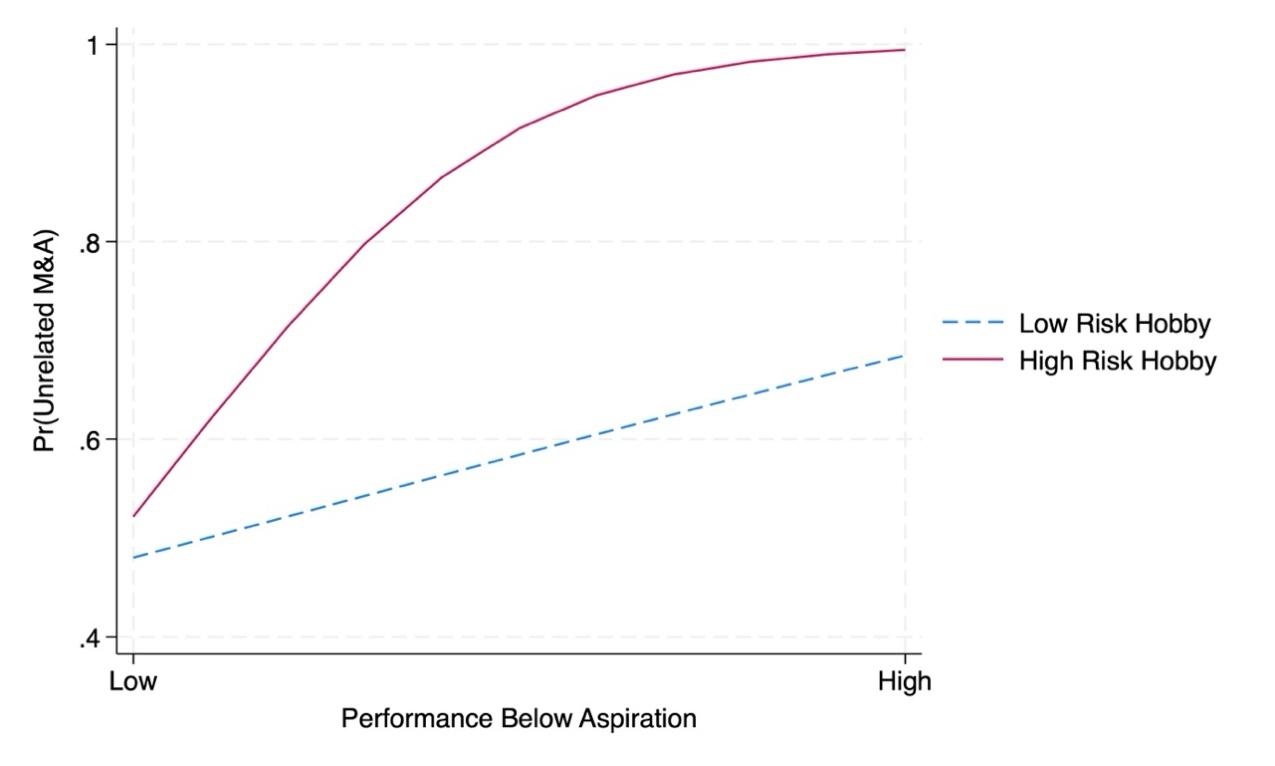
However, at extreme levels of underperformance, the slope of the high-risk hobby line appears to flatten slightly, indicating a diminishing marginal effect of performance decline on risk-taking. This pattern suggests that when performance deteriorates beyond a critical loss threshold, decision-makers may begin to prioritize organizational stability and survival over further risk-taking, thereby weakening the previously strong risk-seeking tendency (Shimizu, 2007).
Ⅴ. Conclusion
This study examines how firms’ prior performance relative to their industry peers affects the likelihood of pursuing unrelated M&A, and how this relationship is moderated by CEOs’ personal risk-taking tendencies as reflected in their leisure activities. Grounded in prospect theory and strategic leadership research, our results indicate that firms falling below their performance aspirations have a higher propensity to pursue unrelated diversification, and this likelihood further increases when the CEO engages in high-risk leisure activities. This research makes four key contributions to the literature. First, it extends prospect theory to the organizational domain by demonstrating that firms, much like individuals, evaluate outcomes relative to aspiration levels and exhibit risk-seeking behavior when operating in the loss domain (Kahneman and Tversky, 1979; Greve, 1998). Although previous studies have separately shown that underperforming firms tend to diversify and that risk-oriented CEOs are more inclined to make bold strategic moves, this study integrates these perspectives to show that strategic risk-taking arises from the interaction between firm-level performance feedback and CEO-level behavioral traits.
Second, this study introduces an observable behavioral measure of CEO risk orientation using information about their leisure activities. Building on Stebbins (2017) and Song et al. (2021), this measure goes beyond demographic or self-reported psychological proxies by capturing voluntarily chosen, publicly documented behaviors as valid indicators of risk tolerance. This methodological contribution enriches the micro foundations of strategic management by empirically linking executive psychology with corporate strategy formation.
Third, this study advances prior research on CEO hobbies and corporate risk-taking by distinguishing between related and unrelated M&A. Prior work, such as Cain and Mc Keon (2016), established that CEOs who engage in risky leisure activities tend to lead firms toward higher overall corporate risk, including more frequent M&A or greater leverage. However, no prior research has examined how such behavioral tendencies affect the type of M&A pursued. By focusing specifically on unrelated diversification a strategic decision characterized by entry into unfamiliar industries with high uncertainty—this study demonstrates that CEOs with risk-oriented hobbies are particularly inclined toward bolder, scope-expanding acquisitions rather than incremental or related ones. This distinction reveals that risk-seeking CEOs differ not only in the degree of risk they assume but also in the form of strategic risk they prefer, thereby deepening our understanding of how personal behavioral traits shape specific patterns of organizational decision-making.
Fourth, the findings highlight a multi-level perspective on strategic risk-taking, showing that organizational outcomes are shaped by the interplay between firm-level performance pressures and individual-level behavioral dispositions. This perspective reinforces the view that corporate strategy emerges not only from structural or financial determinants but also from the psychological imprints of the leaders who interpret and respond to performance feedback.
From a practical standpoint, these findings offer useful insights for boards, investors, and executive search professionals. Boards should recognize that CEOs’ non-work behaviors can serve as early, observable indicators of their risk preferences and may influence strategic choices under performance pressure. Investors and analysts might also incorporate such behavioral cues when evaluating a firm’s strategic risk appetite. Furthermore, leadership selection and development processes should consider the alignment between a CEO’s behavioral tendencies and the firm’s strategic needs risk-tolerant leaders may be better suited for turnaround or high-growth contexts, whereas risk-averse leaders may be more appropriate for firms emphasizing stability and long-term control.
Limitations and Future Research
Despite its contributions, this study has several limitations that suggest directions for future research. First, the hobby-based measure captures only one dimension of CEOs’ psychological traits. Future work could combine this proxy with linguistic, psychometric, or experimental measures for greater validity. Second, the analysis focuses on large, publicly traded U.S. firms; expanding the scope to smaller firms, private enterprises, or firms in different institutional contexts could test the generalizability of the findings. Third, while this study focuses on unrelated M&A as a key form of strategic risk-taking, subsequent research could examine alternative responses to performance shortfalls such as innovation, divestiture, or restructuring—to build a more comprehensive understanding of behavioral strategy under loss conditions.
Fourth, this study conceptualizes unrelated diversification as a risky strategic choice. However, this interpretation may depend on how risk is defined and operationalized. Although entry into unrelated industries generally entails high uncertainty, not all unrelated M&A transactions necessarily involve the same level of risk. When deal size is relatively small, such acquisitions may entail limited financial exposure and downside risk. Following Sitkin and Pablo (1992), who define risk as the uncertainty associated with potentially significant or disappointing outcomes, small-scale unrelated acquisitions may be perceived as less risky despite their lack of relatedness. Accordingly, the extent to which unrelated M&A uniformly represents a risky strategic choice remains an open question. In addition, deal size was not explicitly controlled for in the empirical analysis, which may limit the precision of the risk interpretation. Future research could address this limitation by incorporating deal size or relative transaction magnitude to better capture heterogeneity in strategic risk.
Fifth, this study relies on SIC code–based industry classifications to measure M&A relatedness, which entails well-known limitations. Industry classifications may fail to capture meaningful strategic or technological relatedness, particularly when firms operate in adjacent segments of the same value chain but are assigned to different industry codes. Future research could extend this study by adopting more fine-grained measures of relatedness, such as patent-based technological proximity (Bena and Li, 2014), input–output–based vertical relatedness across industries (Fan and Lang, 2006), or textbased product market similarity derived from firm disclosures (Hoberg and Phillips, 2010). Such approaches would allow for a more nuanced assessment of diversification strategies and further strengthen the behavioral interpretation of strategic risk-taking.
In sum, this study shows that strategic diversification particularly into unrelated industries is shaped not only by firm performance relative to aspirations but also by the behavioral dispositions of top executives. By incorporating psychological dimensions into the study of corporate strategy, this work advances the growing scholarship that bridges behavioral strategy and diversification research, providing a more refined view of how organizational and CEO-level factors together shape strategic risk-taking.
저자 약력
∙ The author, Juyon Oh, is currently working at the Korea Association for AI&ICT Promotion (KAIT). She received her bachelor’s degree in business administration from Korea National University of Transportation and her master’s degree in Strategy from Korea University Business School.
∙ This author Dae-Il Nam is a professor at the Korea University Business School. He teaches Management Strategy and Entrepreneurship. He was the inaugural director of the Seung Myung Ho Center for Entrepreneurship Education. His research interests include business models, startups, IPOs, and innovation in large organizations. He has written several books including 101 Business Model Stories. He also received the Maeil Business Economist Award and the Humax Emerging Scholar Award.