
.jpeg)
Factors Influencing Purchase Intention of Products Created by Influencers: Based on the Trust Transfer Theory*
1 경북대학교, 경영학부 (Kyungpook National University, School of Business Administration)
2 서울대학교, 경영대학 (Seoul National University, College of Business Administration)
3 경북대학교, 경영대학/문화산업연구소 (Kyungpook National University, School of Business Administration/Research Institute of Creative & Cultural Industries)
교신저자: 이새롬 (saeromlee@knu.ac.kr)
DOI: https://doi.org/10.17287/kmr.2026.55.3.1361
Abstract
With the rapid expansion of social media-based commerce, influencer-created product development and active follower involvement in the creation process have emerged as significant phenomena. This research investigates how social media influencers establish trust by transparently disclosing the product creation journey to their followers. Drawing on trust transfer theory, this study examines the mechanism through which trust developed during the creation process transitions into trust toward the final product. Additionally, utilizing the elaboration likelihood model, this research explores how the disclosure of co-creation activities influences consumers’ purchase intentions. Product-related factors are analyzed through the central route, while influencer-specific characteristics are examined through the peripheral route. The findings reveal that value co-creation in product development significantly enhances trust in the product creation process, and psychological distance to the influencer played a critical role in shaping trust toward the influencer. Notably, while trust in the product creation process and the product itself significantly affected purchase intention, trust in influencer did not exert a direct impact. These results provide both theoretical and practical insights into the underlying mechanisms of consumer decision-making within influencer-driven social commerce.
Ⅰ. Introduction
Technological advancements in online commerce have diversified the value chain, extending from product development to sales and consumption (Esmaeili and Hashemi, 2019). Among these, social commerce, which involves selling through social media platforms, has become a prominent form (Sardar et al., 2024). In 2022, global social commerce revenue reached approximately $728 billion, with a projected CAGR of 31.6% from 2023 to 2030 (Statista, 2023). This rapid growth has elevated the role of influencers, who are no longer just product promoters but active participants in product creation and direct sales (Wang et al., 2015; Zhang et al., 2015). This expansion of the influencer's role is further supported by recent empirical evidence demonstrating that influencer marketing generates significantly larger sales effects compared to traditional TV and online advertising (Kim et al., 2026).
The concept of co-creation, where producers and consumers collaboratively develop products online, has received increasing attention (Füller et al., 2008). In influencer commerce, this involves influencers transparently sharing their product creation process with followers and integrating feedback. However, limited research has examined how such transparency and influencer characteristics influence consumer trust and purchase behavior. Most prior studies have focused on trust in platforms or established brands, overlooking influencer-created products, which often lack institutional trust. Recent meta-analytic evidence further supports this shift, revealing that in the evolving social commerce landscape, post characteristics such as informational and hedonic value have become more decisive drivers of purchase intention than traditional reach metrics (Pan et al., 2025). This suggests that the transparency of the product creation process acts as a high-value informational cue that satisfies modern consumers' demand for substance over mere promotion. To address this gap, this study applies trust transfer theory and the Elaboration Likelihood Model (ELM) to explore how influencers can impact purchase intentions by openly sharing the product creation process.
Trust is a key enabler of online commerce (Gefen, 2000). Yet influencers, unlike brands, must build trust from scratch (Jarvenpaa et al., 2000). Direct communication and behind-the-scenes product disclosures are emerging strategies to establish trust and boost purchase intention (Kim and Kim, 2021). According to trust transfer theory, trust can be transferred from a known, related source (e.g., the creation process) to a less familiar target (e.g., the product) (Lin, 2011; Stewart, 2003). This study investigates how such trust transfers occur when influencers are not initially perceived as credible producers.
The ELM framework explains that individuals process persuasive information through two routes: the central route, involving deliberate assessment of product-related information, and the peripheral route, which relies on heuristics like influencer appeal or perceived credibility (Cyr et al., 2018). In this context, product creation transparency is considered a central route cue, while influencer characteristics represent peripheral cues. The importance of these routes is amplified by the fact that influencer authenticity is now viewed as a collaborative assemblage between influencers and brands, where resolving perceptual misalignments through transparent communication is key to maintaining trust (Duffek et al., 2025). Moreover, influencers are increasingly employing strategic authenticity through the deliberate disclosure of the production journey to foster deeper engagement and bridge the psychological distance with followers (Zhu and Wang, 2025). By examining process transparency as a central cue, this study aligns with these contemporary findings on how strategic disclosure shapes consumer evaluations.
This study examines how both routes influence trust and, subsequently, purchase intentions. The research question guiding this study is: What factors influence consumer purchase decisions for influencer-created products, and through which mechanisms is trust in these products established? Influencer commerce, similar to small businesses or solo entrepreneurs, often lacks brand familiarity. Thus, consumers may rely on alternative signals such as co-creation disclosure to form judgments through central processing routes. Unlike traditional endorsement contexts where influencers promote third-party brands, influencer-created products require consumers to evaluate the product itself as an outcome of the influencer’s production effort. This structural difference may alter the pathway through which trust affects purchase intention. Therefore, the absence of a direct effect of trust in influencer on purchase intention should be understood as a contextual boundary condition inherent to influencer-created product environments, rather than as a contradiction of prior influencer endorsement findings. This study posits that trust can be cultivated through repeated interaction and authentic storytelling, even in the absence of brand equity (Sohn and Kim, 2020).
To validate the proposed model and hypotheses, data were analyzed using SPSS 25.0 and SmartPLS 4.0, employing structural equation modeling (SEM) via partial least squares (PLS). This approach will help clarify the mechanisms of trust formation and its impact on purchase decision-making in influencer-driven social commerce.
Ⅱ. Literature Review
2.1 Influencer on Social Media
Social media influencers are defined as users who, through social media platforms, exert significant influence over their followers’ decisions. They are typically individuals with a stable and substantial follower base (Wang and Huang, 2023). Enke and Borchers (2019) describe influencers as “third-party actors who have built a significant number of relevant relationships with organizational stakeholders through content creation, distribution, interaction, and presenting a personal image on social media that exerts specific qualities and influence” (p. 267). Much of the prior research on online commerce has examined influencers from a marketing standpoint. Influencers often earn income by endorsing products, services, brands, or opinions in exchange for material or monetary compensation from advertisers (Campbell and Farrell, 2020). Marketers frequently employ influencers to engage in two-way communication with consumers, especially those skeptical of traditional one-way advertising (Conick, 2018).
More recently, influencers’ roles have expanded beyond brand promotion to include direct commercial activity, such as developing and selling their own products with the support of their followers. Research on this topic is emerging (Yasa and Cop, 2022). For example, Yasa and Cop (2022) examined how trust is built in Instagram stores run by influencers and how this trust affects purchase intention. On Instagram, users can promote their products directly via posts, and consumers can make purchases based on this content. Despite the considerable effort influencers invest in product creation, trust in these products remains relatively low and is comparable to that of individual sellers due to a lack of institutional trust afforded to established brands. As a result, consumers often seek more detailed information before purchasing from influencer-led brands.
Influencers are frequently idealized as aspirational workers within platform capitalism, characterized by unpaid labor and a meritocratic narrative (Annabell, 2025). Their commercial activities are often framed as passion projects, not purely profit-driven ventures, and are legitimized under the idea of “monetizing for the right reasons” (Annabell, 2025). To establish and maintain consumer trust, influencers perform affective labor, forming emotional bonds through personal storytelling (Cuevas et al., 2024). Some deliberately obscure sponsorship disclosures to avoid appearing inauthentic and to preserve audience trust (Musiyiwa and Jacobson, 2023). Despite the growing prevalence of influencer-created products, few studies have explored why consumers purchase from influencers operating social commerce brands (Wang and Huang, 2023).
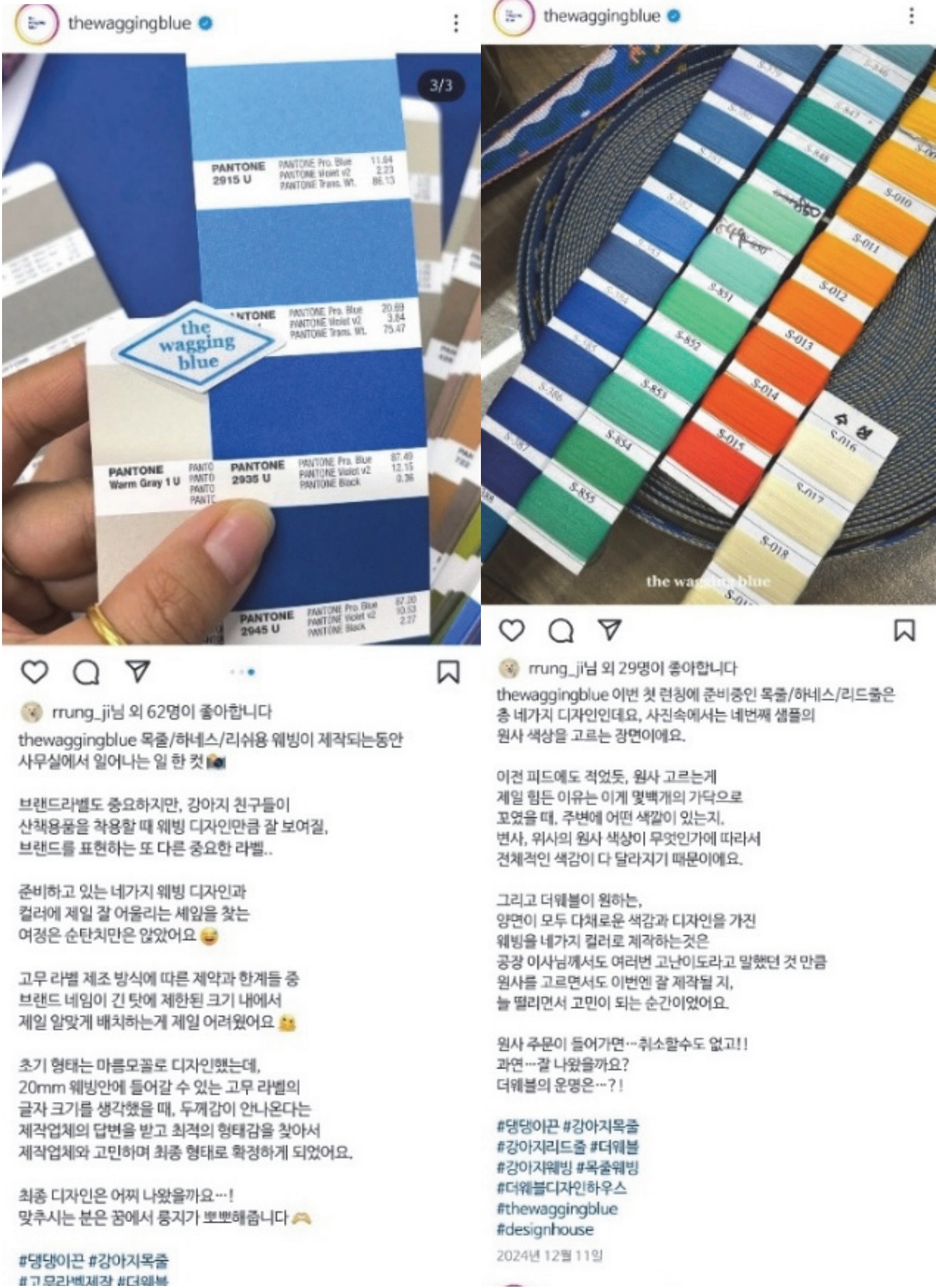
Figures 1-a and Figure 1-b present excerpts from posts by the Instagram account @thewaggingblue, which provides a detailed account of the product creation process through videos, photos, and accompanying text. These posts allow consumers to understand how decisions regarding the color and pattern of the dog leash were made, and offer insight into the creator’s intentions, the extent of their deliberation, and the discussions held with business partners during the development process.

Source: screenshots captured from publicly available Instagram content.
2.2 Trust Transfer Theory
Due to the high levels of uncertainty and dynamism in online environments, trust has been widely recognized as a critical factor influencing consumers’ purchase intention (Gefen and Straub, 2003; Lin, 2011). Given the multidimensional nature of trust, it has been defined in various ways. For example, Barney and Hansen (1994) conceptualized trust as mutual confidence that neither party will exploit the other. In online commerce, where consumers cannot physically inspect products before purchase, concerns arise about the credibility of information or product quality (Mc Knight et al., 2002). In this context, trust helps reduce perceived risk and fosters favorable attitudes toward purchasing (Ladhari and Michaud, 2015; Mayer et al., 1995; Mc Knight et al., 2002).
This study examines how influencers, who generally lack the institutional trust held by established brands, can serve as credible sellers. We investigate whether influencers can build trust through transparent disclosure of the product creation process, thereby encouraging purchase intentions. To explain this mechanism, we draw on trust transfer theory, which posits that trust in a familiar entity can be transferred to a related, unfamiliar one (Lin, 2011; Stewart, 2003). This theory has been applied in various digital contexts. For instance, trust in influencers transferring to brands they endorse (Reinikainen et al., 2020), or trust in social group members affecting trust in recommended apps (Cheng et al., 2019). Such transfer occurs when consumers perceive a clear association or similarity between two entities (Campbell, 1958). Influencer-created products often begin with low consumer trust due to a lack of brand recognition. To compensate, influencers frequently share behind-the-scenes content and updates on the product development process through social media (Moghadamzadeh et al., 2020). This transparent engagement allows consumers to observe production decisions and even participate in feedback loops, fostering a sense of co-creation.
Research has increasingly highlighted the impact of trust transfer in social media and digital commerce. For example, Chen et al. (2022) found that trust in live streamers leads to trust in promoted products, while Guo et al. (2021) demonstrated that interpersonal rapport (swift guanxi) mediates trust transfer in livestreaming commerce. These findings underscore that trust is not only critical to purchase intention but can also be cultivated and transferred through interaction, transparency, and social proximity.
In summary, while prior studies have examined the outcomes of consumer trust, relatively few have investigated the initial formation of trust, especially in the context of influencer-created products. This study addresses that gap by applying trust transfer theory and the ELM to explore how trust in influencer or in the product creation process translates into trust in the product itself and, ultimately, influences intention to purchase. In this study, trust in the product creation process refers to consumers’ confidence in the reliability, transparency, and integrity of the process through which the product is planned, developed, and produced by the influencer. This construct is conceptually distinct from trust in product, which concerns confidence in the final product as an outcome, and from brand trust, which concerns confidence in a brand as a broader market entity.
2.3 Elaboration Likelihood Model
Dual process theory suggests that individuals engage in either systematic or heuristic information processing depending on the perceived importance of a message (Chaiken, 1980). When accuracy and truthfulness are critical, individuals engage in systematic processing via the central route, emphasizing message reliability. In contrast, when the decision is perceived as less important, individuals rely on heuristic strategies, prioritizing cognitive efficiency over accuracy.
The ELM (Petty and Cacioppo, 1986) is a widely used dual process model that explains how individuals are persuaded. The model posits that the motivation and ability to process information determine whether the central route or peripheral route is utilized. The central route involves in-depth evaluation of message content, requiring cognitive effort and analytical thinking. Trust formed through this route is stable and resistant to change, as it stems from critical examination and prior knowledge. Conversely, the peripheral route depends on superficial cues such as the attractiveness or credibility of the message source, number of arguments, or emotional responses. Trust formed this way is quick but often temporary and less robust.
In social media commerce, consumers may apply different processing routes when evaluating influencer-created products, which are not associated with traditional brand cues. Research shows that influencer marketing introduces unique persuasion mechanisms. For instance, Farivar et al. (2023) identified originality, uniqueness, and informativeness as central route factors, and physical attractiveness and credibility as peripheral ones. Similarly, Chen et al. (2022), using ELM and trust transfer theory, distinguished between central cues (e.g., product quality, brand awareness) and peripheral cues (e.g., streamer expertise, viewer responses, value similarity) in live-streaming commerce. Their findings show that central route cues influence trust in the product, while peripheral cues shape trust in influencer.
Building on this, the current research applies ELM to examine how consumers process information when deciding whether to purchase products created by influencers. It distinguishes between product-related attributes processed through the central route and influencer-related cues processed via the peripheral route, providing a framework for understanding trust formation and purchase behavior in the context of social media commerce. In this study, product creation transparency is categorized under the central route because it provides substantive evidence regarding the product’s functional value, requiring consumers to engage in high-level cognitive elaboration (Pan et al., 2025). Conversely, influencer characteristics like value similarity and psychological distance are positioned as peripheral route factors. Although these constructs can involve identification processes, they function in this context as heuristic anchors or ‘source cues’ that allow consumers to reduce perceived risk and simplify their evaluations through strategic authenticity (Zhu and Wang, 2025). This integrated framework suggests that trust is not a single-track transfer but a multi-dimensional process where relational signals (peripheral) and substantive disclosures (central) converge to shape purchase intentions (Duffek et al., 2025).
Ⅲ. Research Hypotheses
Purchase intention refers to a consumer’s likelihood of buying a specific product and serves as a key predictor of actual purchasing behavior (De Magistris and Gracia, 2008). Numerous studies highlight trust as a crucial factor influencing this intention, as it reduces perceived risk and uncertainty, and fosters positive attitudes toward transactions (Morgan and Hunt, 1994; Mayer et al., 1995). Trust in the product is defined as the belief that the product will fulfill expectations and perform reliably (Pappas, 2016). In online commerce―especially in non-face-to-face settings―consumers often lack sufficient information, which can lead to a gap between expectations and actual product performance, increasing perceived risk (Pavlou, 2003). While trust does not reduce objective risk, it effectively lowers perceived risk, encouraging purchase behavior (Gefen, 2000). According to the ELM, trust in such contexts can form via the central route, where consumers critically assess detailed product attributes like originality, uniqueness, and informativeness (Petty and Cacioppo, 1986). These central cues play a key role in shaping purchase intention in influencer-driven commerce. Accordingly, the overarching hypothesis of this study is:
Hypothesis 1: Trust in product will have a positive effect on purchase intention.
Trust in the product creation process refers to the belief that a product is developed with transparency and reliability, meeting consumer expectations (Wang and Emurian, 2005). It involves confidence in ethical practices, quality control, and clear communication during production (Fisher, 2009). Transparency in these processes helps reduce uncertainty and fosters consumer trust (Pappas, 2016). In influencer commerce, transparency is often achieved through detailed sharing of the product development process on social media (Hwang and Zhang, 2018). By offering behind-the-scenes content and authentic storytelling, influencers demystify production, signal product quality, and strengthen consumer connections. This ongoing disclosure not only builds credibility but also increases consumer confidence in the product’s reliability. Therefore, trust in the product creation process is expected to positively influence purchase intention, by reducing perceived risk and reinforcing product quality perceptions. Thus, we propose the following hypothesis:
Hypothesis 2: Trust in the product creation process will have a positive effect on purchase intention.
Trust in influencer refers to the belief that the influencer is reliable, provides high-quality services, and does not exploit consumers (Lu et al., 2010). However, influencers who have built personal brands may face difficulties in establishing trust compared to well-known, established brands. Previous research indicates that startups that are not well-known to consumers struggle to build trust due to the lack of prior consumer experiences (Konya-Baumbach et al., 2019). Consequently, influencers strive to secure trust by offering experiences to consumers through social media. Consumers utilize all available information to form initial trust in unfamiliar brands (Mc Knight et al., 2002; Schlosser et al., 2006). The experiences provided by influencers can play a crucial role in this trust-building process. For instance, by sharing authentic and engaging content, influencers can offer transparency and foster a sense of reliability and integrity. This approach helps consumers feel more connected and assured about the influencer's recommendations and endorsements. Trust in influencer can reduce perceived risks associated with online purchases, enhance the perceived value of the products endorsed by the influencer, and ultimately lead to higher purchase intention (Kim et al., 2008). Therefore, this study proposes the following hypothesis:
Hypothesis 3: Trust in influencer will have a positive effect on purchase intention.
Trust transfer theory suggests that trust in a familiar person or object can be transferred to a related but unfamiliar entity (Stewart, 2003). Prior studies have shown that trust in social media influencers can transfer to the brands or products they promote (Cheng et al., 2019; Reinikainen et al., 2020). In influencer commerce, where products often lack brand recognition, influencers attempt to build trust by transparently sharing the product creation process. Through social media, consumers can observe and participate in co-creation activities, gaining insight into how the product is made (Moghadamzadeh et al., 2020). This transparency—similar to public disclosure practices by ethical companies or open-kitchen restaurants—enhances perceived credibility (Energy Economy News, 2022; Maeil Business Newspaper, 2019). By revealing behind-the-scenes processes and offering real-time interaction, influencers reduce uncertainty and foster trust. Accordingly, it is expected that trust in the product creation process can be transferred to trust in the product itself. Therefore, the following hypothesis is proposed:
Hypothesis 4: Trust in the product creation process will have a positive effect on trust in the product.
Prior studies suggest that trust in influencers may influence consumers’ trust in the products they endorse, particularly in social commerce contexts (Chen et al., 2022; Park and Lin, 2020). For example, Park and Lin (2020) found that consumers’ favorable attitudes toward influencers were associated with more positive evaluations of their endorsed products. Similarly, Chen et al. (2022) drew on trust transfer theory to examine how trust in streamers during live streaming can shape trust in the promoted products. Influencers often build trust through consistent interaction with followers, including personal content that goes beyond sales promotion. Such interactions foster parasocial relationships and enhance perceived authenticity, which can serve as heuristics when evaluating associated products. Prior research also indicates that trust in celebrities or influencers can affect not only purchase intention but also consumer perceptions of endorsed brands (Chung and Cho, 2017; Gong and Li, 2017). Therefore, we propose the following hypothesis:
Hypothesis 5: Trust in influencer will have a positive effect on trust in the product.
Value co-creation is defined as the enactment of interactional creation across interactive system-environments, where stakeholders collaboratively shape outcomes through mutual engagement and resource integration (Ramaswamy and Ozcan, 2018). This process repositions consumers from passive recipients to active participants in value formation. In digital product development contexts, such co-creation often involves consumers providing feedback, contributing suggestions, and participating in idea generation to improve product outcomes (Hoyer et al., 2010). Unlike traditional branding, which builds trust through symbolic associations or perceived image, value co-creation allows consumers to directly engage in the production of value. This hands-on participation offers diagnostic cues about the trust and transparency of the process, enabling consumers to judge how responsive and fair the development process is, rather than relying on peripheral impressions. This active involvement increases the personal relevance of the product creation process for consumers, which in turn influences how they cognitively process related information. According to the ELM, when individuals perceive an issue or process as important, they are more likely to engage in central-route information processing, carefully attending to and evaluating substantive cues (Petty and Cacioppo, 1990). The ELM further posits that evaluations formed via the central route are more enduring, stable, and resistant to change (Reinhard and Sporer, 2010). Therefore, when consumers participate in the product creation process through value co-creation, they are more likely to process that experience via the central route, leading to stronger and more resilient trust in the product creation process based on critical and informed judgment rather than superficial cues. Therefore, the following hypothesis is advanced:
Hypothesis 6: Value co-creation will have a positive effect on trust in the product creation process.
Consumer expertise refers to an individual’s accumulated knowledge and experience regarding product attributes and available alternatives (Sheth et al., 1999). Highly knowledgeable consumers can better comprehend complex product information and evaluate its relevance and quality (Alba and Hutchinson, 1987). They are more likely to focus on diagnostic cues and engage with substantive information (Bettman and Park, 1980), whereas less experienced consumers often rely on surface-level heuristics like brand image or influencer popularity. In digital commerce environments—especially those involving transparent co-creation—expert consumers are more inclined to assess the product creation process based on content quality rather than external cues. According to the ELM, individuals with greater ability and motivation process information via the central route, leading to more stable and strongly held judgments (Eagly and Chaiken, 1993; Petty and Cacioppo, 1990). Thus, consumers with higher expertise are likely to evaluate the creation process critically, forming trust based on substantive reasoning. In contrast, low-expertise consumers may rely on peripheral cues, resulting in weaker or less consistent trust. Therefore, we propose the following hypothesis:
Hypothesis 7: Consumer expertise in the product creation process will have a positive effect on trust in the product creation process.
Perceived consumer response to influencers indicates that other members agree with or endorse the information provided by the influencer. In social media contexts, such responses can be observed through positive comments, likes, and the influencer’s follower count (Cheng et al., 2019). These social cues serve as heuristic information that consumers use to evaluate the credibility of both the influencer and their content (Walther et al., 2009). According to the ELM, cues such as “likes” and positive comments are processed primarily through the peripheral route, functioning as superficial indicators that shape perceptions of the influencer’s likability and credibility. User responses processed via this route (e.g., favorable comments or high engagement) can enhance the perceived trustworthiness of the source (Hsu et al., 2014; Lim et al., 2006). For instance, Chen et al. (2022) found that in live-streaming contexts, other consumers’ responses play a significant role in trust formation for the promoted product via the peripheral route. Accordingly, when consumers observe positive responses from others, they are more likely to perceive the influencer as trustworthy. Therefore, we propose the following hypothesis:
Hypothesis 8: Positive perceived consumer response will have a positive effect on trust in influencer.
Value similarity refers to the perception that two parties share similar goals, beliefs, or lifestyles (Morgan and Hunt, 1994). This perceived alignment acts as a heuristic cue that enhances message credibility and trust (Metzger et al., 2003). Prior research shows that attitudinal similarity between message sender and receiver increases trust more than demographic similarity (Metzger et al., 2003). In influencer marketing, influencers often present lifestyles and attitudes that mirror those of their followers, fostering social identification and closeness (Naderer et al., 2021). Based on social cognitive theory, people are more receptive to messages from those they perceive as similar (Bandura, 1994), and are more likely to trust and follow recommendations aligned with their values (Doney and Cannon, 1997). Therefore, we propose the following hypothesis:
Hypothesis 9: Value similarity will have a positive effect on trust in influencer.
Psychological distance refers to an individual’s perceived gap from an object, event, or person across temporal, spatial, social, or hypothetical dimensions (Trope and Liberman, 2010). According to construal level theory, low psychological distance leads to more concrete information processing, while high distance induces abstract thinking (Liberman and Trope, 2008). In social contexts, reduced distance enhances interpersonal relevance and connection (Andersen et al., 1998), which fosters familiarity and trust in consumer–brand relationships (Edwards et al., 2009). Consumers tend to trust sources perceived as socially close, especially when repeated interactions build intimacy (Swift, 1999). For example, Darke et al. (2016) showed that personal identity cues reduce psychological distance and boost trust online. In influencer marketing, frequent, informal interactions decrease perceived distance, increasing trust in influencer messages.
Hypothesis 10: Decreased psychological distance will have a positive effect on trust in influencer.
Ⅳ. Data and Variables
4.1 Data Sources and Sample Selection
A pilot survey was conducted from March 11 to 17, 2023, targeting individuals with experience in product co-creation. Of the 37 responses received, 30 valid cases were analyzed after excluding 7 invalid ones. Based on the pilot results and feedback from three experts, the questionnaire was revised for clarity and relevance. The main survey was then administered via a professional survey firm from May 1 to 7, 2023. After excluding unreliable responses, 183 out of 200 were used for final analysis.
4.2 Variables
This study used validated measurement items adapted from prior literature. Purchase intention was measured based on Lee and Kozar (2009) and Zhang et al. (2011), while trust in the product and trust in influencer were adapted from Gefen and Straub (2003). Trust in the product creation process was newly developed by the authors to reflect the study’s context. Value co-creation and consumer expertise were measured using items from Cheung et al. (2021) and Fang et al. (2014), respectively. Items for perceived consumer response and value similarity were adapted from Liang et al. (2019), and psychological distance from Xue et al. (2020). All items were modified as needed to fit the context and measured on a 7-point Likert scale (1 = “strongly disagree” to 7 = “strongly agree”). To ensure semantic equivalence, the survey was translated into Korean and back-translated into English. Control variables—gender, age, income, past transaction experience, co-creation participation, and social media usage time—were included to account for potential confounding effects, based on prior studies (Pavlou and Fygenson, 2006; Ranganathan and Jha, 2007).
Ⅴ. Empirical Results and Analysis
5.1 Results of Measurement Model Analysis
Data from 183 respondents were analyzed using SPSS 25.0 and SmartPLS 4.0. Table 1 presents the demographic characteristics of the respondents. Frequency analysis was conducted in SPSS to summarize sample characteristics. To test the research model, a two-step PLS-SEM approach was applied, including measurement and structural model analysis. Confirmatory factor analysis, correlation analysis, and partial least squares path modeling were used to assess reliability and validity. Structural equation modeling was performed using SmartPLS 4.0, which is appropriate for small sample sizes.
Table 1 Characteristics of survey respondents.
| Category | Frequency (People) | Percentage (%) | |
|---|---|---|---|
| Gender | Male | 85 | 46.4 |
| Female | 98 | 53.6 | |
| Age Group | 20s | 30 | 16.4 |
| 30s | 73 | 39.9 | |
| 40s | 49 | 26.8 | |
| 50s | 31 | 16.9 | |
| Education Level | High School Graduate | 12 | 6.6 |
| College Graduate | 22 | 12.0 | |
| University Graduate | 135 | 73.8 | |
| Graduate School Graduate | 14 | 7.7 | |
| Monthly Income | Less than 2 million KRW | 23 | 12.6 |
| 2–3 million KRW | 39 | 21.3 | |
| 3–4 million KRW | 47 | 25.7 | |
| 4–5 million KRW | 33 | 18.0 | |
| Over 5 million KRW | 41 | 22.4 | |
| Social Media Usage Time | Less than 1 hour | 42 | 23.0 |
| 1–2 hours | 74 | 40.4 | |
| 2–3 hours | 48 | 26.2 | |
| More than 3 hours | 19 | 10.4 | |
| Product Creation Participation Frequency | 1 time | 31 | 16.9 |
| 2–3 times | 102 | 55.7 | |
| 4 times | 32 | 17.5 | |
| More than 5 times | 18 | 9.8 | |
| Product Purchase Frequency | 1 time | 18 | 9.8 |
| 2–3 times | 86 | 47.0 | |
| 4 times | 43 | 23.5 | |
| More than 5 times | 36 | 19.7 | |
This study evaluated the reliability and validity of the measurement items in the measurement model to verify the convergent validity based on PLS-SEM. The evaluation included factor loading of observed variables, Cronbach's alpha (α), composite reliability (CR), and average variance extracted (AVE). The measurement model follows the following criteria: factor loading, representing the correlation between latent variables and observed variables, should be above 0.5 (Bagozzi and Yi, 1988); Cronbach's alpha value is recommended to be above 0.7 (Hair et al., 2017); CR should exceed 0.7 (Chin, 1998); and AVE should be above 0.5, indicating that latent constructs explain more than half of the variance of the items (Fornell and Larcker, 1981). As presented in Table 2, all items meet the criteria. Thus, the measurement items used in this study satisfy each criterion, ensuring convergent validity. Furthermore, to ensure that the correlations among independent variables do not adversely affect the data analysis, the variance inflation factor (VIF) was checked to see if it exceeds the threshold. The results indicate that all VIF values are below five, suggesting that multicollinearity is not a significant concern.
Table 2 Reliability and Validity Test
| Factors | Factor loading | Mean | Cronbach’s α | CR | AVE | VIF | |
|---|---|---|---|---|---|---|---|
| Purchase Intention | PI1 | .776 | 5.142 | .732 | .734 | .651 | 1.351 |
| PI2 | .822 | 5.213 | 1.478 | ||||
| PI3 | .821 | 4.803 | 1.590 | ||||
| Trust in Product | TP1 | .895 | 5.077 | .879 | .880 | .805 | 2.297 |
| TP2 | .891 | 5.109 | 2.403 | ||||
| TP3 | .904 | 5.011 | 2.592 | ||||
| Trust in the Product Creation Process | TPC1 | .861 | 5.011 | .845 | .847 | .763 | 1.993 |
| TPC2 | .874 | 4.918 | 1.930 | ||||
| TPC3 | .885 | 5.077 | 2.199 | ||||
| Trust in Influencer | TI1 | .905 | 5.087 | .883 | .884 | .811 | 2.579 |
| TI2 | .911 | 5.011 | 2.776 | ||||
| TI3 | .885 | 5.137 | 2.251 | ||||
| Value Co-creation | VCC1 | .863 | 4.514 | .806 | .812 | .720 | 2.010 |
| VCC2 | .845 | 4.322 | 1.954 | ||||
| VCC3 | .837 | 4.874 | 1.523 | ||||
| Consumer Expertise | EXP1 | .855 | 4.306 | .890 | .896 | .751 | 2.104 |
| EXP2 | .850 | 4.208 | 2.358 | ||||
| EXP3 | .893 | 3.661 | 2.835 | ||||
| EXP4 | .867 | 4.311 | 2.510 | ||||
| Perceived consumer response | PCR1 | .835 | 5.011 | .799 | .805 | .712 | 1.641 |
| PCR2 | .866 | 5.208 | 1.758 | ||||
| PCR3 | .830 | 5.126 | 1.729 | ||||
| Value Similarity | VS1 | .890 | 4.781 | .806 | .828 | .719 | 1.918 |
| VS2 | .855 | 4.967 | 1.777 | ||||
| VS3 | .798 | 4.459 | 1.625 | ||||
| Psychological Distance | PD1 | .899 | 4.913 | .875 | .876 | .800 | 2.395 |
| PD2 | .896 | 5.077 | 2.346 | ||||
| PD3 | .888 | 4.907 | 2.347 | ||||
Next, discriminant validity was evaluated. As shown in Table 3, the square root of the average variance extracted for each variable exceeds the correlation coefficients with all other variables, satisfying the Fornell-Larcker criterion. Additionally, discriminant validity was verified using the heterotrait-monotrait ratio (HTMT) (Ringle et al., 2023). Discriminant validity is achieved when the confidence interval for the estimated HTMT ratio does not contain a value of 1. In the present study, the intervals for the pairs of TP–PI, TPC–PI, and TP–TPC contained 1.00, indicating that discriminant validity was only partially established. This limitation is addressed through further empirical checks provided in the Appendix.
Table 3 Discriminant Validity of Constructs
| PI | TP | TPC | TI | VCC | EXP | PCR | VS | PD | |
|---|---|---|---|---|---|---|---|---|---|
| PI | .807 | ||||||||
| TP | .787 | .897 | |||||||
| TPC | .750 | .830 | .873 | ||||||
| TI | .706 | .814 | .817 | .900 | |||||
| VCC | .608 | .635 | .643 | .611 | .848 | ||||
| EXP | .426 | .418 | .467 | .416 | .675 | .866 | |||
| PCR | .699 | .686 | .569 | .547 | .551 | .409 | .844 | ||
| VS | .534 | .499 | .597 | .593 | .557 | .630 | .505 | .848 | |
| PD | .623 | .622 | .621 | .651 | .648 | .563 | .566 | .573 | .894 |
Note: The square roots of AVEs are in boldface.
Legends: PI=Purchase Intention, TP=Trust in Product, TPC=Trust in Product Creation Process, TI=Trust in Influencer, VCC=Value Co-creation, EXP=Consumer Expertise, PCR=Perceived Consumer Response, VS=Value Similarity, PD=Psychological Distance
Supplementary robustness checks indicate that discriminant validity among the trust-related constructs is partial rather than complete. As shown in Appendix Table A1, recalculated HTMT values for the TP–PI (.979), TPC–PI (.970), and TP–TPC (.960) pairs included 1.00 within their 95% bootstrap confidence intervals. Although an indicator-level analysis confirms that each item correlates most strongly with its intended composite (Table A2), the high cross-correlations support the interpretation of partial empirical separation. To ensure these overlaps do not bias the findings, a collapsed-composite model was tested (Table A3). The results demonstrate that the core substantive interpretation, specifically the strong positive effect of product-focused trust on purchase intention (β = .730, p < .001), remains robust even when TP and TPC are treated as a single composite. Accordingly, we retain the theoretical distinction while explicitly acknowledging only partial empirical separability and interpreting the related structural paths with caution.
5.2 Results of Structural Model Analysis
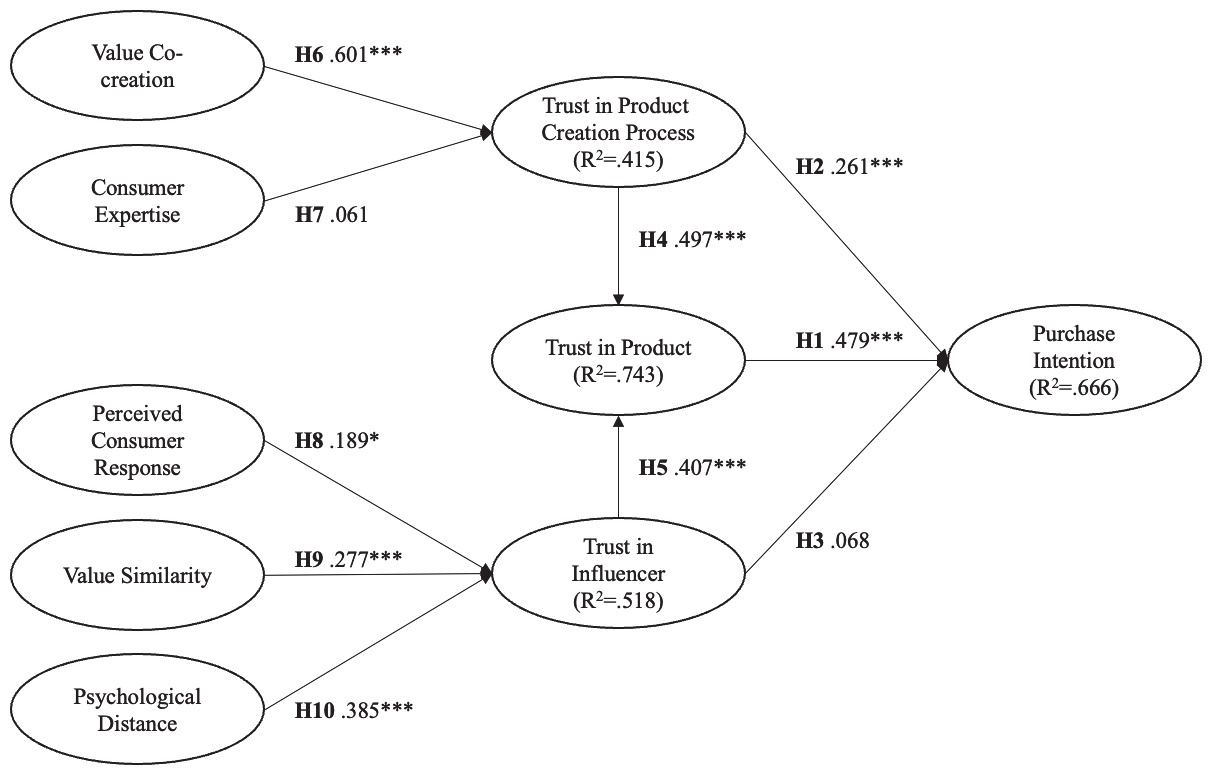
PLS-SEM was employed for hypothesis testing following the assessment of the measurement model's reliability and validity. The hypotheses were tested using the bootstrapping method (5,000 subsamples) in SmartPLS 4.0 to evaluate the statistical significance and magnitude of path coefficients within the structural model. The results of the structural model analysis are depicted in Figure 2.
Note: *p < .05, **p < .01, ***p < .001.
The analysis showed that trust in the product positively influenced purchase intention (β = .479, t = 3.895, p = .001), supporting H1. Similarly, trust in the product creation process also had a significant positive effect on purchase intention (β = .261, t = 3.256, p = .001), supporting H2. However, trust in influencer did not significantly impact purchase intention (β = .068, t = .590, p = .555), leading to the rejection of H3. To further explore this unexpected finding regarding H3, we conducted post-hoc analyses focusing on the boundary conditions and indirect mechanisms. First, a supplementary robustness check indicated that the direct role of influencer trust is contingent upon the consumer's psychological distance from the creator. The interaction between influencer trust and psychological distance was significant (β = -.105, p = .001). A subgroup analysis based on a median split of psychological distance revealed that the direct association was positive and significant only in the higher-distance group (β = .260, p = .047), while it was non-significant in the lower-distance group (β = -.053, p = .554). Second, bootstrapping results confirmed that influencer trust exerts a significant indirect effect on purchase intention through product trust (β = .195, t = 3.615, p = .000). These findings, detailed in Appendix Table A3, suggest that for the general audience, influencer trust is not translated directly into purchase intent but is first transferred to product-level trust. Regarding the formation of product trust, trust in the creation process significantly influenced trust in the product (β = .497, t = 4.777, p = .001), supporting H4, while trust in influencer also positively affected trust in the product (β = .407, t = 3.508, p = .001), supporting H5. Value co-creation had a strong positive effect on trust in the creation process (β = .601, t = 6.724, p = .001), confirming H6. In contrast, consumer expertise did not significantly influence trust in the production process (β = .061, t = .686, p = .493), leading to the rejection of H7.
To provide more empirical weight to the H7 finding, a supplementary moderation analysis was conducted. The results showed a significant negative interaction between trust in the creation process and consumer expertise on purchase intention (β = -.121, p = .005). As reported in Appendix Table A3, process-based trust has a significantly weaker behavioral impact for high-expertise consumers (β = .228) compared to low-expertise consumers (β = .470). This suggests that as expertise rises, process-based trust carries less behavioral weight. This does not necessarily contradict the ELM; rather, expert consumers may process process-related information carefully but judge it as less diagnostic, instead prioritizing alternative cues such as functional performance or ingredients.
Finally, concerning the antecedents of trust in influencer, perceived consumer response (β = .189, t = 2.005, p = .045), value similarity (β = .277, t = 4.066, p = .001), and psychological distance (β = .385, t = 4.333, p = .001) all had significant positive effects, supporting H8–H10. Mediation analysis further confirmed that trust in the product significantly mediated the effect of both trust in the creation process (β = .238, t = 2.475, p = .013) and trust in influencer (β = .195, t = 3.615, p < .01) on purchase intention (See Table 4).
Table 4 Results of the Mediating Test
| Path | $\beta$ | t-value | p-value | Results |
|---|---|---|---|---|
| Trust in Product Creation Process → Trust in Product → Purchase Intention | .238 | 2.475 | .013 | Supported |
| Influence Trust → Trust in Product → Purchase Intention | .195 | 3.615 | <.01 | Supported |
The analysis of control variables revealed that most factors did not significantly affect purchase intention, including gender (β = -.045, t = .499, p = .618), age (β = -.011, t = .232, p = .817), education level (β = .008, t = -.199, p = .842), monthly income (β = -.043, t = .777, p = .437), social media usage time (β = .024, t = .473, p = .636), participation frequency in product creation (β = .030, t = .581, p = .561). However, the frequency of purchasing co-created items was found to have a significant positive effect on purchase intention (β = .111, t = 2.034, p = .042). These results indicate that demographic factors and prior experiences with product creation or purchase do not significantly influence purchase intention. This supports previous findings that monthly income is not a decisive factor in purchase capability. Overall, consumers’ purchase intention appears to be shaped more by current perceptions than by past behavior or demographic characteristics.
VI. Conclusion and Implications
This study explored how trust is formed and transferred in influencer-driven commerce by applying the ELM and trust transfer theory. Trust was differentiated into three dimensions: trust in influencer, in the product creation process, and in the product. Results showed that trust in the product and trust in the product creation process significantly predicted purchase intention, whereas trust in influencer did not have a significant direct effect. Additional post-hoc analysis, however, showed that trust in influencer significantly influenced purchase intention indirectly through trust in the product, supporting the sequential logic of trust transfer theory. This finding indicates that, in influencer-created product contexts, trust in influencer is more likely to affect purchase intention through a mediated trust formation process rather than through a direct path. Unlike traditional endorsement settings in which influencers recommend third-party brands, influencer-created product contexts require consumers to evaluate the product as an outcome of the influencer’s own production effort.
Under this condition, trust in influencer alone may be insufficient to trigger purchase intention unless it is translated into trust in the product itself. This highlights a contextual boundary condition of influencer trust and extends trust transfer theory to creator-commerce environments. To address the potential conceptual overlap among the three dimensions of trust, this study maintains that although they are highly correlated due to their sequential nature in the influencer commerce journey, they remain distinct in their evaluative focus. Specifically, trust in influencer pertains to relational integrity, trust in the product creation process relates to procedural transparency, and trust in the product concerns functional outcome. While the integrated nature of influencer-led brands may lead to high inter-construct correlations, following the assemblage perspective (Duffek et al., 2025), we argue that consumers still perform discrete cognitive evaluations for each target.
Value co-creation, as a central-route cue, significantly enhanced trust in the product creation process, whereas consumer expertise had no significant impact. This suggests that although expertise increases consumers’ ability to process information, expert consumers may not regard creation-process disclosure itself as the most diagnostic basis for trust formation and may instead prioritize more concrete product-level cues, such as quality, performance, and detailed reviews. The lack of support for H7 suggests that consumer expertise does not automatically lead to higher trust in the product creation process. While the ELM posits that experts are more capable of central-route processing, our findings indicate that expertise may instead shift evaluative criteria toward intrinsic product attributes rather than procedural transparency cues. For highly expert consumers, the disclosure of the creation process might be perceived as a secondary or auxiliary signal, as they likely rely on their existing internal schemas and objective product specifications to form trust. This implies that expertise functions as a moderator of informational focus where experts prioritize 'what' the product is over 'how' it was made, rather than acting as a direct driver of trust formation in the production journey. While this specific mechanism was not directly tested in the current model, it provides a systematic alternative explanation for why the expected ELM path was not observed in this influencer-commerce context. Finally, trust in influencer was positively shaped by perceived consumer response, value similarity, and reduced psychological distance, reflecting prior findings on social proof, attitudinal alignment, and interpersonal closeness. These outcomes underscore the role of both central and peripheral cues in shaping trust-related outcomes in influencer commerce.
This study makes three key theoretical contributions. First, this study introduces trust in the product creation process (TPC) as a context-specific trust locus, extending the multi-dimensional perspective of trust beyond established brand signals (Chen et al., 2022). In creator-commerce settings where institutional brand equity is limited, TPC serves as a compensatory mechanism that substitutes for missing brand cues. While we position TPC as an emergent construct due to its empirical overlap with trust in product, our robustness checks confirm its distinct role in driving purchase intention. Consequently, this study provides a foundational basis for future research on procedural integrity in low-reputation environments (Duffek et al., 2025).
Second, this study extends the ELM by identifying product creation transparency as a substantive informational cue processed via the central route. While prior influencer marketing literature emphasizes peripheral cues such as attractiveness or popularity (Campbell and Farrell, 2020), our findings demonstrate that consumers engage in cognitive elaboration of functional value when brand familiarity is low (Pan et al., 2025). This confirms that trust in influencer commerce is a dual-process outcome where substantive disclosures and relational signals converge. Accordingly, by identifying transparency as a substantive cue, this study expands the academic discourse on influencer persuasion effects within complex social commerce landscapes (Zhang and Hur, 2025).
Third, this research expands trust transfer theory by demonstrating a multi-pathway mechanism of trust formation. Departing from traditional focus on transitions from platforms or firms (Cheng et al., 2019), this study shows that trust can transfer not only from an individual (influencer) but also from a process. These results are consistent with recent evidence in service management literature, which confirms the robustness of trust transfer as a cross-domain mechanism where trust established in a specific agent extends to associated entities (Choi and Choi, 2025). By identifying these mechanisms in the absence of brand equity, this study provides a starting point for incorporating process-based antecedents into trust transfer theory within decentralized commercial environments (Zhu and Wang, 2025).
Practically, influencers should emphasize transparency by disclosing product creation details and actively involving followers in co-creation through mechanisms like polls or feedback sessions. Such participatory storytelling strengthens trust, especially when brand familiarity is lacking. Marketers must also recognize that influencer trust does not automatically translate to product trust; instead, relational closeness and value alignment must be actively fostered. Platforms can support scalable trust-building by embedding interactive features that facilitate consumer involvement in co-creation.
This study has several limitations. It focused on Korean Instagram users, potentially limiting generalizability across cultures and platforms. Future research could explore cross-cultural effects or platform-specific dynamics (e.g., YouTube, Tik Tok). Also, product types were not distinguished; future studies should investigate how utilitarian vs. hedonic products moderate persuasion processes. Lastly, the use of self-reported measures may introduce bias; experimental or longitudinal designs are recommended to capture the evolution of trust over time. In addition, the HTMT results indicate that discriminant validity was only partially established for some construct pairs, which should be considered when interpreting the structural model. Further work could also explore mediators such as emotional resonance or perceived fairness to unpack the mechanisms of trust transfer more deeply and refine the measurement items to strengthen conceptual separation among related constructs. While our findings demonstrate significant structural associations, they represent a static snapshot of trust alignment at a single point in time rather than a captured longitudinal movement. Therefore, the term “transfer” in this study should be interpreted as a structural linkage derived from theoretical frameworks. Future research employing experimental designs is necessary to track the real-time evolution and causal direction of trust transfer more rigorously.
Appendix: Supplementary Empirical Checks
Table A1 Recalculated HTMT Inference for Key Overlapping Constructs
| Construct pair | HTMT | 95% bootstrap CI | Discriminant Validity? |
|---|---|---|---|
| Purchase Intention - Trust in Product | .979 | [.897, 1.085] | No |
| Purchase Intention - Trust in Product Creation Process | .970 | [.889, 1.076] | No |
| Trust in Product - Trust in Product Creation Process | .960 | [.903, 1.026] | No |
| Trust in Influencer - Trust in Product | .921 | [.830, .985] | Yes |
| Trust in Influencer - Trust in Product Creation Process | .895 | [.807, .958] | Yes |
Note. HTMT = Heterotrait-Monotrait Ratio. CI = Confidence Interval. Discriminant validity is established when the 95% bootstrap CI (based on 5,000 resamples) does not include 1.00.
Table A2 Indicator-level Item to Construct Correlations for Trust Measures
| Item | Intended construct | Corr. with TP | Corr. with TPC | Corr. with TI |
|---|---|---|---|---|
| TP1 | TP | .889 | .749 | .793 |
| TP2 | TP | .895 | .733 | .679 |
| TP3 | TP | .907 | .786 | .710 |
| TPC1 | TPC | .791 | .911 | .669 |
| TPC2 | TPC | .780 | .893 | .696 |
| TPC3 | TPC | .681 | .874 | .739 |
| TI1 | TI | .748 | .734 | .898 |
| TI2 | TI | .723 | .675 | .913 |
| TI3 | TI | .720 | .709 | .890 |
Note. Bold values indicate the highest correlation for each indicator across the constructs, confirming that each item relates most strongly to its intended composite. While individual indicators load correctly, high cross-construct correlations between TP and TPC justify the robustness checks in Table A3.
Table A3 Robustness Checks for H3, H7, and Collapsed Composites
| Analysis | β | p-value | Implication |
|---|---|---|---|
| Collapsed-composite robustness | |||
| (TP + TPC) → PI | .730 | <.001 | Core positive effect remains strong after collapsing TP and TPC |
| TI → PI | .059 | .458 | Direct TI effect remains non-significant |
| H3 Robustness (Moderated by PD) | |||
| TI × PD → PI | -.105 | .001 | Direct effect of TI is conditional upon PD |
| High PD group (n = 92), TI → PI | .260 | .047 | Direct positive association appears only when PD is high |
| Low PD group (n = 91), TI → PI | -.053 | .554 | Direct effect disappears when PD is low |
| H7 Robustness (Moderated by EXP) | |||
| TPC × EXP → PI | -.121 | .005 | TPC carries less behavioral weight as EXP rises |
| Simple slope at Low EXP (-1 SD) | .470 | - | Stronger behavioral relevance of TPC |
| Simple slope at High EXP (+1 SD) | .228 | - | Weaker behavioral relevance of TPC |
Note. PI = Purchase Intention; TP = Trust in Product; TPC = Trust in Product Creation Process; TI = Trust in Influencer; PD = Psychological Distance; EXP = Consumer Expertise. All coefficients in this table are standardized composite-score OLS estimates using the same control variables as the manuscript.
Author Biographies
∙ Hyerin Kim received her master’s degree in MIS from Kyungpook National University. Her research focuses on consumer behavior and service experiences in digital platforms, including social commerce, information credibility, and AI-based services. She has actively participated in various research projects and academic conferences. Her research interests include digital consumer behavior and platform business models.
∙ Suhan Woo is a Research Professor at the College of Business Administration, Seoul National University. He received his BS from Chungbuk National University and earned his PhD in MIS from Seoul National University. His research interests include Digital Business Strategy, Human-Computer Interaction, and Digital Inclusion & Divide.
∙ The author Saerom Lee has been with the School of Business Administration, Kyungpook National University, Daegu, Rep. of Korea, where she is now an assistant professor, since 2018. She received her BS degree from Pusan National University, in 2010, and her PhD degree in management information systems from Seoul National University, Seoul, in 2016. Her main research interests are open collaboration and cyber bullying behaviors.