
.jpeg)
Cognitive Biases, SCM Decision-Making Quality, and Logistics Performance: An Empirical Investigation
* 울산대학교, 경영경제융합학부 (University of Ulsan, School of Business and Economics)
** 서강대학교, 경영학과 (Sogang University, Sogang Business School)
**교신저자: 김수효 (ksh7261@sogang.ac.kr)
DOI: https://doi.org/10.17287/kmr.2026.55.3.1335
Abstract
This study examines how cognitive biases from behavioral economics impact supply chain management (SCM) decision-making quality and logistics performance. Using structural equation modeling with 314 survey responses from SCM professionals, we investigated the effects of three core cognitive biases: confirmation bias, availability heuristic, and loss aversion on supplier selection quality and inventory management accuracy, and their subsequent impact on logistics performance. Results demonstrate that all three cognitive biases significantly impair both supplier selection quality and inventory management accuracy. Furthermore, both supplier selection quality and inventory management accuracy positively influence logistics performance. These findings extend behavioral economics principles to SCM contexts, providing empirical evidence that human cognitive limitations systematically affect operational decisions and performance outcomes. The study offers practical implications for developing bias-aware decision-making processes and highlights the need for structured evaluation frameworks in supply chain operations.
Ⅰ. Introduction
Supply chain management (SCM) has transformed from an operational activity into a strategic competence that affects corporate performance and competitive advantage. In today’s volatile and ambiguous business world, an increasing number of decisions are made by organizations’ SC managers, from supplier selection to inventory management, demand forecasting, and risk mitigating methods. Traditional SCM studies largely adopt the view that decision makers are rational beings who process information systematically to reach optimal decisions that maximize expected returns (Fahimnia et al., 2019).
However, increasingly prominent insights from behavioral economics and cognitive psychology indicate that humans do not behave like computers in how they make decisions. As Kahneman and Tversky (1979) posited, decision makers are limited in their cognitive capacities, influenced by emotion, and prone to certain patterns of biased decision making that can result in less-than-ideal choices. These cognitive biases are important for SCM because they can influence important decisions from selecting strategic suppliers to tactical inventory management through an adverse impact on the decision-making process (Arlinghaus et al., 2020).
The recent development of behavioral operations management (BOM) reflects an expanding understanding that human elements contribute to operational decisions (Bendoly et al., 2006; Fahimnia et al., 2019). Since the publication of the first formal review in 2006, the field has grown considerably and a need exists for a systematic examination of the impacts of behavioral factors on SC performance (Croson et al., 2013). Recent work has examined the effect of cognitive biases on other dimensions of SCM (e.g., inventory and risk) (Booth and Theodossiou, 2024). However, the literature remains fragmented, and little systematic analysis investigates how particular cognitive biases influence the most important SCM decision-making processes and their subsequent effect on logistics performance.
This study is motivated by the lack of empirical research on the aforementioned and examines the impacts of three core cognitive biases on SCM decision-making quality and logistics performance: i) confirmation bias (search for confirming evidence), ii) the availability heuristic (bringing a mental image to mind as a representation of reality), iii) and loss aversion (giving more weight to losses than gains). These biases are essential components of human decision making that have been successfully validated in other domains but have yet to be exhaustively investigated in the SCM domain.
This study provides both theoretical and practical contributions to the field. Theoretically, behavioral economics principles are extended to SCM, thereby offering new insights into how cognitive biases influence operational decision-making. Practically, this study provides SC managers with evidence-based understanding of decision-making pitfalls and potential strategies for improving decision quality.
II. Literature review and theoretical background
2.1 Behavioral economics and cognitive biases
Behavioral economics is born out of frustration at the caricature of Homo economicus drawn by traditional economic theory. Kahneman and Tversky’s (1979) groundbreaking research on prospect theory has demonstrated that people consistently violate the axioms of expected utility theory, especially in the context of risk and uncertain environments. Irish researchers found that people consistently make decisions based on a number of predictable biases, including a tendency to avoid types of losses, the probability of specific outcomes they cannot accurately forecast, and comparisons based on prior experiences.
Cognitive biases are ways in which human thinking deviates from conventional decision-making norms. These biases arise from the dual-process anatomy of human cognition, in which intuitive automatic thinking frequently overshadows reflective, contemplative thinking. Although these cognitive shortcuts (heuristics) can be efficient in many situations, they have the potential to result in systematic judgment and decision-making errors, particularly in complex organizations.
2.2 Behavioral economics and cognitive biases
The use of behavioral economic concepts within operations management (OM) has become popular in the last two decades (Bendoly et al., 2006; Fahimnia et al., 2019). BO research investigates how human factors such as cognitive bias, social preference, and emotions affect operational decisions and performance.
Early seminal studies in this area include Bendoly et al. (2006), who reviewed the literature on BOM and assumptions about human rationality in operations settings. Their work demonstrates the relevance of behavior in OM and human factors in operational systems, thereby warranting further systematic research.
Goudarzi et al.’s (2023) systematic review verified the effect of behavior variables on coordination mechanisms of the SC. Based on a study of 89 journal articles, they found that risk- and social preference-driven behavioral factors are important characteristics for SC decision problems. Furthermore, most behavioral SC research is based on experimental approaches and then on analytical modeling, thus highlighting heuristics and individual preferences as important factors in SC decision making.
Croson et al. (2013) presented similar results via a thorough examination of developments in BO research. Their review emphasized that despite advances in automation, decision making in practice has been increasingly recognized as still largely subject to human judgment.
BO theory has developed most specifically from experimental research. Croson and Donohue (2002) led the way for the utilization of experimental economics in SCM, and demonstrated how laboratory experiments can contribute to understanding behavioral phenomena in SCs. Their later studies (Croson and Donohue, 2003, 2006) focused on the effect of information sharing on SC performance and the perceived behavioral reasons for the bullwhip effect.
Croson et al. (2013) further explored order stability in SCs, focusing on coordination risk and the role of coordination stock. Their research determined that coordination risk, where individuals cannot be certain how their SC partners will behave, contributes significantly to bullwhip behavior and SC instability.
Arlinghaus et al. (2020) made early attempts to establish a holistic framework related to cognitive bias in SCRM on digitalization projects. They found a number of biases that drive risk identification, assessment, and mitigation decisions, and effectively suggested a more thorough consideration of behavioral aspects in SCM settings.
Booth and Theodossiou (2024) recently showed the influence of behavioral factors, including overconfidence, on inventory management policy in the SC environment. Their research revealed that cognitive biases may have quantifiable impacts on SC-related costs and performance, and utilized a general probabilistic model to examine the effect of confidence bias on inventory holding and shortage cost.
2.3 Cognitive biases in SCM
Cognitive bias refers to a pattern in which individuals systematically deviate from rational judgment. Such biases arise from the cognitive system's reliance on mental shortcuts that enable rapid decision-making, which can lead to judgment errors when applied inappropriately (Tversky and Kahneman, 1973). Cognitive biases have several key characteristics, including their tendency to persist even when individuals are aware of them and their systematic rather than random influence on judgment (Kahneman and Tversky, 1979). These cognitive biases are also highly important in the SCM context because supply chain decision-making generally involves uncertainty and information complexity. Consequently, heuristic-based information processing tends to predominate under such conditions (Carter et al., 2007).
2.3.1 Confirmation bias
Confirmation bias refers to the tendency to search for, interpret, and remember information in a way that confirms pre-existing beliefs or hypotheses. In the context of SC, this bias takes on several forms as evidence of selective attention to positive supplier information, biased performance measurement, or reluctance to change an existing relationship with suppliers. Although confirmation bias is a well-researched topic in psychology and decision sciences, its application to SC decisions has not been firmly established.
Recent studies on behavioral BSCM have acknowledged the instrumental role of cognitive biases in decision making. Carter et al. (2007) offered a typology of judgmental and decision processes in behavioral supply chain management and laid the groundwork for investigating how different biases influence purchasing and supplier selection decisions.
2.3.2 Availability heuristic
The availability heuristic refers to the fact that people are more likely to judge events as probable when retrieving the instances of that class from memory is easier for them than when not (Tversky and Kahneman, 1973). This shortcut can result in predictable biases in probability judgments because vivid, recent, and emotionally impactful events are more likely to be retrievable from memory and hence overweighted in decision making. Although well researched in the area of psychology, applications in SCM have only been partially considered despite the potential benefits for risk analysis and demand forecasting.
Heuristics are considered in various aspects of OM. Katsikopoulos (2013) offered a research program to explain when heuristics can be assets rather than liabilities in BO, which calls for detailed insight into how different heuristics impact operational performance in diverse situations.
2.3.3 Loss aversion
One of the central features of prospect theory, loss aversion (tendency to overweight losses relative to equivalent gains) postulates that people are generally more sensitive to losses than gains (Kahneman and Tversky, 1979). In recent years, loss aversion has been incorporated into inventory management, supplier selection, and SC coordination models in SCM research.
Wang and Webster’s (2009) analysis of the loss-averse newsvendor problem was the first to systematically investigate loss aversion in the SC. Their results revealed that the ordering behavior of loss-averse decision makers systematically differs from that of risk-neutral agents, thereby establishing fundamental understanding about how loss aversion influences inventory decisions under uncertainty.
Based on these preliminary results, Hu et al. (2016) further considered trilevel SC coordination with a loss-averse retailer under revenue-sharing contracts.
More recently, Liu et al. (2021) studied the problem of loss-averse risk management in an SC coordination scenario under combined revenue-sharing and buyback contracts. They demonstrated that well-designed contracts can coordinate the SC even when decision makers have loss-averse preference.
Other studies have investigated loss aversion in other areas of the SC. Schweitzer and Cachon (2000) offered the first empirical evidence of decision bias in the newsvendor problem; they revealed that behavioral factors are very important in order-place decisions. Their research laid the groundwork for the empirical examination of the psychological influences on inventory control.
2.4 SCM decision-making variables
2.4.1 Supplier selection quality
Supplier development is recognized as one of the most important strategic components of SCM, and has direct effects on cost, quality, delivery, and SC responsiveness. Supplier selection is usually achieved based on a multi-criteria comparison of alternatives in terms of factors such as cost, quality, delivery performance, technology capability, and financial viability (Dickson, 1966).
Research has repeatedly confirmed the significance of well-defined supplier selection procedures as a key success factor for companies. Empirical work suggests that decision makers can often be biased in supplier selection behavior, including anchoring effects and herd behavior, which leads to suboptimal selection of suppliers (Carter et al., 2007).
The issue of supplier selection decision-making in the context of uncertainty has been studied from different behavior perspectives. Research indicates that managers frequently resort to simple decision rules and heuristics when selecting suppliers, especially when facing time pressure or information overload. In the Korean context, Lee (2013) empirically demonstrated that the quality of cooperative partnerships in supply chains significantly influences supplier performance through relational social capital, suggesting that systematic and unbiased relationship management is essential for achieving superior supply chain outcomes.
2.4.2 Inventory management accuracy
Inventory management accuracy comprises the accuracy of the demand forecast, inventory record, and added and planned inventory levels. Effective inventory management is important for sustaining service levels while maintaining carrying and stockout risks at optimum levels (Silver et al., 1998).
Behavioral factors have a significant impact on inventory management decisions. From an SC perspective, Booth and Theodossiou (2024) revealed that in a forward SC setting, cognitive biases such as overconfidence can result in systematically biased inventory planning errors in shortages and surpluses with significant SC implications. They demonstrated that overconfidence bias could, under certain circumstances, be beneficial, thus providing further evidence of both the dual nature of cognitive biases and the effect of different ones on the performance of inventory systems.
Inventory management has also been studied experimentally in the search for diverse behavioral phenomena. Evidence of pull-to-center effects has been reported, which is the tendency to order quantities between optimal and myopic solutions, and systematic departures from optimal ordering policies under risk.
Ancarani et al. (2016) investigated overconfidence in procurement and inventory planning decisions and how particular biases in these processes are impacted by this bias. Their research indicated that, contingent on the particular context of the decision, overconfidence can result in either over- or under-ordering.
2.5 Logistics performance
Logistics performance measures the overall efficiency and effectiveness of SC operations, from raw material sourcing to product delivery, and is defined by a high level of efficiency when goods are in transportation throughout the SC (Gunasekaran et al., 2004). Numerous factors such as infrastructure, technology, processes, and human decision-making capacity contribute to the functioning of logistics.
Empirical literature has established a relationship between the quality of decision making and logistics performance in that a more rational and less biased decision-making process leads to better logistics performance. Nevertheless, empirical research that has directly studied how cognitive biases impact logistics consequences is lacking, which is an important research gap that this study aims to address.
SCM behavioral research has increasingly highlighted the need to consider how human processes impact the performance of the entire SC. Gino and Pisano (2008) also offered theoretical mechanisms of behavioral operations, and claimed that the knowledge of behavioral factors is necessary to enhance the performance of operations.
Ⅲ. Theoretical framework and hypotheses development
3.1 Conceptual model development
Drawing from the above literature review and theoretical structure, this study formulates a comprehensive conceptual framework reflecting how cognitive biases affect the quality of SCM decision-making and logistics performance outcomes. The theoretical base is derived from behavioral economics theory, specifically prospect theory (Kahneman and Tversky, 1979), and research on cognitive bias, which are applied to the SCM context. This approach is further supported by Chang and Lee (2010), who empirically demonstrated that the quality of decision-making processes significantly affects firm performance, and that this relationship becomes stronger under conditions of environmental uncertainty―a finding directly applicable to SCM contexts where decision makers routinely operate under high uncertainty.
The proposed model treats cognitive biases as antecedents that systematically shape the quality of critical SCM decisions. We specifically explore three basic cognitive biases, confirmation bias, the availability heuristic, and loss aversion, that are also central aspects of the way human beings make their decisions under uncertainty. These biases have been theorized to negatively impact two critical aspects of SCM decision quality: supplier choice quality and stock management accuracy. These mediating outcome quality variables, in turn, are expected to have substantial effects on overall logistics performance.
Such a theoretical approach is consistent with the operations research literature that considers the role of the human decision maker in operational decision making (Bendoly et al., 2006; Fahimnia et al., 2019; Goudarzi et al., 2023). The model examines specific cognitive processes and how they work in practice to gain insight into how the mental process is transformed into objective SC decisions and operations.
3.2 Confirmation bias and SCM decision quality
One of the most common cognitive biases in human reasoning is confirmation bias, which is characterized by a recurrent pattern of seeking, interpreting, favoring, and recalling information that confirms pre-existing beliefs or hypotheses while giving less attention to alternative possibilities.
Confirmation bias can greatly reduce the quality of decision making in SCM through a variety of mediating processes. In supplier selection, managers can concentrate on sources of information and criteria for evaluation that are consistent with an original impression and ignore weaknesses that may be present in a potential supplier (Nickerson, 1998). When confronted with conflicting evidence on supplier performance, managers may subconsciously assign greater weight to positive data that are congruent with their preferences and discount negative data.
BSCM research presents evidence of decision makers practicing confirmation seeking behavior. Carter et al. (2007) established that confirmation bias is among the judgment biases that influence behavioral SCM and have a possible effect on supplier evaluation and selection processes.
Similarly, in the inventory management context, confirmation bias can distort decision-making quality through its impact on demand forecasting and inventory policy adjustment processes. Managers may develop strong beliefs about demand patterns and seek confirmation while dismissing contradictory signals, consequently leading to systematic forecasting errors and inappropriate inventory levels. This bias can be particularly problematic in dynamic environments in which demand patterns are changing, as managers may resist updating their beliefs based on new information. Accordingly, this study presents the following hypotheses:
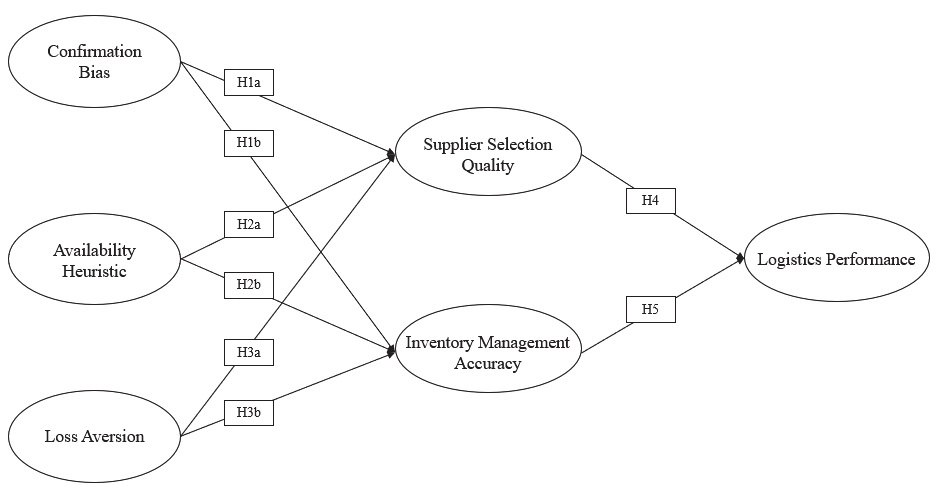
H1a: Confirmation bias negatively affects supplier selection quality.
H1b: Confirmation bias negatively affects inventory management accuracy.
3.3 Availability heuristic and SCM decision quality
Tversky and Kahneman (1973) extensively studied the availability heuristic, which represents a cognitive shortcut that humans use to assess probabilities by substituting the difficult question “How likely is this event?” with the easier question “How easily can I recall similar events?” While efficient in many contexts, this can lead to systematic biases when ease of recall does not accurately reflect actual probabilities.
In SCM, the availability heuristic can lead to drastic distortions in decision making owing to managers who tend to overweight recent, vivid, or emotionally charged events. We assume that in the supplier selection problem, decision makers may pay too much attention to recent experiences with some suppliers (which are easily remembered but not necessarily representative of long-term performance abilities) (Folkes, 1988). For instance, a recent failure of a supplier delivery may be given unproportionally more weight than years of reliable performance, thus resulting in biased supplier performance evaluation that may not reflect actual supplier capability.
The influence of recency and salience in decision making is well established across a range of behavioral operations contexts. Decision makers have been found to disproportionately rely on recent information when making judgments under uncertainty, which has been associated with systematic deviation from optimal decision making.
Forecasts based on recent experiences and information can often put more weight on the recent demand patterns that are mentally very easily retrievable, which results in suboptimal inventory decisions for the entire range of potential demand scenarios. This sequence may induce an overestimation of stockout probabilities and safety stock levels owing to recent stockout events, whereas the recent trend of smooth demand patterns may lead to an underestimation of demand variability and under provision of safety stocks.
The availability heuristic can also affect learning from the inventory management experience. Managers may update their beliefs about demand patterns based primarily on recent, memorable events rather than a comprehensive analysis of historical data, thereby leading to inventory policies that are overly sensitive to recent experience and not well-calibrated to the underlying demand characteristics. Accordingly, this study presents the following hypotheses:
H2a: The availability heuristic negatively affects supplier selection quality.
H2b: The availability heuristic negatively affects inventory management accuracy.
3.4 Loss aversion and SCM decision quality
Loss aversion, which is a fundamental feature of prospect theory (Kahneman and Tversky, 1979), captures the very nature of the asymmetry of how people judge potential gains relative to possible losses. A mainstay result is that losses are felt at least two, if not three, times as much as the equivalent gain, consequently resulting in systematic departures from being rational under uncertainty.
Many SCM studies have documented that loss aversion significantly affects different decision environments. Wang and Webster (2009) found that loss-averse news vendors order very differently from risk-neutral agents. Their pioneering work has been widely expanded for examining loss aversion in SC coordination (Hu et al., 2016), risk management (Liu et al., 2021), and other SC settings.
Empirical evidence strongly indicates that loss aversion exists and is a significant factor in operations. Schweitzer and Cachon (2000) offered one of the first experimental pieces of evidence for decision bias within the context of the newsvendor problem and demonstrated that loss aversion induces systematic departures from the order heuristics that would maximize profits.
In supplier selection contexts, loss aversion can influence decision making through mechanisms related to risk perception and choice framing. Loss-averse managers may exhibit excessive conservatism, thereby displaying strong preferences for familiar suppliers even when objective analysis suggests alternatives would provide superior value. This occurs because switching suppliers involves potential losses (e.g., disruption costs, quality problems, or relationship costs) that are psychologically magnified relative to potential gains from improved supplier performance.
In inventory management, loss aversion can create systematic biases in evaluating trade-offs between stockout and holding costs. Because stockouts are typically framed as losses (lost sales, customer dissatisfaction, opportunity costs) and holding costs as routine operating expenses, loss-averse managers may systematically overweight stockout avoidance relative to holding-cost minimization. Moreover, this can manifest as maintaining excessive safety stock levels to avoid the psychologically painful experience of stockouts, even when economically suboptimal. Accordingly, this study presents the following hypotheses:
H3a: Loss aversion negatively affects supplier selection quality.
H3b: Loss aversion negatively affects inventory management accuracy.
3.5 SCM decision quality and logistics performance
The new framework presented in this study describes the connection between quality of SCM decisions and logistics performance. As established by numerous studies in the field of SCM and OM, high quality of decisions on supplier selection and inventory management are a needed condition for the successful attainment of a higher level of logistics performance outcomes.
Supplier selection quality plays an essential role in logistics performance through several interdependent ways. Suppliers chosen through extensive, unbiased evaluation have a greater probability of having the R&D, production, and service capability, so as to provide stable quality, prompt delivery, and excellent service. Reducing the effect of work complexity Strengthening of the interaction between supplier and customer The supplier capabilities that help reduce the impact of work complexity also enhance the performance of the operations logistics in terms of diminishing the variety of quality, fewer delivery interruptions, and raising the capacity of response regarding customer requirements.
Similarly, the level of an organization’s inventory accuracy serves as an enabler of the trade-off between the service and cost objectives. Improved demand forecasting eliminates stockouts and overstocks, which leads to better customer service and lower carrying costs on overall inventory (Tracey and Tan, 2001). Booth and Theodossiou (2024) found that accuracy in inventory management positively influences the costs and performance of the SC, while cognitive biases also indicate systematic errors in inventory quantity levels. Similarly, Lee and Lee (2014) found that the quality of supply chain management practices significantly influences supplier operational performance through relational capital, providing empirical evidence from Korean suppliers.
BO research has consistently demonstrated the importance of decision quality for operational performance. Studies have revealed that systematic biases in decision making can lead to significant performance degradation, while interventions that improve decision quality can generate substantial performance improvements. Accordingly, this study presents the following hypotheses:
H4: Supplier selection quality positively affects logistics performance.
H5: Inventory management accuracy positively affects logistics performance.
3.6 Theoretical model integration
Our theoretical framework incorporates these relationships into a single model that illustrates how cognitive biases explain logistics performance in a systematic way through their impacts on the critical SCM decision-making mechanisms. The model acknowledges the fact that cognitive biases are essential features of human decision making in a range of decision contexts in SCM.
By concentrating on two key decision domains of SCM, the supplier selection and inventory management, the model captures important pathways through which cognitive biases affect operational outcomes. These activity domains were chosen because they are central SCM activities that have a direct effect on a firm’s logistics performance and are characterized by complex decision making under uncertainty, thereby making them especially fertile for cognitive biases.
The theoretical implications contribute to the operations and BO literature by offering a structural model of the effects of certain cognitive biases on operational decision quality and performance. The model further generalizes the principles of behavioral economics to SCM environments, which provides new understanding about human behavior and its influence on SC performance.
This integrated theoretical framework provides the foundation for an empirical investigation of how behavioral economic principles apply to SCM contexts, which offers both theoretical insights and practical guidance for improving SCM decision-making processes. The focus of the model on measurable decision quality variables and performance outcomes enables rigorous empirical testing, while maintaining practical relevance for SC managers.
The research model of this study based on the above hypotheses is presented in Figure 1.
Ⅳ. Research methodology
Prior to distribution, employees engaged in supply chain–related tasks in order to ensure the validity of the proposed research model subjected the survey questionnaire to a two-month review process in March. Feedback obtained during this stage was incorporated, and the final set of measurement items was developed using a 7-point Likert scale.
The empirical sample of this study comprised employees working in supply chain departments of domestic firms. A total of 3,228 questionnaires were disseminated through the professional survey agency Entrust-Survey. After eliminating invalid responses caused by careless answering, ineligibility, and attrition, 314 valid questionnaires remained and were employed for statistical analysis.
To test the research hypotheses, this study adopted structural equation modeling (SEM), which is widely regarded as a comprehensive methodological framework for analyzing complex relationships among variables (Anderson and Gerbing, 1988). SEM integrates elements of factor analysis, path analysis, and regression analysis into a unified model, allowing researchers to simultaneously examine both direct and indirect effects among observed indicators and latent constructs. This is particularly beneficial in fields such as psychology, the social sciences, and business research, where theoretical frameworks often involve multidimensional and intricate relationships (Anderson and Gerbing, 1988).
SEM provides several methodological advantages. Unlike traditional regression approaches, which become cumbersome when multiple dependent variables are analyzed at once, SEM can simultaneously estimate and assess relationships across multiple outcomes (Nachtigall et al., 2003). It also accounts for measurement error, producing more accurate estimates of the associations between constructs. Furthermore, SEM is well suited for testing models that incorporate mediation, reciprocal relationships, or theoretically driven but empirically underdeveloped constructs by modeling them through latent variables and their corresponding indicators (Nachtigall et al., 2003).
Finally, the use of diverse model fit indices enables researchers to assess the degree of model–data fit and to compare competing models in order to identify the most appropriate specification. SEM is applicable to continuous, ordinal, and categorical data, and it can be employed in both experimental and non-experimental research designs, making it a flexible and powerful tool for hypothesis testing in complex theoretical models.
Ⅴ. Empirical analysis
5.1 Sample characteristics and measurement of variables
The characteristics of the sample used in this study are as follows.
Regarding the duration of employment in supply chain management–related departments, 176 respondents had worked for 1–5 years, representing the largest group, followed by 92 respondents with 6–10 years of experience, and 46 respondents with more than 10 years of experience. With respect to job position, 35.4% of respondents were staff or assistants, 51.9% were middle managers, and 12.7% were senior managers or directors. In terms of supplier evaluation practices, 22.9% of respondents reported conducting evaluations annually, 35.4% semi-annually, 27.4% quarterly, and 14.3% monthly.
With regard to their role in decision-making, 30.9% of respondents were final decision-makers, 47.1% were joint decision-makers, and 22.0% had an advisory role. Finally, in terms of organizational decision-making structure, 58.3% of respondents indicated that their companies adopted a centralized decision-making process, while 41.7% reported decentralized decision-making. With respect to industry sector, the largest group of respondents came from manufacturing (40.1%), followed by distribution/logistics (26.1%), wholesale/retail (20.1%), electronics/IT (8.0%), and others (5.7%). This distribution reflects the broad applicability of SCM decision-making processes across multiple industries. Table 1 presents the descriptive statistics of the sample.
Table 1 Sample characteristics.
| Industry sector | Frequency(n) | Percentage(%) |
|---|---|---|
| Manufacturing | 126 | 40.1% |
| Distribution / Logistics | 82 | 26.1% |
| Wholesale / Retail | 63 | 20.1% |
| Electronics/IT | 25 | 8.0% |
| Others | 18 | 5.7% |
| Years of experience in SCM | Frequency(n) | Percentage(%) |
| 1-5 years | 176 | 56.1% |
| 6-10 years | 92 | 29.3% |
| 11+ years | 46 | 14.6% |
| Job position | Frequency(n) | Percentage(%) |
| Staff / Assistant | 111 | 35.4% |
| Middle manager | 163 | 51.9% |
| Senior manager / Director | 40 | 12.7% |
| Frequency of supplier evaluation | Frequency(n) | Percentage(%) |
| Annual | 72 | 22.9% |
| Semi-annual | 111 | 35.4% |
| Quarterly | 86 | 27.4% |
| Monthly | 45 | 14.3% |
| Decision-making role of respondents | Frequency(n) | Percentage(%) |
| Final decision-maker | 97 | 30.9% |
| Joint decision-maker | 148 | 47.1% |
| Advisory role | 69 | 22.0% |
| Decision-making structure | Frequency(n) | Percentage(%) |
| Centralized | 183 | 58.3% |
| Decentralized | 131 | 41.7% |
Meanwhile, this study employed a total of 24 measurement variables, referencing prior research to ensure the content validity of the latent constructs. Specifically, Confirmation Bias, Availability Heuristic, Loss Aversion, Supplier Selection Quality, Inventory Management Accuracy, and Logistics Performance were each measured using four items. The related details are presented in Table 2.
Table 2 Definitions and measurement of variables.
| Latent variable | Operational definition | Reference |
|---|---|---|
| Confirmation bias | The degree to which decision-makers selectively seek information that supports their initial supplier evaluations. | Carter et al. (2007) |
| The extent to which decision-makers assign greater weight to supplier information that confirms their existing beliefs about supplier capabilities. | ||
| The tendency to focus on supporting evidence when faced with conflicting supplier performance data. | ||
| The propensity to dismiss or minimize negative supplier feedback that contradicts established opinions. | ||
| Availability heuristic | The degree to which recent supplier incidents disproportionately influence current supplier selection decisions relative to comprehensive historical data. | Tversky and Kahneman (1973) |
| The extent to which memorable or emotionally salient supplier events affect future performance evaluations. | ||
| The tendency to overestimate supply chain risk probabilities based on easily recalled recent incidents. | ||
| The degree to which demand-forecasting decisions are biased toward easily retrievable recent sales patterns. | ||
| Loss aversion | The degree to which potential losses from supplier decisions create stronger emotional responses than equivalent potential gains. | Wang and Webster (2009) |
| The extent to which inventory decisions prioritize avoiding stock out costs over optimizing total cost structures. | ||
| The tendency to be more motivated by preventing supply chain disruptions than pursuing equivalent operational improvements. | ||
| The degree to which supplier-switching decisions are perceived as riskier than their potential benefits warrant. | ||
| Supplier selection quality | The degree to which supplier selection processes systematically evaluate comprehensive performance criteria including quality, cost, delivery, and service capabilities. | Carter et al. (2007) |
| The extent to which selected suppliers consistently demonstrate superior capabilities across multiple performance dimensions. | ||
| The degree to which supplier selection decisions result in partnerships that meet or exceed predetermined quality expectations. | ||
| The extent to which chosen suppliers prove reliable and high performing over sustained periods. | ||
| Inventory management accuracy | The degree to which demand forecasting produces predictions that closely align with actual customer demand patterns. | Schweitzer and Cachon (2000) |
| The extent to which inventory levels achieve optimal balance between service level maintenance and carrying cost minimization. | ||
| The degree to which inventory record systems accurately reflect actual physical stock levels. | ||
| The extent to which inventory-planning decisions minimize both stock out occurrences and excessive overstock situations. | ||
| Logistics performance | The degree to which supply chain operations consistently achieve on time and complete product deliveries to customers. | Gunasekaran et al. (2001) |
| The extent to which delivery operations achieve high levels of order accuracy and completeness. | ||
| The degree to which logistics operations demonstrate superior cost and speed efficiency relative to industry benchmarks. | ||
| The extent to which overall supply chain performance meets or exceeds customer satisfaction expectations. |
5.2 Reliability and descriptive statistics analysis
Before testing the hypotheses of this study, we examined the reliability and validity of the measurement variables. To verify reliability, Cronbach's alpha values were calculated. Generally, in social sciences, values above 0.7 are considered to indicate sufficient reliability (Hair et al., 2010). The reliability values for the variables in this study were: Confirmation bias = 0.833, Availability heuristic = 0.796, Loss aversion = 0.890, Supplier selection quality = 0.897, Inventory management accuracy = 0.859 and Logistics performance = 0.854 confirming the precision of the measurement instruments.
Meanwhile, this study examined univariate normality for Confirmation bias, Availability heuristic, Loss aversion, Supplier selection quality, Inventory management accuracy, and Logistics performance using skewness and kurtosis. Here, skewness is a measure that expresses the degree of asymmetry in data distribution, while kurtosis indicates how peaked or flat a distribution is compared to a normal distribution. According to Kline (2005), normality issues are indicated when the absolute value of kurtosis exceeds 7 and when the absolute value of skewness exceeds 2. In this study, no such issues were found. Table 3 below shows the descriptive statistics and normality analysis results used in this study.
Table 3 Descriptive statistics and normality analysis results.
| N | Mean | Standard Deviation | Skewness | Kurtosis | |
|---|---|---|---|---|---|
| Confirmation | 314 | 5.210 | 0.891 | -0.642 | 1.423 |
| Availability heuristic | 314 | 4.873 | 0.933 | -0.483 | 1.122 |
| Loss aversion | 314 | 5.054 | 0.842 | -0.260 | 0.670 |
| Supplier selection quality | 314 | 5.340 | 0.810 | -0.395 | 1.254 |
| Inventory management accuracy | 314 | 5.182 | 0.861 | -0.522 | 1.381 |
| Logistics performance | 314 | 5.423 | 0.797 | -0.470 | 1.193 |
5.3 Feasibility analysis
Using the final measurement items derived
In this study, we conducted a validity analysis. Confirmatory factor analysis was performed to examine validity, looking at both convergent and discriminant validity. First, the convergent validity of measurement variables can be verified through Composite Reliability (CR) and Average Variance Extracted (AVE). Convergent validity is considered established when CR values exceed 0.7 and AVE values exceed 0.5 (Hair et al., 2010).
Specifically, the CR values for each variable were: Confirmation = 0.841, Availability heuristic = 0.801, Loss aversion = 0.889, Supplier selection quality = 0.898, Inventory management accuracy = 0.860 and Logistics performance = 0.853, conceptual reliability can be considered established for all variables.
Subsequently, discriminant validity was examined to verify that the concepts being measured were distinct from each other. The analysis showed that the squared correlation coefficients between all factors were less than their respective AVE values, confirming that discriminant validity was also established. Table 4 below shows the results of the discriminant validity analysis.
Table 4 Discriminant validity analysis results.
| Confirmation | Availability heuristic | Loss aversion | Supplier selection quality | Inventory management accuracy | Logistics performance | |
|---|---|---|---|---|---|---|
| Confirmation | (0.612) | |||||
| Availability heuristic | 0.274*** | (0.637) | ||||
| Loss aversion | 0.291*** | 0.283*** | (0.593) | |||
| Supplier selection quality | 0.256*** | 0.249*** | 0.238*** | (0.654) | ||
| Inventory management accuracy | 0.243*** | 0.231*** | 0.227*** | 0.322*** | (0.671) | |
| Logistics performance | 0.268*** | 0.262*** | 0.254*** | 0.335*** | 0.347*** | (0.642) |
Note(s): Diagonal values in parentheses represent the AVE for each construct; off-diagonal values represent squared correlations between constructs.
***p < 0.001
5.4 Verification of research model
In this study, maximum likelihood method was used to verify the causal relationships and correlations between Confirmation, Availability heuristic, Loss aversion, Supplier selection quality, Inventory management accuracy, and Logistics performance. The research model's goodness of fit was also confirmed to meet most of the recommended criteria suggested by Hair et al. (2010). The hypotheses were then tested, and all hypotheses were found to be accepted. Table 5 shows the structural model's goodness of fit, and Table 6 shows the hypothesis testing results.
Table 5 Research model fit results.
| CIMIN/DF | GFI | AGFI | RMR | RMSEA | TLI | NFI | CFI | |
|---|---|---|---|---|---|---|---|---|
| Model fit index | 2.236 | 0.948 | 0.924 | 0.038 | 0.042 | 0.921 | 0.912 | 0.934 |
| Recommendation criteria | 0.90 or higher Excellent | 0.90 or higher Excellent | 0.05 or less Excellent | 0.05 or less Excellent | 0.90 or higher Excellent | 0.90 or higher Excellent | 0.90 or higher Excellent |
Note(s): CFI, comparative fit index; GFI, goodness-of-fit index; NFI, normed fit index; RMSEA, root mean square error of approximation; TLI, Tucker-Lewis Index; IFI, incremental fit index; AGFI, adjusted goodness of fit index; RMR, root mean square residual
Source(s): Derived from the statistical analysis of this study (SPSS 18.0 and AMOS 18.0)
Table 6 Hypothesis verification results.
| Hypothesis | Estimate | SE | CR | p | Result |
|---|---|---|---|---|---|
| 1a | -0.327 | 0.079 | -4.139*** | 0.000 | Accepted |
| 1b | -0.291 | 0.044 | -6.614*** | 0.000 | Accepted |
| 2a | -0.278 | 0.036 | -7.722*** | 0.000 | Accepted |
| 2b | -0.234 | 0.071 | -3.296*** | 0.001 | Accepted |
| 3a | -0.309 | 0.041 | -7.537*** | 0.000 | Accepted |
| 3b | -0.254 | 0.078 | -3.256*** | 0.002 | Accepted |
| 4 | 0.447 | 0.085 | 5.259*** | 0.000 | Accepted |
| 5 | 0.391 | 0.081 | 4.827*** | 0.000 | Accepted |
Note(s): *p < 0.05, **p < 0.01, ***p < 0.001; SE, standard errors; CR, critical ratios
Source(s): Derived from the statistical analysis of this study (SPSS 18.0 and AMOS 18.0)
Ⅵ. Conclusion
6.1 Hypothesis testing results
This study empirically investigates the effect of cognitive biases in behavioral economics on decision-making quality in SCM and logistics performance. This study investigated the impact of three cognitive biases (confirmation bias, availability heuristic, loss aversion) on supplier selection quality, inventory management accuracy, and logistics performance, and established full support for all hypotheses.
Regarding the relationship between cognitive biases and SCM decision quality, as hypothesized, confirmation bias negatively affected both supplier selection quality (H1a) and inventory management accuracy (H1b). This finding aligns with Carter et al.’s (2007) taxonomy of judgment and decision-making biases in behavioral supply chain management, thus empirically confirming that decision makers’ tendency to selectively seek and interpret information that confirms existing beliefs impairs optimal supplier selection and accurate inventory management.
The availability heuristic also negatively influences the supplier selection quality (H2a) and inventory management accuracy (H2b). This extends Tversky and Kahneman’s (1973) foundational research to the SC context, thereby demonstrating that recent, vivid, or emotionally salient events are overweighted in decision-making processes, consequently leading to suboptimal choices. Moreover, this explains how recent supplier failures or stockout experiences excessively influence long-term performance evaluations or demand forecasting.
Loss aversion negatively affects supplier selection quality (H3a) and inventory management accuracy (H3b). These results support Kahneman and Tversky’s (1979) prospect theory, Wang and Webster’s (2009) loss-averse newsvendor research, and Schweitzer and Cachon’s (2000) experimental evidence. The asymmetric sensitivity to losses leads to overestimation of potential losses from supplier switching and excessive avoidance of stockout costs in inventory management, thereby degrading the overall decision quality.
Regarding the relationship between SCM decision quality and logistics performance, both supplier selection quality (H4) and inventory management accuracy (H5) positively influence logistics performance. This aligns with Booth and Theodossiou’s (2024) research on how cognitive biases affect SC costs and performance, thereby empirically demonstrating the importance of systematic and unbiased decision-making processes. Our findings support the importance of behavioral factors in OM emphasized by Bendoly et al. (2006) and extend the understanding of how behavioral factors influence supply chain coordination mechanisms identified in Goudarzi et al.’s (2023) systematic review. The results also align with Fahimnia et al.’s (2019) comprehensive review that highlights the critical role of human factors in BO and SCM.
6.2 Implications
6.2.1 Theoretical implications
This study offers a theoretical contribution to the behavioral economics literature by applying the fundamental principles of the core logic of behavioral economics to SCs. While prior behavioral operations management research has examined the existence and influence of cognitive biases at a general level, this study empirically identifies the more specific mechanisms through which three cognitive biases affect SCM decision-making. This study contributes to the BOM literature by delineating the specific processes by which confirmation bias, the availability heuristic, and loss aversion influence SC decision making. These results also provide empirical support to by Gino and Pisano’s (2008) call for “behavioral operations theory” and are consistent with the focus of BO research advocated by Croson et al. (2013).
Second, by introducing a multilevel relational model between cognitive biases, decision quality, and performance, we develop a novel theoretical framework beyond the rational actor model. This is theoretically important as it clarifies particular mediating pathways leading to SC performance, rather than demonstrating the presence of cognitive bias.
Third, by examining the role of cognitive biases in the central SC decision areas of supplier selection and inventory management, our work complements Arlinghaus et al.’s (2020) study on cognitive biases in digitalization projects to more general SC decision fields as an initial reference for subsequent BSCM research. Furthermore, this study makes a methodological contribution by providing large-scale empirical evidence from SCM practitioners, going beyond the experimental and analytical approaches that have predominantly been used in this field. This approach can be seen as addressing the ecological limitations of laboratory experiments.
6.2.2 Practical implications
This study can improve SC managers’ understanding of systematic biases in decision making and offers practical interventions to overcome such biases. First, the strategies for reducing confirmatory bias consist of the use of “devil’s advocate” procedures by involving negative information search in evaluating suppliers and designing balanced information seeking involving multiple information sources. In inventory management, routine reviews of demand patterns and validation of forecasts based on exogenous data are beneficial.
Second, avoid the adverse influence of availability heuristic in penetration of decision-making structures, and rely on patterns from long-term performance data, rather than short-term history. A need exists to objectively monitor indicators (performance dashboard) to evaluate suppliers and for reinforcement of quantitative evaluation parameters. Furthermore, inventory management would be helped by systematic historical data analysis and forecasting models for seasonal trends.
Third, managing loss-aversion bias involves establishing evaluation criteria that are neutral with respect to losses and gains during decision-making process. Moreover, choosing suppliers should involve a structured consideration of switching benefits in addition to switching costs, and inventory management should utilize trade-off optimization models involving stockout and holding costs.
Fourth, systemic processes are required to mitigate organizational-level bias. This extends Ancarani et al.’s (2016) approach to quantifying overconfidence bias to systematically detect and deal with a range of cognitive biases. Formalized “regular decision-making process reviews, harnessing collective intelligence with many decision makers, and cultivation for culture of data-driven worlds.”
Fifth, using technology to mitigate bias has important practical implications. As such, advanced technologies for forecasting (such as artificial intelligence (AI) and machine learning (ML)-based models), automatic systems for the performance evaluation of suppliers, and decision support systems can work together to counter the limitations of human cognition.
6.3 Limitations
Despite its contributions, this study has several limitations that should be addressed in future research.
First, we employed a cross-sectional design, which constrains the ability to clearly establish the directionality of causal relationships. Longitudinal studies or experimental designs, such as the experimental economics approaches used by Croson and Donohue (2002, 2003, 2006) are needed to establish causal relationships between cognitive biases and performance outcomes more clearly.
Second, cognitive biases were measured using self-report surveys, and these instruments are prone to social desirability bias and limitations on self-awareness. Future research could use implicit or more behavioral observations as particular objective measurement strategies, which are imperative for studying the situational effects of heuristics (Katsikopoulos, 2013).
Third, as this study focused only on three cognitive biases, the effect of other cognitive biases that are equally important (e.g., overconfidence bias, anchoring effect, effect of framing) may have been missed. For further research, a cognitive bias model should be built to consider more factors and the impacts on SC decision making should be systematically analyzed. Furthermore, the present study does not consider moderating variables such as organizational culture, decision-making model, and level of use of technology, which could moderate the effect of cognitive bias as proposed by Liu et al. (2021), who demonstrated that optimal contract design can reduce the adverse impact of loss aversion.
Finally, since all variables in this study were measured through surveys from the same respondents, there is a possibility of common method bias. Common method bias arises when independent and dependent variables are collected from the same source, and future research would need to employ a multi-respondent design to reduce this issue.
Despite these limitations, this study is significant in that the specific impacts of cognitive biases on decision quality and logistics performance are empirically identified by applying behavioral economics principles to SCM, thus providing a foundation for future BSCM research.
Author Biographies
∙ Author Changjoon Lee is currently an Assistant Professor in the Production and Operations Management track within the School of Business and Economics at the University of Ulsan. He received his bachelor’s degree in Economics from Michigan State University and earned both his M.S. and Ph.D. in Business Administration (LSOM) from Sogang University. After completing his doctoral studies, he served as a Research Professor at the Graduate School of Business at Sogang University. His primary research areas include supply chain management optimization and logistics network design optimization.
∙ Author Soohyo Kim is currently a Lecturer in the School of Business at Sogang University. He received his bachelor’s degree in Business Administration from Dong-A University and earned both his M.S. and Ph.D. in Business Administration with a specialization in LSOM (Logistics, Service and Operations Management) from Sogang University. His primary research interests include supply chain management, risk management, and green supply chain management.