
.jpeg)
Returning to Work after Occupational Injury: Examining the Role of Gender in Shaping the Longitudinal Trajectories of Self-Efficacy and Life Satisfaction
* 성신여자대학교, 경영학과 (Sungshin Women's University, Department of Business Administration, Assistant professor)
** 국립부경대학교, 경영대학 (Pukyong National University, Department of Business Administration, Assistant professor)
**교신저자: 신민주 (mjshin@pknu.ac.kr)
DOI: https://doi.org/10.17287/kmr.2026.55.3.1171
Abstract
The severity and prevalence of occupational injuries remain a pressing concern worldwide. In South Korea, occupational accidents reached a 10-year high of 142,808 in 2023 despite stricter safety legislation, creating impacts that ripple through families, communities, and economies. This study investigated the longitudinal trajectories of self-efficacy and life satisfaction among injured workers who returned to work following the completion of medical care, with a particular focus on the role of gender. The study utilized data from the Panel Study of Workers’ Compensation Insurance in South Korea and employed latent growth modeling. Findings revealed significant positive growth trends in both self-efficacy and life satisfaction over time. Notably, female injured workers experienced a slower rate of increase in self-efficacy compared to male injured workers, which in turn had a negative indirect relationship with increases in life satisfaction. These findings underscore the importance of considering gender differences in the return-to-work process and the need for tailored support that addresses the unique challenges faced by female injured workers. Overall, this paper contributes to an enhanced understanding of the complex interplay between gender and well-being in the context of post-return-to-work experiences.
Ⅰ. Introduction
The severity and prevalence of occupational injuries remain a pressing concern worldwide. According to the International Labour Organization, nearly 3 million workers died from work-related causes in 2019 (ILO, 2023). While fatality statistics—5,283 in the United States in 2023 (U.S. Bureau of Labor Statistics, 2023) and 3,286 workplace fatalities across the European Union in 2022 (Eurostat, 2024)—represent the most tragic outcomes, they are merely the tip of the iceberg. The economic toll is equally devastating through direct medical expenses, lost productivity, and indirect social costs (Takala et al., 2014). In South Korea, for example, occupational accidents reached their highest level in a decade in 2023 despite stricter safety legislation (The Korea Herald, 2024), creating impacts that ripple through families, communities, and economies.
Beyond physical consequences, workplace injuries trigger significant psychological effects. Injured workers frequently develop depression, anxiety, and post-traumatic stress disorder that impede recovery (Chu et al., 2019; Granger and Turner, 2025; Williams-Whitt and Taras, 2010). A meta-analysis revealed bidirectional relationships between work injuries and mental health, with injuries showing stronger associations with subsequent mental health problems, mediated by negative cognitions and perceived job demands (Granger and Turner, 2025). These psychological impacts create lasting consequences affecting economic security, social relationships, and overall well-being (Dembe, 2001). However, less attention has been paid to how individual characteristics shape recovery experiences.
In particular, gender may systematically shape the psychological recovery process following occupational injury. Conservation of resources theory posits that individuals with fewer initial resources are more vulnerable to sustained resource loss (Hobfoll, 1989), while status characteristics theory suggests that individuals are assigned different levels of presumed competence based on categorical attributes such as gender (Berger et al., 1972; Correll and Ridgeway, 2003). Together, these theoretical frameworks suggest that structural disadvantages women face in the labor market–lower wages, weaker vocational support, greater caregiving burdens–are not merely barriers to employment entry but ongoing constraints on the rebuilding of psychological resources such as self-efficacy after occupational injury.
However, this theoretical expectation remains empirically unexamined. For example, Vestling et al. (2003) showed that workers who returned to work following injury reported higher life satisfaction, but their cross-sectional design failed to track how well-being changes over time, and gender was not examined as a meaningful variable. Black et al.’s (2018) systematic review revealed that self-efficacy consistently predicts return-to-work outcomes, but treated self-efficacy only as a predictor of return–not as a resource that may fluctuate after workers resume employment. Lindsay et al. (2018) engaged gender more directly, documenting that women with disabilities faced specific barriers to employment: lowered family expectations, gender-stereotypical vocational training, disproportionate caregiving responsibilities and weaker vocational rehabilitation support. Nevertheless, most injury recovery research either excludes gender analysis or treats it as a control variable, despite the different occupational exposure risks by gender (Biswas et al., 2022) and complex return-to-work processes that may relate to gender differently (Mac Eachen et al., 2006). Importantly, this conventional approach fails to consider that gender plays a role beyond a simple demographic characteristic, potentially shaping the long-term trajectory of psychological recovery after occupational injury.
In this study, we examine the divergent well-being trajectories among injured workers following their return to work. Self-efficacy represents an individual's confidence in their ability to successfully perform specific tasks and achieve desired outcomes (Bandura, 1997), while life satisfaction is conceptualized as a cognitive and evaluative process whereby individuals make judgments about their overall quality of life (Diener et al., 1985; Lackner and Carosella, 1999). Both constructs are central to recovery and rehabilitation, yet their trajectories may differ by gender. Prior research has revealed that self-efficacy beliefs influence pain management, functional recovery, and return-to-work outcomes (Lackner and Carosella, 1999; Shaw et al., 2011). However, whether these psychological resources rebuild at different rates for men and women after returning to work, and whether gender-specific processes–such as differential social support, limited mastery experiences, and disproportionate caregiving responsibilities–produce divergent trajectories over time, remains largely unexplored. As such, it is important to examine gender differences in the trajectories to support systems that effectively address the unique needs and challenges faced by both men and women in successful workforce reintegration.
Drawing on conservation of resources theory (COR) (Hobfoll, 1989) and status characteristics theory (Berger et al., 1972), along with the concept of “masculine defaults” in organizational systems (Cheryan and Markus, 2020), this study examines how gender shapes self-efficacy and life satisfaction trajectories after returning to work following workplace injury. The Korean labor market makes our argument particularly compelling. South Korea’s gender wage gap–the largest among OECD countries at 29.3% (OECD, 2023)–reflects structural inequalities in the resources available to men and women during the injury recovery process. According to COR theory, individuals with fewer initial resources are more vulnerable to loss spirals (Hobfoll, 1989), implying that women may approach the injury event with comparatively lower economic and organizational resources, which can limit the speed at which their self-efficacy is rebuilt following returning to work. We analyze five waves of data from the Panel Study on Workers’Compensation Insurance (PSWCI) in South Korea using latent growth modeling, with implications for equitable rehabilitation systems.
Ⅱ. Theory and Hypotheses
2.1 Changes in Well-being of Injured Workers Post-Return-to-Work
Work is not merely a means of subsistence. Rather, it holds at least two significant meanings. First, work functions as a critical link between the individual and society. According to Hegel (2003), work is mediating activity between individual subjectivity and the institutional life of society, wherein individuals realize their freedom and gain recognition (Fayard, 2021). This perspective positions work as a critical mechanism for integration into the social world. Building on this foundation, Budd (2019) emphasized that work is not only an economic activity to fulfill material needs but also a socially constructed role that enables individuals to internalize institutional norms and expectations, and reinforces their sense of belonging. In this regard, work functions as a central site for meaning-making, identity formation, and social embeddedness.
Second, work enables individuals to cultivate a sense of agency and autonomy, allowing them to exercise control over their lives and make meaningful contributions. Human beings have a fundamental need to perceive themselves as self-determining, capable of exercising free choice, and effectively managing their own activities or environments (Baumeister, 1998; Rosso et al., 2010). Thus, the workplace serves as a central arena in which this sense of agency is continually enacted and reinforced through daily routines, responsibilities, and goal-directed actions.
However, occupational injuries can severely disrupt the foundations of a person’s working life. The disruption of work following an injury not only ruptures individuals’ connections to their occupational roles but also undermines the structured context through which they experience autonomy, competence, and purpose. Such accidents occur unexpectedly and, regardless of the individual’s intentions, force a temporary or permanent separation from their occupational roles that anchor them to broader social and institutional networks. As injured workers lose access to this meaningful framework, their perceived capacity to act as autonomous agents may be substantially weakened. Empirical evidence supports the disruptive effects of work interruption due to occupational injuries. Involuntary work disruption following such injuries is associated with heightened psychological distress, including increased symptoms of depression and anxiety among affected workers (Granger and Turner, 2025; Carnide et al., 2016; Gerasimaviciute et al., 2020). Drawing upon COR theory, we propose that returning to work after occupational injury represents progressive resource restoration that enhances injured workers’ self-efficacy over time. COR theory posits that individuals are motivated to obtain, retain, and protect resources that they value (Hobfoll, 1989; Hobfoll et al., 2018). These resources may include objects, conditions, or energies that are either directly valued or serve as means to obtain other valued resources (Halbesleben et al., 2014). According to COR theory, psychological stress arises not only from the actual loss of these resources but also from the threat of loss or a failure to regain previously lost resources.
Occupational injuries typically create resource loss spirals, simultaneously depleting multiple valued resources, including one's work identity, income stability, social ties, and sense of efficacy (Hobfoll et al., 2018). However, returning to work provides a meaningful opportunity for comprehensive resource restoration. Through re-engagement with work, injured workers can rebuild their sense of control, competence, and autonomy, while reconnecting with the deeper structures of meaning, identity, and continuity that work embeds in everyday life. As this restoration process unfolds, critical psychological resources such as self-efficacy could be progressively strengthened. Empirical studies also support that returning to work significantly increases psychological well-being (Boštjančič and Galič, 2020; Figueredo et al., 2020; Noh et al., 2019).
Hypothesis 1-1: Self-efficacy of injured workers returning to work increases over time.
Building on this, we extend our theoretical framework to examine broader well-being outcomes. While self-efficacy represents a vital internal resource that helps workers regain control over their work-related functioning, life satisfaction represents a broader evaluative judgment of one’s overall quality of life (Diener et al., 1985). From a COR perspective, returning to work initiates a positive gain cycle in which the recovery of multiple psychological and social resources collectively contributes to enhanced well-being (Hobfoll, 2001). Specifically, the return to work provides a renewed sense of purpose, financial stability, and social connectedness, all of which are critical determinants of subjective well-being (Diener et al., 2003). As this resource rebuilding process continues, injured workers are likely to experience gradual improvements in their life satisfaction throughout the reintegration process.
Hypothesis 1-2: Life satisfaction of injured workers returning to work increases over time.
We further suggest the positive relationship between self-efficacy and life satisfaction during the return-to-work process. From a COR perspective, self-efficacy functions as a resource caravan passageway (Hobfoll et al., 2018). It means that its restoration does not operate in isolation but instead unlocks pathways through which additional valued resources are subsequently acquired. As injured workers regain self-efficacy through returning to work, this restored psychological resource activates a cascading process of resource accumulation—enabling access to career advancement opportunity, social recognition, and financial stability—all of which are central determinants of life satisfaction (Diener and Fujita, 1995). This resource accumulation operates partly through a positive spillover effect, wherein gains in work-related efficacy permeate into non-work domains, strengthening their sense of purpose, competence, and social connectedness. Empirically, Kim (2024) found a significant positive relationship between self-efficacy and life satisfaction among injured workers in return-to-work contexts. This finding suggests that workers’ enhanced efficacy contributes to their overall life satisfaction during the reintegration process.
Hypothesis 2: Increases in self-efficacy of injured workers returning to work are positively related to increases in their life satisfaction.
2.2 Gender Divergent Trajectories in Well-Being Post-Return-to-Work
We propose that gender creates different trajectories in resource restoration during return-to-work processes, with female injured workers experiencing systematically slower recovery of self-efficacy compared to their male counterparts. This disparity stems from deeply embedded structural inequalities that privilege masculine norms and expectations in both workplace cultures and recovery frameworks. Despite progress in labor market participation, occupational gender imbalance continues to disadvantage women (Levanon and Grusky, 2016), who remain overrepresented in lower-paying service, care, and administrative roles while men dominate higher-paying, male-coded sectors such as construction, manufacturing, and engineering (Folbre et al., 2023; Goldin, 2014; Ngai and Petrongolo, 2017). These disparities not only mirror existing societal norms but also reinforce a hierarchy of occupational value that places female-dominated work at a disadvantage (England, 2010).
Two complementary theoretical frameworks explain how gender systematically undermines women’s self-efficacy recovery. First, status characteristics theory (Berger et al., 1972; Correll and Ridgeway, 2003) demonstrates that individuals are assigned differing levels of social status and presumed competence based on gender, race, and socioeconomic backgrounds. Among various individual characteristics, gender is uniquely visible and influential in shaping expectations within mixed-sex groups (Chen et al., 2023). For instance, women may be regarded as less competent or unsuitable for high-status roles solely because of their gender, regardless of actual performance (Eagly and Karau, 2002). This perception becomes more pronounced in male-dominated work environments, where gender becomes not only visible but also structurally consequential. It reinforces gender hierarchies and leads to tangible disadvantages for women in occupational settings.
In the context of returning to work following occupational injury, these status-based expectations shape how others perceive and interact with female injured workers. As a result, female workers returning to work after injury may receive reduced support, be held to lower expectations, and encounter fewer chances to reaffirm their competence. This lack of opportunity to demonstrate capability can hinder the reinforcement of a positive self-concept (Bandura, 1997). Simultaneously, others’ low expectations may be internalized, shaping female workers’ self-evaluations in ways that make it more difficult to rebuild self-efficacy during the recovery process.
Second, we draw on the notion of “masculine defaults” (Cheryan and Markus, 2020) to examine how recovery norms reflect gendered expectations. In particular, such norms are often structured around masculine ideals of speed, independence, and emotional control (Eagly and Steffen, 1984; Hentschel et al., 2019). While injured men also face pressure to recover quickly and suppress vulnerability, the critical distinction lies how these norms intersect with gender identity. For male workers, masculine defaults align with their gender identity, making successful compliance an efficacy-affirming experience. For female workers, however, these same norms create a double bind: conforming to masculine recovery standards risks being judged as inauthentic, while failing to conform may be perceived as dependency or incompetence.
Empirical research supports our argument by revealing how gendered assumptions are embedded within institutional structures that govern post-injury recovery. These masculine defaults extend beyond workplace expectations into formal support systems, where industrial accident compensation remains primarily designed for male-dominated “core industries” while systematically excluding female-concentrated sectors such as domestic and caregiving work (Ferguson, 2013; Lee, 2019). For instance, in 2022, the occupational injury recognition rate in Korea starkly differed between male (81%) and female (19%) workers (Public Data Portal, 2024).
This structural exclusion is compounded by the sectoral characteristics of female-dominated work. Service and care occupations—where women are disproportionately concentrated—tend to offer limited organizational support, lower job security, and reduced access to formal legal or administrative resources. From the perspective of COR theory (Hobfoll, 1989), this creates a resource loss spiral: when institutional channels for injury recognition are inaccessible or systematically biased, injured female workers are unable to replenish the material and social resources lost at the point of injury. The resulting resource deficit not only prolongs physical and economic hardship but also impairs the accumulation of mastery experiences and social support—two primary mechanisms through which self-efficacy is built (Bandura, 1997). Critically, the low injury recognition rate for women does not reflect safer working conditions but rather a cultural tendency to attribute women's musculoskeletal and mental health conditions to domestic labor or personal factors rather than occupational causes (Messing, 1998; Park, 2020), further eroding the institutional legitimacy that injured female workers need to rebuild their sense of competence and agency.
Critically, occupational injury amplifies these structural disadvantages. The injury event creates precisely such a state of acute resource depletion (Hobfoll et al., 2018), stripping away the buffer resources that ordinarily allow workers to navigate structural inequalities. For women, whose buffer resources are already more constrained due to lower occupational status and gender-based competence expectations, this depletion is particularly consequential: without resources to counteract status-based biases, the structural disadvantages that were manageable pre-injury become disproportionately burdensome during the vulnerable recovery period. It is the interaction between pre-existing structural disadvantage and acute resource depletion that creates a distinctive post-injury gender trajectory. Therefore, we propose the following hypothesis:
Hypothesis 3-1. Injured workers’ gender (female) is negatively related to increases in self-efficacy.
These gendered barriers create an indirect pathway whereby female workers experience diminished life satisfaction through impaired self-efficacy. As women face systematic disadvantages in rebuilding this essential psychological resource, their diminished self-efficacy subsequently undermines broader well-being outcomes, particularly life satisfaction.
Hypothesis 3-2. Gender is indirectly negatively related to increases in life satisfaction through increases in self-efficacy.
Ⅲ. Methods
We utilized data from the first to the fifth wave (2018–2022; respectively corresponding to Times 1–5 in this study) of the second cohort of the Panel Study of Worker’s Compensation Insurance (PSWCI) conducted by the Korea Workers’ Compensation and Welfare Service. The PSWCI, which has been conducted annually since 2013, is a comprehensive survey of workers who experienced occupational injuries and illnesses and completed medical treatment. It collects data on various characteristics of these workers, such as household status, income, consumption, health, and living conditions. The second cohort survey, initiated in 2018, includes 3,249 workers who completed medical treatment between January and December 2017.
To examine the trajectories of injured workers’ experiences upon returning to work following the completion of medical treatment, we restricted our sample to individuals who maintained employment throughout all five waves and had no missing data on the study variables. This allowed us to conduct a thorough analysis using a latent growth model approach. The final sample consisted of 959 individuals. The demographic and injury-related characteristics of the final sample are presented in Table 1.
Table 1 Characteristics of the final sample
| Characteristics | N(%) | |
|---|---|---|
| Gender | Female | 137(14.3) |
| Male | 822(85.7) | |
| Age | 30s and under | 201(21.0) |
| 40s | 268(27.9) | |
| 50s | 356(37.1) | |
| 60s and over | 134(14.0) | |
| Education level | None | 12(1.3) |
| Elementary school | 87(9.1) | |
| Middle school | 128(13.3) | |
| High school | 475(49.5) | |
| College or higher | 257(26.8) | |
| Disability ratings | None | 241(25.1) |
| 13-14(Light) | 338(35.2) | |
| 10-12(Mild) | 265(27.6) | |
| 8-9(Moderate) | 73(7.6) | |
| 4-7(Severe) | 40(4.2) | |
| 1-3(Critical) | 2(0.2) | |
| Types of occupational injuries and illnesses | Workplace accidents | 901(94.0) |
| Occupational illnesses | 54(5.6) | |
| Commuting accidents | 4(0.4) | |
| Types of economic activity | Returning to previous employer | 526(54.8) |
| Re-employed elsewhere | 383(39.9) | |
| Self-employed | 50(5.2) | |
| Occupational status at the time of the workplace injury | Permanent full-time | 681(71.0) |
| Temporary/Contract | 71(7.4) | |
| Day laborer | 202(21.1) | |
| Self-employed | 5(0.5) | |
| The size of organization where the workplace injury occurred | Less than 5 employees | 153(16.0) |
| 5-9 employees | 202(21.1) | |
| 10-19 employees | 165(17.2) | |
| 20-29 employees | 74(7.7) | |
| 30-99 employees | 173(18.0) | |
| 100-299 employees | 79(8.2) | |
| 300-999 employees | 42(4.4) | |
| 1,000 employees or more | 71(7.4) | |
3.1 Measures
Unless otherwise noted, all survey items were rated using a 5-point Likert scale (1=strongly disagree to 5=strongly agree).
3.1.1 Self-efficacy
We assessed self-efficacy using seven items from Sherer et al. (1982). An example item was “I can achieve important goals if I set them.” The coefficient alphas for this scale were .81 (Time 1: 2018), .79 (Time 2: 2019), .78 (Time 3: 2020), .78 (Time 4: 2021), and .80 (Time 5: 2022).
3.1.2 Life satisfaction
Life satisfaction was measured using a single-item scale, which asked participants to rate their overall life satisfaction on a 5-point scale, where 1=very satisfied and 5=very dissatisfied. The item was reverse coded, so that higher values corresponded to higher levels of life satisfaction. The use of a single-item measure for life satisfaction has been validated against multi-item scales (Cheung and Lucas, 2014) and has been widely employed in previous research (Cheung and Lucas, 2014; Fjaestad et al., 2023; Mo et al., 2022; Wei et al., 2023).
3.1.3 Gender (Female)
Participant gender was coded as 0 for male and 1 for female.
3.1.4 Control variables
Several control variables were used to mitigate the potential for alternative explanations. Unless otherwise noted, all controls were assessed at Time 1(T1). First, we controlled for disability ratings and subjective health assessments prior to their workplace injuries. Second, we included a job change variable indicating whether participants remained employed by the organization where the injury occurred from T1 to T5 post-recovery, coded as 0 for ‘yes’ and 1 for ‘no’. Third, we controlled for annual income for each year, after transforming individual income into its natural logarithm to address income distribution skewness, aligning with approaches used in previous studies (Gao-Urhahn et al., 2016; Raffiee and Coff, 2016). Lastly, we controlled for the workforce size of the organization where the workplace injury occurred to account for potential differences in resources and support available to injured workers based on organization size.
3.2 Data Analysis
To explore the trajectories of self-efficacy and life satisfaction, we utilized latent growth modeling with Mplus 8.4. This advanced methodology allows for the estimation of latent factors, initial values (intercept), and growth trajectories (slopes) based on observed indicators collected longitudinally. Through this approach, we are equipped to analyze baseline trends and the interrelations among them comprehensively. For handling missing data, we applied the full-information maximum likelihood estimation technique (Arbuckle, 1996).
IV. Results
To examine the trajectories of self-efficacy and life satisfaction among injured workers, we first compared the model fit of three models: no-growth, linear growth, and quadratic growth. The goodness-of-fit indices for each model are presented in Table 2. The linear growth model showed a good fit to the data, as indicated by the fit indices meeting the recommended cutoff values (Hu and Bentler, 1999). Furthermore, as shown in Table 2, the results of the model comparison indicate that the linear growth model provides better fit to the data, compared to the no-growth and quadratic growth models.
Table 2 Model comparison results
| Variables | Chi-square | df | CFI | TLI | RMSEA | SRMR | |
|---|---|---|---|---|---|---|---|
| Self-efficacy | No growth | 106.17 | 13 | .94 | .96 | .09 | .07 |
| Linear | 22.14 | 10 | .99 | .99 | .04 | .05 | |
| Quadratic | 16.33 | 6 | .99 | .99 | .04 | .04 | |
| Life satisfaction | No growth | 78.94 | 13 | .94 | .95 | .07 | .07 |
| Linear | 20.15 | 10 | .99 | .99 | .03 | .03 | |
| Quadratic | 15.21 | 6 | .99 | .99 | .04 | .03 | |
The estimates for the linear growth models of self-efficacy and life satisfaction are presented in Table 3. For self-efficacy, the mean initial value was 3.59, and the mean slope was .03, both of which were statistically significant (p<.01), indicating a positive growth trend over time. Similarly, the mean initial value of life satisfaction was 3.48, and the mean slope was .03, both of which were significant (p<.01), suggesting a positive growth trend over time. Therefore, Hypotheses 1-1 and 1-2 were supported. The variance of the initial value of self-efficacy was .12 (p<.01), while the variance of the slope was .004 (p<.01). For life satisfaction, the variance of the initial value was .16 (p<.01), and the variance of the slope was .004 (p<.01). These significant variances indicate that there is substantial individual variability in both the initial levels and the rates of change for self-efficacy and life satisfaction. Furthermore, the covariance between the initial value and the slope of self-efficacy was -.01 (p<.05), and the covariance between the initial value and the slope of life satisfaction was -.01 (p<.05). These negative covariances suggest that individuals with higher initial levels of self-efficacy and life satisfaction tend to exhibit slower rates of change over time, indicating a potential ceiling effect. Parallel process latent growth modeling was employed to investigate the relationship between the trajectories of self-efficacy and life satisfaction while controlling for the influences of control variables. The model demonstrated a good fit to the data: χ²(106)=182.21, CFI=.98, TLI=.97, RMSEA=.03, SRMR=.05. The results are depicted in Figure 1. We found that increases in injured worker's self-efficacy was positively related to increases in life satisfaction (B=1.27, p<.01). Hence, Hypothesis 2 was supported.
Table 3 Results (initial values and slopes)
| Mean(SE) | Variance(SE) | Covariance(SE) | ||
|---|---|---|---|---|
| Self-efficacy | initial value | 3.59**(.01) | .12**(.01) | -.01*(.00) |
| slope | .03**(.00) | .00**(.00) | ||
| Life satisfaction | initial value | 3.48**(.02) | .16**(.01) | -.01*(.00) |
| slope | .03**(.01) | .00**(.00) | ||
Note. *p<.05, **p<.01.
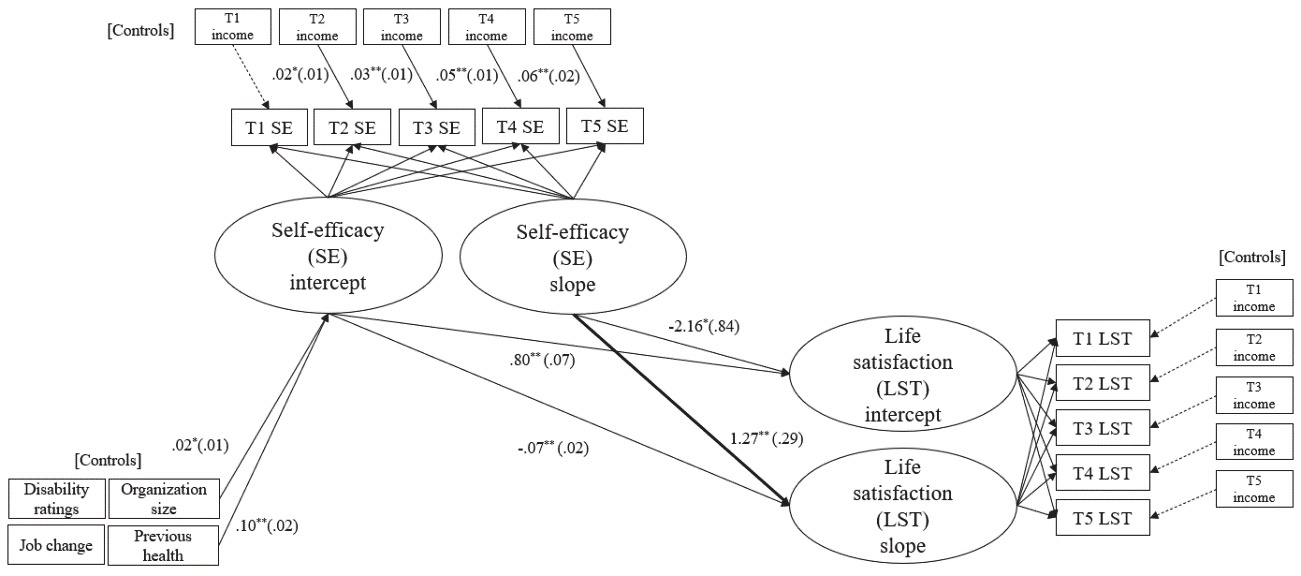
Note. For the sake of parsimony, nonsignificant paths have been omitted from the visual representation of the model, with the exception of the paths representing the influence of annual income. In this case, nonsignificant paths are denoted by dashed lines. *p<.05, **p<.01.
To further examine the relationships among gender, the trajectory of self-efficacy, and the trajectory of life satisfaction, an additional parallel process latent growth modeling was utilized. The model showed a good fit to the data: χ²(112)=189.74, CFI=.98, TLI=.97, RMSEA=.03, and SRMR=.04. The results are illustrated in Figure 2. We found that injured workers' gender (female) was negatively associated with the growth rate of self-efficacy (B=-.03, p<.05). Hence, Hypothesis 3-1 was supported. Further, increases in self-efficacy was positively related to increases in life satisfaction (B=1.3, p<.01). To assess the significance of the indirect effects, we conducted a bootstrap analysis with 5,000 iterations to generate bias-corrected confidence intervals. Injured workers’ gender (female) had a negative indirect relationship with increases in life satisfaction through increases in self-efficacy (B=-.04, 95% CI= [-.08, -.01]). Thus, Hypothesis 3-2 was supported.
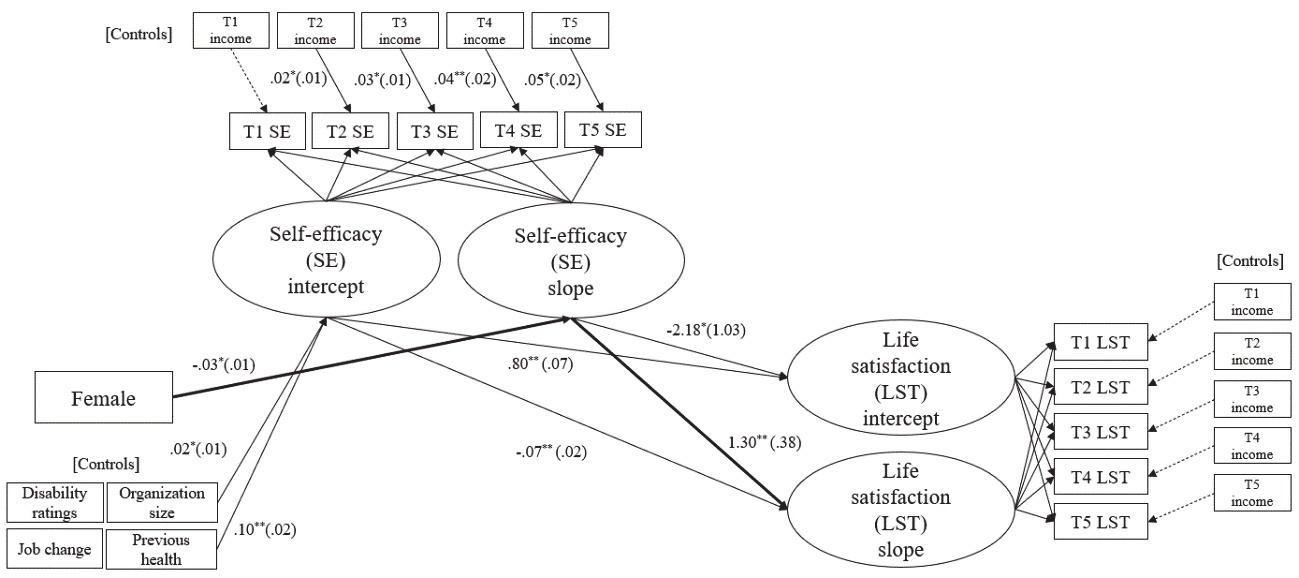
Note. For the sake of parsimony, nonsignificant paths have been omitted from the visual representation of the model, with the exception of the paths representing the influence of annual income. In this case, nonsignificant paths are denoted by dashed lines. *p<.05, **p<.01.
Ⅴ. Discussion
This study examined the longitudinal effects of return to work on injured workers’ self-efficacy and life satisfaction, with a focus on gender differences. The latent growth modeling results showed that returning to work steadily increased self-efficacy over time. The observed increase in self-efficacy was associated with subsequent increases in life satisfaction. Importantly, women experienced smaller gains in self-efficacy, which in turn limited their increases in life satisfaction. This suggests a gendered disparity in how workers psychologically benefit from return to work.
These findings offer two key theoretical contributions. First, prior research established that returning to work is associated with higher well-being (Vestling et al., 2003) and that self-efficacy predicts return-to-work outcomes (Black et al., 2018), but these relationships were documented cross-sectionally or with self-efficacy treated solely as a predictor of return. Our study extends this work by showing that self-efficacy gained from returning to work drives subsequent life satisfaction, and that this restorative process unfolds progressively over time. As such, we highlight that work functions not only as an economic activity but also as a sustained source of psychological well-being (Budd, 2019). In this way, our findings illuminate the symbolic and restorative value of work, suggesting its potential to act as a form of welfare in the post-injury recovery process. Further, recent research shows that well-being interventions are most effective when tailored to particular psychological factors (e.g., Huang et al., 2025), underscoring the importance of focused evaluations.
Second, drawing on perspectives that emphasize socially constructed disparities in status and institutionalized masculine norms, namely status characteristic theory (Berger et al., 1972) and the notion of “masculine default” (Cheryan and Markus, 2020), we theorized and empirically demonstrated that the restorative process of return to work is not experienced equally across genders. Return-to-work has long been theorized as a key mechanism for restoring a sense of competence, identity, and social integration (Budd, 2019; Pransky et al., 2016). Yet our longitudinal findings reveal that female injured workers exhibit significantly slower trajectories of self-efficacy enhancement and life satisfaction improvement following return to work compared to their male counterparts. Lindsay et al. (2018) showed that women with disabilities face specific barriers (e.g., lowered family expectations, gender-stereotypical vocational training, and weaker vocational rehabilitation support). Our findings suggest that these barriers continue to constrain the mastery experiences and workplace support through which self-efficacy is rebuilt after injury. These results call into question the unconditional universality of this process, showing that gendered status hierarchies and male-centric institutional norms may constrain women’s ability to fully engage in such psychological recovery. It is important to note, however, that return to work is not an uncomplicated positive process even for the general injured worker population: regardless of gender, returning workers may encounter social stigma, occupational identity disruption, and institutional pressures that complicate psychological recovery (Pransky et al., 2016). Our general hypotheses (H1-1, H1-2) reflect the net positive prediction derived from COR theory that the resources gained through work reintegration outweigh these challenges on average. The gendered hypotheses (H3-1, H3-2), in turn, capture the structural barriers that specifically amplify these challenges for female injured workers, producing statistically detectable differences in recovery trajectories.
5.1 Limitations and Future Research
This study has several limitations. First, while our sample comprised workers who maintained employment during all five waves of data collection, this design choice may have introduced a potential selection bias. Specifically, a healthy worker survivor bias (Buckley et al., 2015) may exist, as individuals with more severe injuries or lower self-efficacy who left employment earlier were not captured in the sample. Given our theoretical argument that women face systematic disadvantages in resource recovery, female injured workers may be disproportionately represented among those who exited employment and were thus excluded from the sample. If so, the gender gap in self-efficacy and life satisfaction trajectories observed in our study may be conservative, understanding the full extent of gendered disparities in post-injury psychological recovery. Additionally, the negative covariance between initial levels and growth rates in our models indicates workers who started higher showed slower gains–a ceiling effect that may further attenuate the observed trajectories and gender differences. Accordingly, the reported growth rates and gender gaps may underestimate the magnitude of these differences. Also, workers with significant recovery challenges or barriers to reintegration were excluded from our analysis. We invite future researchers to utilize more inclusive sampling that follows injured workers regardless of their employment status, enabling comparisons between those who successfully maintain employment and those who exit the labor force.
Second, the use of self-reported data by injured workers may be vulnerable to social desirability bias and common method variance (Podsakoff et al., 2003). In particular, life satisfaction was measured using a single item, which may raise concerns regarding measurement reliability. Although single-item life satisfaction measures have demonstrated reliability in prior research (e.g., Lucas and Donnellan, 2012), future research should consider adopting multi-item scales such as the Satisfaction with Life Scale (SWLS; Diener et al., 1985). Also, future researchers could collect data from multiple sources (e.g., objective indicators such as advancement rates and supervisor or peer evaluations). Additionally, employing ecological momentary assessment (e.g., experience sampling method) may offer valuable insights into the temporal fluctuations of self-efficacy and life satisfaction throughout the return-to-work process, thereby deepening our understanding of these developmental trajectories.
Third, the unique socio-cultural characteristics of South Korea, in which our data were collected, may constrain the generalizability of our findings. Considering that South Korea has the huge gender wage gap among OECD countries (OECD, 2023), the structural challenges faced by female workers in the Korean labor market could be particularly pronounced.
These contextual elements may interact with the recuperation experiences associated with occupational injuries, showing different patterns observed in more gender-equal societies. Lastly, while we theorize that workplace reintegration is the primary driver of the observed self-efficacy and life satisfaction trajectories, the current research design cannot fully disentangle return-to-work specific effects from natural recovery processes, emotional adjustment, or the simple passage of time since injury. The absence of a comparison group of injured workers who did not return to work during the same period limits causal attribution.
Thus, we suggest directions for future research. First, the present study was conducted within a single cultural context, which may limit the generalizability of the findings. Future research would benefit from cross-cultural comparative studies that examine how varying degrees of (objective and subjective) gender equality and cultural norms shape the return-to-work experiences of injured workers. Second, future research should employ quasi-experimental designs such as propensity score matching between returning and non-returning injured workers or experience sampling methods capturing day-to-day fluctuations in psychological states to better isolate the return-to-work specific effect on psychological resource trajectories.
5.2 Conclusion
Our findings highlight the need for gender-sensitive return-to-work programs that address the slower self-efficacy recovery among female workers. Organizations could implement mentoring programs pairing female injured workers with successful female role models who have navigated similar challenges. More specifically, organizations should consider three type of gender-sensitive interventions. First, phased job reassignment programs can provide female injured workers with modified roles upon initial return that offer early, visible opportunities to demonstrate competence which directly supplies the enactive mastery experiences (Bandura, 1997) that accelerate self-efficacy restoration. Second, flexible work arrangements — including phased return schedules, reduced-hour options, and remote work — can mitigate the competing caregiving demands that disproportionately burden female workers during recovery, reducing the role conflict that otherwise impedes sustained workplace reintegration. Third, gender-sensitive mentoring programs that connect female injured workers with experienced female colleagues who have successfully navigated similar recovery processes can provide vicarious efficacy experiences and counter the low-competence expectations they may encounter up on return.
Additionally, policy reforms should address inequalities impeding women's psychological recovery following occupational injuries. Recent research suggests that individual-level coping strategies alone may be insufficient to address burnout, highlighting the need for structural and organizational interventions (e.g., Mihai et al., 2025). Gender-sensitive monitoring systems can track intervention effectiveness over time, while comprehensive follow-up systems should monitor both physical recovery and psychological well-being indicators. Through this holistic approach, decision-makers can create more equitable support systems that recognize the gendered nature of post-injury recovery, fostering better outcomes for all injured workers.
Author Biographies
∙ Yeseul Jo is currently an assistant professor in the Department of Business Administration at Sungshin Women's University. Her research focuses on diversity, well-being, proactivity, and the future of work.
∙ Minju Shin is an assistant professor in the Department of Business Administration at Pukyong National University. Her research focuses on labor issues from generational and gender perspectives.