
.jpeg)
Hidden Pay, Hidden Voice: Justice as a Mediator and Pay Level as a Boundary Condition
1 서울대학교, 경영학 박사과정 (Seoul National University, Ph.D. candidate in Business Administration)
2 서울대학교, 경영대학 교수 (Seoul National University, Professor, College of Business Administration)
교신저자: 이현정 (leehjwoo@snu.ac.kr)
DOI: https://doi.org/10.17287/kmr.2026.55.2.613
Abstract
Despite extensive research on the organizational consequences of pay information disclosure, relatively little is known about how pay transparency and pay secrecy shape employees’ voice behavior. This research addresses this gap by examining how pay information disclosure indirectly influences employee voice behavior through perceptions of organizational justice. We tested our theoretical model across two complementary time-lagged survey studies. Study 1, conducted with South Korean employees (N = 203), provided initial evidence that pay secrecy reduces both promotive and prohibitive voice behavior by lowering organizational justice perceptions. Study 2, using a sample of U.S. employees (N = 182), replicated these findings and further tested pay level as a boundary condition. Results showed that pay information disclosure indirectly increased both promotive and prohibitive voice behavior through heightened perceptions of organizational justice. Moreover, this indirect effect was contingent upon employees’ pay level, such that the positive indirect effect of pay transparency on voice via justice perceptions was stronger among lower-paid employees. Together, these findings contribute to research on pay information disclosure and employee voice by identifying organizational justice as a key mechanism and pay level as a meaningful boundary condition.
김성수 교수는 서울대학교 경영연구소의 연구지원을 받음.
Ⅰ. Introduction
Organizations are entering an era in which pay transparency is no longer a discretionary choice but a regulatory mandate. Several U.S. states are enacting salary-range disclosure laws that require employers to list pay bands in job postings starting in 2025. In Europe, the EU’s Pay Transparency Directive mandates that member states implement national laws by June 2026 requiring pay criteria disclosure, gender-gap reporting, and salary-range transparency. In South Korea, a pay disclosure plan is under consideration aimed at narrowing the gender pay gap by comprehensively disclosing the wage status of male and female employees in both public and private organizations. Consequently, in this era of strengthened pay transparency, there is a growing need to examine how pay information disclosure shapes various organizational outcomes.
In line with these societal demands, organizational scholars have increasingly focused on understanding how pay transparency influences employee attitudes, behaviors, and broader workplace dynamics (Park et al., 2024). Organizations continue to uphold pay secrecy because it offers several advantages, and scholars have identified multiple reasons for this practice. For example, it can protect employee privacy (Cullen and Perez-Truglia, 2023), reduce unnecessary envy and conflict among coworkers (Bamberger and Belogolovsky, 2017), and allow managers greater discretion in compensation decisions (Day, 2012). However, the benefits of greater pay transparency have become increasingly evident, as research shows that higher levels of pay information disclosure can enhance pay satisfaction (Scheller and Harrison, 2018), improve individual performance (Bamberger and Belogolovsky, 2010; Belogolovsky and Bamberger, 2014) and organizational citizenship behavior (Marasi et al., 2018), reduce deviant or counterproductive work behavior (Marasi et al., 2018; Siman Tov-Nachlieli and Bamberger, 2021), and increase the retention of high-performing employees (Alterman et al., 2021; Card et al., 2012). These positive effects largely stem from increased fairness perceptions and organizational trust that arise when employees have access to accurate and consistent pay information (Alterman et al., 2021; Brown et al., 2022; Marasi et al., 2018; Stofberg et al., 2022). Thus, from an organizational perspective, increasing pay disclosure and promoting transparency may serve as an effective means to motivate employees and improve overall performance.
While extensive research has examined how pay information disclosure affects employee outcomes (e.g., Marasi et al., 2018; Siman Tov-Nachlieli and Bamberger, 2021), the implications of pay information disclosure on employees' voice behavior have received surprisingly limited attention. Voice behavior, defined as the discretionary communication of constructive ideas, concerns, or suggestions intended to improve organizational effectiveness (Van Dyne and Le Pine, 1998; Morrison, 2023), is particularly critical because it allows organizations to proactively address problems, foster innovation, and enhance decision-making quality (Choi et al., 2020). The way an organization handles pay information (whether it discloses or withholds it) serves as a salient signal of its broader communication climate, which can influence employees’ decisions about whether to speak up or remain silent. Despite the clear potential significance of this relationship, research explicitly exploring how pay information disclosure relates employee voice remains scarce.
Moreover, organizational justice perceptions—encompassing distributive, procedural, and informational justice—have been widely identified as important predictors of employee voice behavior (Colquitt et al., 2001; Detert and Edmondson, 2011). However, the mediating role of organizational justice in the relationship between pay information disclosure and employee voice has been notably overlooked in prior studies. To date, research has separately addressed the impact of pay transparency on justice perceptions (Colella et al., 2007; Marasi et al., 2018) and the positive relationship between justice perceptions and voice (Detert and Burris, 2007; Liang et al., 2012). Yet, the integrated pathway linking pay information disclosure to voice through shifts in organizational justice perceptions has received little empirical attention.
The current study addresses this critical research gap by proposing and empirically testing a model in which pay information disclosure indirectly enhances employee voice behavior by increasing organizational justice perceptions. Drawing upon the organizational justice theory (Colquitt, 2001; Greenberg, 1990) and social exchange theory (Blau, 1964), this study investigates how pay information disclosure affects employees' organizational justice perception. Furthermore, we argue that organizational justice subsequently increases employees' willingness to engage in voice behavior, thus establishing an indirect positive relationship between pay information disclosure and voice behaviors.
Beyond examining the mediating role of justice, we also investigate how pay level functions as a boundary condition. Because employees at different pay levels attach different meaning and importance to pay information, the effects of disclosure on justice and subsequent voice are likely to vary (Bamberger and Belogolovsky, 2017; Montag-Smit and Smit, 2021); thus, we consider pay level to be a critical conditional factor. By integrating uncertainty management theory (Lind and Van den Bos, 2002), social comparison theory (Festinger, 1954), and equity theory (Adams, 1965), we suggest that employees may respond more or less sensitively depending on their pay levels under identical conditions of pay disclosure (Siman Tov-Nachlieli and Bamberger, 2021). Those receiving higher pay are more likely to perceive their situation as fair or justified, and therefore, the presence or absence of pay-related information may have limited influence on their perceptions of organizational justice and subsequent proactive behaviors. In contrast, employees with lower pay levels are more likely to evaluate their pay—both in terms of amount and the transparency of its determination process—as key signals of fairness. Accordingly, such evaluations are expected to play a more substantial role in shaping their perceptions of justice and, ultimately, their willingness to engage in voice behavior.
This study offers several important contributions to the existing literature. First, it extends prior research by examining the indirect mechanism linking pay information disclosure, organizational justice perceptions, and voice behavior—thus bridging and integrating the justice and pay communication literatures (Colella et al., 2007; Marasi et al., 2018). In doing so, we clarify the underlying psychological processes through which pay information disclosure influences critical employee behaviors.
Second, we identify pay level as a critical contextual factor that moderates the relationship between pay information disclosure and voice behavior through organizational justice perceptions. Although prior research has demonstrated that employees’ perceived pay position relative to referent others moderates the effect of outcome pay transparency and distributive justice (Siman Tov-Nachlieli and Bamberger, 2021), the present study extends this work by examining how the objective level of pay can also influence the relationship between pay information disclosure and organizational justice perceptions.
Third, from a practical standpoint, our findings highlight potential risks associated with pay secrecy policies. Specifically, maintaining pay secrecy may inadvertently create a culture of silence, discouraging employees from sharing constructive feedback and suggestions critical to organizational innovation and risk management (Detert and Edmondson, 2011; Morrison, 2023). Moreover, this study suggests that HRM (human resource management) strategies regarding pay communication may need to be tailored to employees’ actual pay levels in order to effectively manage perceptions of pay secrecy.
Ⅱ. Hypotheses Development
2.1 Pay Information Disclosure and Employee Voice
Pay information disclosure refers to the communication of pay-related information among organizational members (Brown et al., 2022). As widely noted, it is best understood as a continuum that spans from strong pay secrecy to full pay transparency (Colella et al., 2007; Brown et al., 2022). Higher levels of disclosure reflect greater transparency, characterized by open access to pay information and clarity regarding how pay is determined (Ramachandran, 2011). In contrast, lower levels of disclosure reflect stronger pay secrecy, in which organizations restrict employees’ access to information about others’ compensation or the criteria used to set pay (Colella et al., 2007; Marasi et al., 2018).
Scholars have long investigated how varying levels of pay information disclosure shape employees’ work attitudes and behaviors. A substantial body of research demonstrates that increasing transparency in compensation systems enhances employees’ perceptions of fairness and trust in their employers (Siman Tov-Nachlieli and Bamberger, 2021; Stofberg et al., 2022). These positive perceptions translate into a range of beneficial outcomes, such as improved individual performance and citizenship behaviors toward both coworkers and the organization (Bamberger and Belogolovsky, 2010; Bamberger and Belogolovsky, 2014; Marasi et al., 2018), and lower levels of deviant or counterproductive work behavior (Marasi et al., 2018; Siman Tov-Nachlieli and Bamberger, 2021). Pay transparency has also been shown to strengthen retention outcomes (Stofberg et al., 2022), particularly among high-performing employees (Alterman et al., 2021; Card et al., 2012). However, despite these well-documented consequences, surprisingly little empirical attention has been devoted to understanding how pay secrecy relates to employee voice behavior. This omission is noteworthy because voice, defined as employees’ voluntary expressions of suggestions, concerns, or ideas intended to enhance organizational functioning (Van Dyne and Le Pine, 1998; Morrison, 2023), is widely recognized as a critical mechanism through which employees contribute to organizational effectiveness (Kim et al., 2024; Bashshur and Oc, 2015).
Voice behavior is commonly differentiated into promotive and prohibitive forms. Promotive voice involves proposing new ideas or improvements to strengthen team or organizational effectiveness, whereas prohibitive voice entails speaking up about practices, events, or behaviors that may harm the organization (Liang et al., 2012). Although the two types differ in motivational orientation—with promotive voice reflecting a promotion focus and prohibitive voice reflecting a prevention focus (Lin and Johnson, 2015)—they share similar psychological under-pinnings. Both represent proactive efforts undertaken by employees to support organizational functioning (Chamberlin et al., 2017; Liang et al., 2012). Importantly, both forms carry interpersonal and career-related risks, as employees may face social or evaluative costs for speaking up (Brinsfield, 2013; Milliken et al., 2003). For this reason, although we distinguish between promotive and prohibitive voice for conceptual clarity, we expect pay information disclosure to exert similar effects across the two forms.
The discretionary and risky nature of voice behaviors makes it particularly sensitive to employees' perceptions of how they are treated by their organization. Social exchange theory posits that employees evaluate the quality of their relationship with the organization based on the resources and information the organization provides (Blau, 1964; Cropanzano and Mitchell, 2005). Because pay information is one of the most sensitive and consequential forms of organizational information, the degree of disclosure may serve as a critical signal of whether the organization is willing to engage in open, reciprocal, and trustworthy exchanges with its members. When organizations disclose pay information transparently, employees are more likely to interpret such disclosure as a signal that the organization values fairness and sincerely supports employees with respect (Stofberg et al., 2022). This, in turn, fosters a stronger sense of reciprocity (Marasi et al., 2018), thus more willing to offer constructive voice (Kim, 2025). In contrast, when pay information is restricted, employees may perceive the organization as withholding vital resources and limiting reciprocal exchange, which can erode trust and commitment (Scheller and Harrison, 2018; Alterman et al., 2021), ultimately discouraging voice behaviors. Thus, we expect that high level of pay information disclosure would enhance employee’s voice behaviors.
2.2 Organizational Justice as a Mediator
Building on this logic, we propose that organizational justice serves as the key mechanism through which pay information disclosure influences voice behavior. Organizational justice theory provides a framework for understanding what constitutes fair treatment, identifying two primary dimensions that are particularly relevant to compensation practices: distributive justice (whether outcomes like pay are allocated fairly based on relevant contributions) and procedural justice (whether decision-making processes are consistent, unbiased, and transparent) (Colquitt, 2001; Greenberg, 1990). These justice perceptions are crucial for voice behavior because research consistently shows that employees are more willing to speak up when they believe their input will be treated fairly and their contributions are valued (Liang et al., 2012; Detert and Treviño, 2010).
Low level of pay information disclosure (i.e., pay secrecy) poses a direct threat to both dimensions of organizational justice, creating the psychological conditions that discourage voice behavior. Regarding distributive justice, pay secrecy prevents employees from accurately assessing whether their compensation is fair relative to others with similar qualifications, performance, or responsibilities. Without access to comparative information, employees often develop systematically biased perceptions of inequity, typically overestimating others' pay while underestimating their own relative standing (Lawler, 1967; Card et al., 2012). These distorted perceptions of unfair outcomes may undermine employees’ motivation to engage in discretionary voice behavior.
Concerning procedural justice, pay secrecy obscures the very processes through which compensation decisions are made. When information about evaluation criteria, decision-making procedures, and the consistency of their application remains hidden, employees cannot assess whether these processes are fair and unbiased (Tremblay et al., 2000). This opacity may lead employees to assume that compensation decisions are arbitrary, inconsistent, or influenced by favoritism rather than merit. Such perceptions of procedural unfairness signal that the organization may not be trustworthy or receptive to employee input, thereby discouraging voice behavior.
In contrast, high levels of pay information disclosure (i.e., pay transparency) can foster both forms of justice, thereby strengthening employees’ willingness to speak up. Greater pay transparency enables employees to evaluate their compensation relative to peers using accurate information rather than assumptions, reducing reliance on biased social comparisons and reinforcing the perception that outcomes are distributed fairly (Day, 2012; Siman Tov-Nachlieli and Bamberger, 2021). When pay levels and evaluation criteria are disclosed, employees can better understand how their pay aligns with their contributions (Colella et al., 2007), which enhances distributive fairness perceptions and supports greater engagement in voice.
Similarly, pay transparency can also increase procedural justice perceptions, as it allows employees to understand and evaluate the legitimacy of compensation processes (Colella et al., 2007; Day, 2012). When the rationale behind pay decisions is openly communicated, employees are more likely to perceive these processes as fair, merit-based, and predictable (Siman Tov-Nachlieli and Bamberger, 2021). This perception of procedural fairness signals that employee input is valued, thereby making voice behavior feel less risky and more worthwhile.
Accordingly, drawing on social exchange theory and organizational justice theory, along with empirical evidence linking justice perceptions to voice behavior, we propose that pay information disclosure indirectly influences employees’ promotive and prohibitive voice behaviors through perceptions of organizational justice:
Hypothesis 1 (H1): Pay information disclosure will influence both promotive and prohibitive voice behaviors indirectly through organizational justice perceptions, such that pay secrecy decreases—whereas pay transparency increases—organizational justice perceptions, which in turn enhances employees’ likelihood of engaging in either form of voice behavior.
2.3 Pay level as a Boundary Condition
Uncertainty management theory (UMT) posits that individuals rely more heavily on fairness-related information when facing ambiguous, unpredictable, or uncontrollable situations (Lind and Van den Bos, 2002). In such contexts, organizational justice serves as a critical psychological resource that helps individuals navigate uncertainty, restore a sense of control, and reduce anxiety. Rather than responding solely to objective conditions, individuals actively search for fairness cues to interpret their environment, especially when they lack clarity or feel vulnerable (Van den Bos and Lind, 2002). Thus, justice becomes more influential not in all situations equally, but particularly when ambiguity is high and individuals are motivated to reduce uncertainty.
In the context of pay information disclosure, this dynamic becomes particularly salient. The absence of transparency about compensation systems inherently introduces ambiguity regarding one’s relative worth, treatment, and standing within the organization (Colella et al., 2007). Social comparison theory (Festinger, 1954) and equity theory (Adams, 1965) further suggest that employees do not interpret this ambiguity uniformly. Social comparison theory proposes that individuals evaluate their compensation by comparing themselves to relevant others (Festinger, 1954), and equity theory argues that individuals assess fairness by comparing their input–outcome ratios with those of peers (Adams, 1965). When pay information is concealed, opportunities to make accurate comparisons diminish, prompting employees (especially those in disadvantaged positions) to presume unfavorable comparisons.
Consistent with these theories, we argue that the extent to which individuals perceive and react to the ambiguity created by pay secrecy depends on their own pay level—an indicator that, in this study, is conceptualized as reflecting employees’ objective monthly income while also capturing their relative standing within the compensation structure. Employees at lower pay levels are likely to experience greater ambiguity and perceived vulnerability under conditions of pay secrecy. Without access to comparative information, they lack a clear basis for assessing whether their compensation is fair relative to others. This ambiguity, coupled with their already disadvantaged position, heightens the psychological threat they experience. As a result, they are more inclined to scrutinize organizational practices through the lens of fairness, using justice perceptions as a means of managing their uncertainty (Lind and Van den Bos, 2002). Given their lower pay standing, these employees may be especially susceptible to interpreting hidden pay information as evidence of potential inequity, thereby reacting more strongly when fairness cues are absent.
In contrast, higher-paid employees are less likely to experience such ambiguity as threatening. Given their favorable outcomes, they may presume that the system is functioning fairly—what Van den Bos (2001) refers to as the fairness heuristic. Because their compensation already confirms a sense of personal value or legitimacy within the organization, they are less motivated to seek additional fairness cues to reduce uncertainty. Moreover, empirical evidence shows that higher pay levels are associated with greater perceptions of distributive justice (Tekleab et al., 2005), reinforcing the notion that higher-paid employees are less susceptible to interpreting pay secrecy as unfair. As a result, pay information disclosure is less likely to activate concerns about justice among higher-paid individuals, leading to weaker emotional and behavioral reactions.
Taken together, these theoretical and empirical insights including UMT, social comparison theory, and equity theory indicate that pay level systematically shapes how employees interpret pay information disclosure. Specifically, lower-paid employees exhibit stronger justice reactions to variations in pay transparency or secrecy. Because organizational justice is a well-established antecedent of voice behavior (Liang et al., 2012), this moderated relationship carries implications for downstream outcomes. Specifically, the indirect effect of pay information disclosure on promotive and prohibitive voice behaviors through organizational justice perception should be conditional on employees’ pay level, being stronger for those in lower-paying positions. Thus, we hypothesize that:
Hypothesis 2 (H2): Pay level will moderate the indirect relationship between pay information disclosure and employees’ promotive and prohibitive voice behaviors via organizational justice perceptions, such that the positive indirect effect of high pay information disclosure will be stronger among employees with lower pay levels.
Synthesizing the above discussion, the proposed research model is presented in Figure 1.
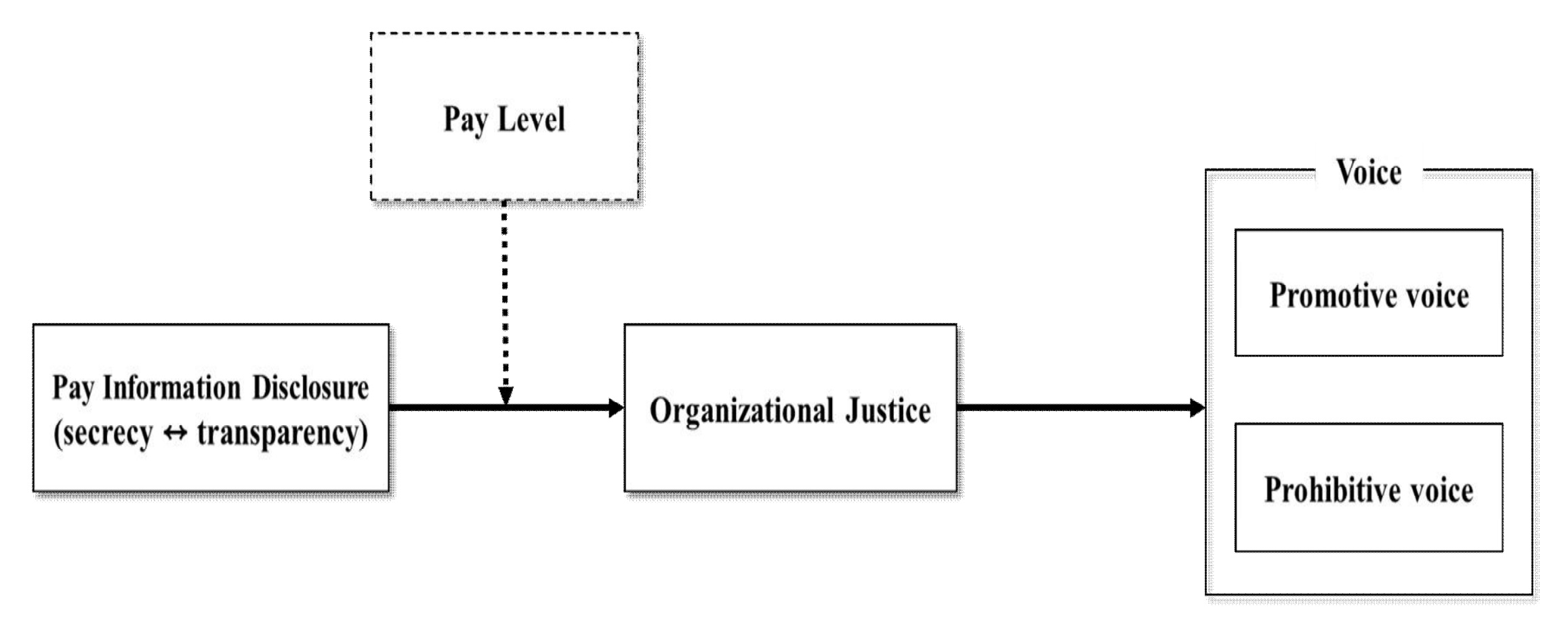
Note. Paths shown with solid lines were tested in both Study 1 and Study 2; a path shown with dashed lines was tested only in Study 2.
Ⅲ. Overview of Studies
To comprehensively investigate the hypothesized relationship between pay information disclosure and employee voice behaviors, we conducted two studies using time-lagged survey methodologies. The two studies shared the same theoretical framework but differed in variable operationalizations. Study 1 aimed to provide an initial test of the proposed mediation model using a Korean sample. Specifically, it examined the relationship between pay secrecy and employee voice (measured as promotive and prohibitive forms), mediated by organizational justice. Study 2 aimed to replicate and extend these findings using a U.S. employee sample and an alternative operationalization of the focal construct. Specifically, it examined pay transparency, which is conceptually opposite to pay secrecy on the same continuum, to test the robustness of the proposed mechanism. Further, study 2 distinguished organizational justice into distributive and procedural dimensions to provide a more nuanced test of its mediating role, while additionally including pay level as a moderator.
Notably, while Study 1 operationalized the focal construct as pay secrecy, Study 2 adopted a conceptually related but opposite operationalization, pay transparency, which is conceptualized along a single secrecy–transparency continuum (Brown et al., 2022; Colella et al., 2007). This deliberate variation was not intended merely for conceptual diversity but reflected a methodological and theoretical rationale.
First, by employing opposite operationalizations of the same construct, we sought to conduct a form of construct validity triangulation (Campbell and Fiske, 1959; Jick, 1979). When the same theoretical mechanism is replicated across distinct operationalizations, the consistency of results indicates that the observed effects stem from the underlying construct itself rather than from specific measurement choices. In this case, if both the negatively framed pay secrecy and the positively framed pay transparency yield parallel justice-based mediation patterns, this convergence provides strong evidence that the theorized mechanism is a function of pay disclosure per se.
Second, adopting opposite framings also reduces potential measurement contamination and framing-specific response bias. Pay secrecy scales often rely on negatively worded items (e.g., “information about pay is restricted”), which can induce affective or socially desirable response tendencies (Schwarz, 1999; Tourangeau et al., 2000), whereas pay transparency measures typically use positively valenced items (e.g., “pay information is clearly communicated”). Alternating between these opposite framings across studies helps counterbalance wording polarity effects and reduces common method bias, as recommended by Podsakoff et al. (2003).
Finally, integrating both secrecy and transparency perspectives extends the theoretical generalizability of our findings on pay information disclosure. Prior research has predominantly emphasized the harms of secrecy (Colella et al., 2007) or the benefits of transparency (Bamberger and Belogolovsky, 2017; Brown et al., 2022). Examining both ends of this continuum allows our study to test whether the same justice-based mechanism operates consistently across the full spectrum of pay disclosure practices, thereby clarifying when and why disclosure enhances or undermines employee voice.
Through this two-study design, our research can provide a rigorous, triangulated test of the proposed model, reduce framing-related measurement artifacts, and broaden the theoretical scope of pay disclosure research.
Ⅳ. Study 1 Method
4.1 Sample and Procedure
To test the hypotheses of this study, we conducted a two-wave time-lagged online survey with full-time employees from various industries in South Korea. Participants were recruited through Macromill Embrain, a Korean survey platform analogous to Amazon’s Mechanical Turk (MTurk). The panel consisted of individuals aged 20 to 59 who were currently employed in regular positions and voluntarily agreed to participate after being informed of the study’s purpose. This online panel approach has been widely used in recent management research both domestically and internationally (Lee et al., 2020), including in studies on pay secrecy (e.g., Marasi et al., 2018). To enhance external validity and representativeness beyond convenience sampling, stratified sampling was employed by gender and age. Participants received monetary compensation per survey, similar to MTurk protocols. At Time 1, 345 respondents completed the survey, of whom 203 participated at Time 2, resulting in a retention rate of 58.8%. Among the participants, 53.2% were women. Regarding educational background, 8.9% had completed high school or less, 19.2% graduated from two-year colleges, 65.5% held a bachelor’s degree, and 6.4% had completed postgraduate education. Participants represented a range of industries, with manufacturing accounting for the largest proportion (39.4%), followed by services (20.2%), information and communication (10.3%), construction (7.4%), distribution (6.4%), finance (2.5%), and others (13.8%).
4.2 Measures
We measured predictor and moderator variables at Time 1, and outcome variables at Time 2, with a 7–10 day interval between measurements. All survey instruments were originally developed in English and were translated into Korean using standard back-translation procedures (Brislin, 1986) to ensure conceptual and linguistic equivalence across languages.
Pay secrecy was assessed using four items from Alterman et al. (2021). Sample items include “In my organization, employees are discouraged from sharing their pay with coworkers,” and “The organization does not disclose administrative procedures for determining pay and raises for managerial or technical roles.” Cronbach’s alpha was .887.
Organizational justice was measured using six items adapted from Ambrose and Schminke (2009), which capture respondents’ global evaluations of fairness within their organization. The items reflect both personal experiences (e.g., “Overall, I’m treated fairly by my organization”) and general perceptions about how the organization treats its employees (e.g., “For the most part, this organization treats its employees fairly”). Responses were rated on a seven-point Likert scale (1 = strongly disagree, 7 = strongly agree). Cronbach’s alpha for this scale was .852.
To capture employees’ voice behavior, we employed the two-dimensional measure developed by Liang, Farh, and Farh (2012), which distinguishes between promotive and prohibitive voice. Promotive and prohibitive voice were assessed at Time 2 using five items each, rated on a five-point Likert scale (1 = strongly disagree, 5 = strongly agree). A sample item for promotive voice is “Proactively develop and make suggestions for issues that may influence the unit,” while a sample item for prohibitive voice is “Speak up honestly with problems that might cause serious loss to the work unit, even when dissenting opinions exist.” Cronbach’s alpha was .913 for promotive voice and .866 for prohibitive voice.
Following prior employee research on voice and organizational justice (Colquitt 2001; Sibunruanga and Kawai, 2023; Tangirala and Ramanujam, 2008), this study included age, gender, education level, organizational tenure, and job level as control variables. Age was controlled because older employees tend to have higher informal status in organizations, which increases their confidence and likelihood of speaking up (Kim, 2023). Gender was included given evidence that cultural and social factors influence voice behavior differently by gender, with women preferring more supportive work environments and demonstrating distinct organizational justice perceptions (Adisa, 2024; Andersén and Andersén, 2019). Education was controlled to account for its role in shaping employees' access to organizational knowledge and fairness perceptions (Adisa, 2024; Kim, 2023). Organizational tenure was included because longer tenure reflects greater familiarity and comfort in voicing opinions in the organization, which influences employee voice behavior (Detert and Burris, 2007). Lastly, job level was controlled because formal hierarchical status independently impacts voice behavior and justice perceptions (Elovainio, 2004; Kim, 2023).
Age was computed in years based on participants’ self-reported birth year. Gender was measured using a single categorical item (0 = female, 1 = male). Education level was assessed using a single item coded from 1 to 5 (1 = high school diploma, 2 = two-year colleges, 3 = bachelor’s degree, 4 = master’s degree, and 5 = doctoral or other postgraduate degree). Organizational Tenure was calculated in months to capture more granular differences in service length. Job level was measured using a single item that asked respondents to indicate their current hierarchical position in the organization (1 = staff, 2 = assistant manager, 3 = manager, 4 = senior manager, and 5 = department manager or higher). These variables were treated as ordinal in the analyses.
4.3 Analytic Strategy
Prior to hypothesis testing, we conducted a confirmatory factor analysis (CFA) to evaluate the convergent and discriminant validity of our focal constructs: pay secrecy, organizational justice, promotive voice, and prohibitive voice. The hypothesized four-factor measurement model demonstrated acceptable fit indices: $\chi^2(146) = 263, p < .001$; CFI = .954; TLI = .946; RMSEA = .063 (90% CI = .050, –.075); SRMR = .057. All factor covariances aligned with theoretical expectations, showing significant associations in expected directions (p < .001). We further compared this four-factor model to alternative models. A three-factor model, combining promotive and prohibitive voice into a single latent factor, resulted in a poorer fit: $\chi^2(149) = 434, p < .001$; CFI = .887; TLI = .870; RMSEA = .097 (90% CI = .087, –.108); SRMR = .071. Additionally, a two-factor model, merging organizational justice with the combined voice measures into a single latent factor, showed an even worse fit: $\chi^2(134) = 886, p < .001$; CFI = .670; TLI = .623; RMSEA = .166 (90% CI = .156, –.177); SRMR = .116. Finally, the one-factor model with all measures loaded onto a single latent factor demonstrated the poorest fit among all alternatives: $\chi^2(135) = 1238, p < .001$; CFI = .516; TLI = .451; RMSEA = .201 (90% CI = .190, –.211); SRMR = .145. In summary, the four-factor model provided the best fit to the data and supported the convergent and discriminant validity of the constructs. Therefore, this four-factor structure was retained for subsequent analyses.
Ⅴ. Study 1 Results
Means, standard deviations, and correlations are reported in Table 1. Results from the regression analyses are summarized in Table 2. Pay secrecy had a significant negative effect on organizational justice (B = –.128, p = .018). Organizational justice, in turn, positively predicted both promotive voice (estimate = .249, p = .000) and prohibitive voice (B = .217, p = .001). We subsequently tested the indirect effects of pay secrecy on voice behaviors through organizational justice. As shown in Table 3, the indirect effect on promotive voice was significant and negative (B = –.0319, 95% CI = –.0807, –.0016). Similarly, the indirect effect on prohibitive voice was also significant and negative (B = –.0278, 95% CI = –.0697, –.0012). Additionally, the direct effects of pay secrecy on both promotive voice (B = –.0516, 95% CI = –.1553, .0522) and prohibitive voice (B = –.0452, 95% CI = –.1435, .0530) were not significant, indicating full mediation. These results provide strong support for Hypotheses 1, indicating that pay secrecy negatively influences both promotive and prohibitive voice behavior only through reduced perceptions of organizational justice.
Table 1 Correlation Matrix and Descriptive Statistics for All Variables (Study1)
| Variables | M | SD | 1 | 2 | 3 | 4 | 5 | 6 | 7 | 8 |
|---|---|---|---|---|---|---|---|---|---|---|
| 1. Age | 39.27 | 10.20 | ||||||||
| 2. Gender | .47 | .50 | .135 | |||||||
| 3. Education | 2.70 | .73 | -.026 | .142* | ||||||
| 4. Organizational Tenure | 87.66 | 78.22 | .604*** | .139* | -.045 | |||||
| 5. Job Level | 2.67 | 1.38 | .669*** | .372*** | .169** | .454*** | ||||
| 6. Pay Secrecy | 3.27 | 1.04 | -.235*** | .048 | -.037 | -.207** | -.021 | |||
| 7. Organizational Justice | 3.13 | .68 | .079 | .125 | .018 | .037 | .017 | -.181** | ||
| 8. Promotive Voice | 3.24 | .71 | .328*** | .211** | .108 | .223** | .290*** | -.162* | .285*** | |
| 9. Prohibitive Voice | 3.22 | .65 | .248*** | .093 | .070 | .171* | .245*** | -.137 | .250*** | .649*** |
Note. N = 203. * p < .05. ** p < .01. *** p < .001.
Table 2 Regression Analysis (Study1)
| Variables | Dependent variable: | |||||
|---|---|---|---|---|---|---|
| Organizational Justice | Promotive Voice | Prohibitive Voice | ||||
| Estimate | SE | Estimate | SE | Estimate | SE | |
| Hypothesized Predictors | ||||||
| Pay Secrecy | -.128* | .054 | -.052 | .053 | -.045 | .050 |
| Organizational Justice | .249*** | .069 | .217** | .065 | ||
| Control Variables | ||||||
| Age | .008 | .007 | .015* | .007 | .006 | .007 |
| Gender | .220* | .103 | .162 | .101 | -.020 | .095 |
| Education | .007 | .067 | .077 | .065 | .036 | .061 |
| Organizational Tenure | .000 | .001 | .000 | .001 | .000 | .001 |
| Job level | -.052 | .052 | .037 | .050 | .078 | .048 |
| $R2$ | .057 | .209 | .135 | |||
Note. N = 203. * p < .05. ** p < .01. *** p < .001.
Table 3 Direct and Indirect Effects of Pay Secrecy on Voice Behaviors (Study 1)
| Paths | Dependent variable: Voice behaviors | |||
|---|---|---|---|---|
| Effect | SE | LL 95% CI | UL 95% CI | |
| Direct effect (Pay Secrecy → Promotive Voice) | -.0516 | .0526 | -.1553 | .0522 |
| Indirect effect (Pay Secrecy → Organizational Justice → Promotive Voice) | -.0319 | .0203 | -.0807 | -.0016 |
| Direct effect (Pay Secrecy → Prohibitive Voice) | -.0452 | .0498 | -.1435 | .0530 |
| Indirect effect (Pay Secrecy → Organizational Justice → Prohibitive Voice) | -.0278 | .0178 | -.0697 | -.0012 |
Note. N = 203. Bootstrap sample size = 5,000. LL = lower limit; CI = confidence interval. UL = upper limit.
Ⅵ. Study 2 Method
6.1 Sample and Procedure
Participants were recruited through Prolific, an online crowdsourcing platform. Prolific has been widely utilized in psychological and organizational research, as it produces data with internal and external validity comparable to that of traditional convenience sampling methods (Lin et al., 2022; Sherf and Morrison, 2020). To qualify for participation, participants had to be full-time employees working in the United States. To ensure data quality, only individuals with a Prolific approval rate of 97% or higher were eligible to participate.
Participants in the Time 1 survey responded to measures of pay transparency perceptions, pay level, and distributive and procedural justice, as well as demographic variables including age, gender, education, organizational tenure, and job level. Only those who completed the Time 1 survey were eligible to participate in the Time 2 survey, in which they reported on their voice behavior. The Time 2 survey was administered three days after the Time 1 survey.
Participants who chose to take part in each survey were first presented with a consent form on the initial page. They were informed that clicking the "Next" button would indicate their consent to participate in the study. Participants received £1.5 for completing each survey.
A total of 234 participants completed Time 1 survey, and 197 participants completed Time 2 survey. After excluding those who failed attention check items, 187 participants remained for the final analysis. Among the final sample, 43.85% identified as female, and 55.08% identified as male. 72.19% of the respondents reported being married, while 20.32% were single. The average participant age was 39 years (SD = 11.41). In terms of education level, 5.35% were high school graduate; 6.42% went to some college without degree; 5.88% had associate’s degree; 41.18% had bachelor’s degree; 36.68% had master’s degree; and 4.81% had doctorate or professional degree. Regarding organizational tenure, 2.14% of participants had worked for less than one year, 11.76% for 1 to 2 years, 27.76% for 3 to 5 years, 31.02% for 6 to 10 years, 17.65% for 11 to 15 years, 4.81% for 16 to 19 years, and 5.35% for more than 20 years.
6.2 Measures
Pay transparency was measured using eight items from Siman Tov and Bamberger (2021). Of these, four items assessed outcome pay transparency, referring to the extent to which actual pay levels of employees are disclosed. The remaining four items assessed process pay transparency, which captures the degree to which employees are informed about how pay is determined within the organization (Fulmer and Chen, 2014; Smit and Montag-Smit, 2019). A sample item for outcome pay transparency is: “My employer publishes pay information.” An example of process pay transparency is: “My company has held formal educational sessions in which they explain how pay levels are determined for its jobs.” All items were rated on a 5-point Likert scale ranging from 1 (strongly disagree) to 5 (strongly agree). Cronbach’s alpha coefficients were .89 for outcome pay transparency and .92 for process pay transparency, indicating high internal consistency.
Pay level was measured using a single item: “What is your average monthly income?” Responses were recorded on a 5-point scale: 1 = $2,000 or less, 2 = $2,001–$4,000, 3 = $4,001–$6,000, 4 = $6,001–$10,000, and 5 = $10,001 or more. These response categories were designed to reflect the typical income distribution of full-time workers in the United States. According to the U.S. Bureau of Labor Statistics (2025), the median weekly earnings of full-time workers were $1,194, which corresponds to a monthly income of approximately $4,776. In our sample, 8.18% of respondents selected category 1, 24.54% selected category 2, 25.00% selected category 3, 25.00% selected category 4, and 17.27% selected category 5.
Organizational justice was assessed using seven items: four items measuring distributive justice from Colquitt (2001), and three items measuring procedural justice from Sung et al. (2017). A sample item for distributive justice is “My pay reflects the effort I have put into my work,” while a sample item for procedural justice is “The organizational processes of performance appraisal and salary decisions are fair.” All items were rated on a 5-point Likert scale ranging from 1 (strongly disagree) to 5 (strongly agree). Cronbach’s alpha coefficients were .95 for distributive justice and .92 for procedural justice, indicating excellent internal consistency.
Voice behavior was measured using six items adapted from Liang et al. (2012), including three items assessing promotive voice and three items assessing prohibitive voice. A sample item for promotive voice is “I raise suggestions to improve the team (or unit)’s working procedure,” while a sample item for prohibitive voice is “I advise other colleagues against undesirable behaviors that would hamper job performance.” All items were rated on a 5-point Likert scale ranging from 1 (strongly disagree) to 5 (strongly agree). Cronbach’s alpha coefficients were .88 for promotive voice and .69 for prohibitive voice. Although the Cronbach’s alpha for prohibitive voice falls slightly below the conventional .70 cutoff, given the strong theoretical validity of the construct and the small number of items, the scale was retained.
As in Study 1, age, gender, education, organizational tenure, and job level were included as control variables. Age was computed in years based on participants’ self-reported birth year. Gender was measured using a single categorical item (1 = male, 2 = female, 3 = non-binary/third gender, 4 = prefer not to say). Education level was assessed using a single item coded from 1 to 7 (1 = less than high school, 2 = high school graduate, 3 = some college with no degree, 4 = associate’s degree, 5 = bachelor’s degree, 6 = master’s degree, 7 = doctoral or professional degree). Organizational tenure was measured with a single item coded from 1 to 8, indicating length of service (1 = less than 6 months, 2 = 6 months to 1 year, 3 = 1 to 2 years, 4 = 3 to 5 years, 5 = 6 to 10 years, 6 = 11 to 15 years, 7 = 16 to 20 years, 8 = more than 20 years). Job level was measured using a single item indicating respondents’ hierarchical position (1 = entry-level, 2 = mid-level, 3 = senior-level, 4 = executive-level, 5 = top-level). These variables were treated as ordinal in the analyses; robustness checks using dummy variables for job levels yielded substantively identical results. Following Becker’s (2005) recommendation, all analyses were conducted with and without controls, and results remained consistent. Reported results include control variables.
6.3 Analytic Strategy
As in Study 1, prior to hypothesis testing, we ran a confirmatory factor analysis (CFA) to assess the convergent and discriminant validity of our focal constructs: outcome and process pay transparency, distributive and procedural justice, and promotive and prohibitive voice behavior. Given that pay level is a single item, we excluded this construct for the CFA. The hypothesized six-factor measurement model demonstrated acceptable fit to the data: $\chi^2(174) = 291.55, p < .001$; CFI = .96; RMSEA = .06; SRMR = .043. All items significantly loaded onto their intended latent constructs ($p < .001$). Standardized factor loadings ranged from .68 to .92 for outcome pay transparency, .80 to .91 for process pay transparency, .86 to .94 for distributive justice, .86 to .89 for distributive justice, .77 to .91 for promotive voice, and .56 to .78 for prohibitive voice. In addition, the factor correlations aligned with theoretical expectations: both outcome and process pay transparency were positively associated with distributive and procedural justice, which, in turn, were positively associated with both promotive and prohibitive voice. Among the six factors, the correlation between distributive justice and procedural justice was the highest (.82), yet remained within an acceptable range for establishing discriminant validity.
In addition, this model had a better fit than other alternative models. A three-factor model with outcome and process pay transparency, procedural and distributive justice, and promotive and prohibitive voice loaded on three latent factors resulted in substantially worse fit: $\chi^2(186) = 905.41, p < .001$; CFI = .77; RMSEA = .14; SRMR = .11. Three four-factor models, where one of pay transparency, justice perception, or voice behavior dimensions were distinguished and the other two constructs were loaded on one latent factor showed worse fit: $\chi^2(183) = 498.28, p < .001$; CFI = .90; RMSEA = .10; SRMR = .08; $\chi^2(183) = 757.72, p < .001$; CFI = .81; RMSEA = .13; SRMR = .10; $\chi^2(183) = 847.36, p < .001$; CFI = .78; RMSEA = .14; SRMR = .11. Three five-factor models, where only one of pay transparency, justice perception, or voice behavior dimensions were loaded on one latent factor had worse fit than the six-factor model: $\chi^2(179) = 699.44, p < .001$; CFI = .83; RMSEA = .13; SRMR = .10; $\chi^2(179) = 440.08, p < .001$; CFI = .92; RMSEA = .09; SRMR = .06; $\chi^2(179) = 349.99, p < .001$; CFI = .94; RMSEA = .07; SRMR = .06. Because a five-factor model that collapsed distributive and procedural justice fit worse than a six-factor model that separated them, we retained them as distinct dimensions in Study 2 and in all subsequent analyses.
In sum, the results support both convergent and discriminant validity and validate the use of the six-factor structure in further analyses.
Ⅶ. Study 2 Results
Means, standard deviations, and correlations are in Table 4. After centering process and outcome pay transparency and pay level, we tested the hypothesized mediation and moderated mediation effects. Table 5 shows the results of path analysis. Process pay transparency had a significant positive effect on distributive (B = .344, p = .000) and procedural justice (B = .476, p = .000), while outcome pay transparency had no significant effect on both justice perceptions. Procedural justice had a significant positive effect on promotive voice behavior (B = .117, p = .026).
Table 4 Correlation Matrix and Descriptive Statistics for All Variables (Study2)
| Variables | M | SD | 1 | 2 | 3 | 4 | 5 | 6 | 7 | 8 | 9 | 10 | 11 | 12 |
|---|---|---|---|---|---|---|---|---|---|---|---|---|---|---|
| 1. Age | 38.58 | 11.41 | ||||||||||||
| 2. Gender | 1.47 | 0.54 | 0.18* | |||||||||||
| 3. Education | 5.11 | 1.16 | 0.03 | 0.02 | ||||||||||
| 4. Organizational tenure | 4.85 | 1.36 | 0.67** | 0.17* | 0.00 | |||||||||
| 5. Job level | 2.23 | 0.74 | 0.25** | 0.01 | 0.33** | 0.21** | ||||||||
| 6. Outcome pay transparency | 2.59 | 1.17 | 0.02 | 0.02 | 0.05 | -0.00 | -0.01 | |||||||
| 7. Process pay transparency | 2.92 | 1.18 | -0.16* | -0.06 | 0.24** | -0.11 | 0.15* | 0.46** | ||||||
| 8. Distributive justice | 3.28 | 1.07 | -0.06 | -0.14 | 0.15* | 0.02 | 0.13 | 0.13 | 0.45** | |||||
| 9. Procedural justice | 3.34 | 1.05 | -0.07 | -0.11 | 0.18* | -0.07 | 0.16* | 0.27** | 0.61** | 0.76** | ||||
| 10. Pay level | 3.17 | 1.2 | 0.11 | -0.15* | 0.40** | 0.15* | 0.32** | 0.02 | 0.28** | 0.39** | 0.32** | |||
| 11. Promotive voice | 4.1 | 0.61 | -0.04 | 0.04 | 0.08 | 0.01 | 0.27** | -0.10 | 0.08 | 0.19* | 0.21** | 0.10 | ||
| 12. Prohibitive voice | 3.69 | 0.73 | -0.14* | -0.03 | 0.11 | -0.09 | 0.16* | -0.03 | 0.17* | 0.25** | 0.23** | 0.16* | 0.47** |
Note. N = 187. *p < .05. **p < .01.
Table 5 Unstandardized Coefficients of the Path Analysis Model (Study2)
| Variables | Dependent variable: | |||||||
|---|---|---|---|---|---|---|---|---|
| Distributive Justice | Procedural Justice | Promotive Voice | Prohibitive Voice | |||||
| Estimate | SE | Estimate | SE | Estimate | SE | Estimate | SE | |
| Hypothesized Predictors | ||||||||
| OPT | -0.063 | 0.063 | 0.001 | 0.057 | -0.071 | 0.041 | -0.054 | 0.050 |
| PPT | 0.344*** | 0.066 | 0.476*** | 0.061 | -0.022 | 0.053 | 0.029 | 0.064 |
| Pay Level | 0.259*** | 0.061 | 0.143* | 0.056 | -0.015 | 0.043 | 0.033 | 0.052 |
| OPT × Pay Level | -0.116* | 0.053 | -0.076 | 0.048 | 0.004 | 0.035 | -0.021 | 0.043 |
| PPT × Pay Level | -0.130* | 0.053 | -0.109* | 0.048 | -0.022 | 0.036 | 0.017 | 0.043 |
| Distributive Justice | 0.022 | 0.048 | 0.105 | 0.058 | ||||
| Procedural Justice | 0.117* | 0.053 | 0.036 | 0.063 | ||||
| Control Variables | ||||||||
| Age | -0.001 | 0.008 | 0.007 | 0.007 | -0.007 | 0.005 | -0.010 | 0.006 |
| Gender | -0.113 | 0.121 | -0.079 | 0.111 | 0.091 | 0.080 | 0.049 | 0.096 |
| Education | -0.063 | 0.066 | -0.035 | 0.056 | -0.016 | 0.041 | 0.003 | 0.049 |
| Organizational Tenure | 0.008 | 0.064 | -0.079 | 0.059 | 0.019 | 0.043 | -0.017 | 0.051 |
| Job level | 0.027 | 0.110 | 0.091 | 0.101 | 0.272*** | 0.072 | 0.168 | 0.088 |
| $R2$ | .358 | .439 | .141 | .113 | ||||
Note. N = 187. OPT = Outcome pay transparency. PPT = Process pay transparency. * p < .05. ** p < .01. *** p < .001.
As in Study 1, we tested the indirect effects of outcome and process pay secrecy on promotive and prohibitive voice behaviors via procedural and distributive justice, using PROCESS Model 4 in R (Hayes, 2012). We employed 5,000 bootstrap resamples to construct percentile-based and bias-corrected confidence intervals for the mediated effect. An indirect effect was considered statistically significant if its 95% confidence interval did not include zero, in line with best practices for evaluating the mediation effects. Table 6 illustrates the results of the mediation effects whilst controlling for age, gender, education level, organizational tenure, and job level. The results showed that the direct effects of outcome and process pay secrecy on promotive and prohibitive voice behaviors were mostly not statistically significant, indicating that the relationship is primarily mediated through internal psychological processes, such as procedural and distributive justice perceptions. The indirect effect of outcome pay transparency on promotive voice via procedural justice was significant and positive (B = .0303, 95% CI = .0072, .0610). The indirect effects of process pay secrecy on promotive voice via both distributive and procedural justice were significantly positive (B = .0394, 95% CI = .0029, .0793; B = .0731, 95% CI = .0208, .1260). The indirect effect of outcome pay transparency on prohibitive voice via procedural justice was significant and positive (B = .0343, 95% CI = .0039, .0728). The indirect effect of process pay transparency on prohibitive voice via distributive justice was significant and positive (B = .0553, 95% CI = .0087, .1108). These results provide partial support for Hypothesis 1. In sum, whereas the indirect effects of outcome and process pay transparency on promotive and prohibitive voice behaviors through procedural and distributive justice perceptions were significant, the direct effects of pay transparency on voice behaviors became non-significant when justice perceptions were included in the model, indicating full mediation.
Table 6 Direct and Indirect Effects of Outcome and Process Pay Secrecy on Promotive and Prohibitive Voice Behavior (Study 2)
| Paths | Effect | SE | LL 95% CI | UL 95% CI |
|---|---|---|---|---|
| Promotive voice | ||||
| Direct effect | ||||
| (OPT → Promotive Voice)* | -.0616, -.0797 | .0369, .0377 | -.1344, -.1542 | .0111, -.0053 |
| (PPT → Promotive Voice)* | -.0269, -.0605 | .0423, .0469 | -.1104, -.1530 | .0567, .0320 |
| Indirect effect | ||||
| (OPT → DJ → Promotive Voice) | .0122 | .0089 | -.0013 | .0331 |
| (OPT → PJ → Promotive Voice) | .0303 | .0140 | .0072 | .0610 |
| (PPT → DJ → Promotive Voice) | .0394 | .0196 | .0029 | .0793 |
| (PPT → PJ → Promotive Voice) | .0731 | .0265 | .0208 | .1260 |
| Prohibitive voice | ||||
| Direct effect | ||||
| (OPT → Prohibitive Voice)* | -.0357, -.0511 | .0443, .0459 | -.1230, -.1417 | .0517, .0394 |
| (PPT → Prohibitive Voice)* | .0106, -.0005 | .0506, .0568 | -.0892, -.1126 | .1105, .1115 |
| Indirect effect | ||||
| (OPT → DJ → Prohibitive Voice) | .0189 | .0129 | -.0016 | .0483 |
| (OPT → PJ → Prohibitive Voice) | .0343 | .0180 | .0039 | .0728 |
| (PPT → DJ → Prohibitive Voice) | .0553 | .0262 | .0087 | .1108 |
| (PPT → PJ → Prohibitive Voice) | .0665 | .0391 | -.0106 | .1429 |
Note. N = 187. OPT = Outcome pay transparency. PPT = Process pay transparency. DJ = Distributive Justice. PJ = Procedural Justice. Bootstrap sample size = 5,000. LL = lower limit; CI = confidence interval. UL = upper limit. * The first value is the direct effect when DJ is the mediator, and the second value is the direct effect when PJ is the mediator.
The moderated mediation effects of outcome and process pay transparency on voice behaviors were tested using PROCESS Model 8 in R (Hayes, 2012). Before testing the moderated mediation, the results of path analysis in Table 5 show consistent results with our hypotheses, such that pay level moderated the effect of outcome pay transparency on distributive justice (B = -.116, SE = .053, p < .05) and that of process pay transparency on both distributive justice (B = -.130, SE = .053, p < .05) and procedural justice (B = -.109, SE = .048, p < .05).
Regarding the moderated mediation hypotheses, the indirect effects of outcome pay transparency on promotive voice via procedural justice, the effect was positive at low pay levels (B = 0.0195, 95% CI = -.0015, .0586) and negative at high pay levels (B = -.0151, 95% CI = -.0416, .0027); however, none of these individual conditional indirect effects reached statistical significance. Notably, the index of moderated mediation was significant, B = -.0173, SE = .0103, 95% CI = -.0408, -.0024, indicating that the indirect effect of outcome pay transparency on promotive voice through procedural justice was contingent on employees’ pay level, such that the mediation became more positive as pay level decreased. However, the moderated mediation effect of outcome pay transparency on promotive voice via distributive justice was marginally significant (B = -.0171, SE = .0113, 95% CI = -.0425, .0009).
The moderated mediation analysis revealed a significant conditional indirect effect of process pay transparency on promotive voice via procedural justice across all levels of pay. Specifically, the indirect effect increased when pay level is low, with effect sizes of .0847 (95% CI = .0155, .1555) at low pay level, and .0469 (95% CI = .0086, .0907) at high pay level. Importantly, the index of moderated mediation was significant, B = -.0189, SE = .0107, 95% CI = -.0447, -.0026, indicating that the strength of the indirect effect of process pay transparency on promotive voice increases as employees' pay level decreases. However, the moderated mediation effect of process pay transparency on promotive voice via distributive justice was marginally significant (B = -.0165, SE = .0117, 95% CI = -.0416, .0020).
Regarding the indirect effects of outcome pay transparency on prohibitive voice via distributive justice, the effect was significant and positive at low pay levels (B = 0.0412, 95% CI = .0027, .0970), but not significant at high pay levels (B = -.0061, 95% CI = -.0365, .0145). The index of moderated mediation was significant, B = -.0237, BootSE = .0149, 95% CI = -.0592, -.0014, indicating that the indirect effect of outcome pay transparency on prohibitive voice through distributive justice was contingent on employees’ pay level, such that the mediation became more positive as pay level decreased. The moderated mediation effect of outcome pay transparency on prohibitive voice via procedural justice was marginally significant (B = -.0152, SE = .0128, 95% CI = -.0472, .0006).
Finally, the moderated mediation analysis revealed a significant conditional indirect effect of process pay transparency on prohibitive voice via distributive justice depending on pay level. When pay level is low, the effect size was .0705 (95% CI = .0021, .1440), but the effect size becomes insignificant when pay level is high (effect = .0217, 95% CI = -.0060, .0592). The index of moderated mediation was -.0244, SE = .0143, 95% CI = -.0568, -.0007, indicating that the strength of the indirect effect of process pay transparency on prohibitive voice via distributive justice increases as employees' pay level decreases. However, the moderated mediation effect of process pay transparency on prohibitive voice via procedural justice was marginally significant (B = -.0163, SE = .0138, 95% CI = -.0487, .0043).
Although some conditional indirect effects were statistically insignificant or marginally significant, the overall patterns show that pay level moderates the relationship between pay transparency and voice behavior via organizational justice, such that the relationship becomes more positive when pay level is low, supporting Hypothesis 2.
Ⅷ. Discussion
The findings across two studies show that pay information disclosure influences employee voice behavior exclusively through employees’ perceptions of organizational justice, with no evidence of a direct effect. In other words, the relationship exhibits full mediation: pay secrecy itself does not directly reduce voice behavior; rather, it affects voice only insofar as it alters employees’ perceptions of organizational justice, including distributive and procedural justice. When pay information is withheld―reflecting low outcome or process transparency―employees tend to perceive the pay system as less fair, and this diminished sense of justice subsequently lowers their willingness to speak up. This pattern highlights an important theoretical implication: it is not pay secrecy per se that shapes employees’ voice behavior, but the justice perceptions conveyed by the organization’s level of pay information disclosure. Moreover, the mediating process varies by employees’ pay level, such that lower-paid employees are more sensitive to pay information disclosure and tend to interpret low transparency as a signal of unfair treatment, reducing their likelihood of engaging in voice, whereas higher transparency is more likely to be interpreted as fairer treatment, thereby enhancing their willingness to speak up.
8.1 Theoretical Implications
This study contributes to the pay communication literature by demonstrating that pay information disclosure does not uniformly affect all employees, but rather exerts its influence through employees’ perceptions of justice, which are contingent on their pay level. While prior research has predominantly focused on the direct effects of transparency or secrecy policies (e.g., Stofberg et al., 2022), our findings emphasize the importance of employees’ pay level in shaping how they interpret the fairness of such policies. By highlighting the conditional role of objective pay level in moderating the psychological effects of pay information disclosure, this study moves beyond binary discussions of transparency versus secrecy and offers a more nuanced and employee-centered understanding of how pay communication practices operate within organizations.
Moreover, the study makes a theoretical contribution by empirically validating the assumption—common in prior literature—that pay transparency and pay secrecy represent opposite ends of a single continuum (Brown et al., 2022). Whereas theoretical discussions have often used the two terms interchangeably, empirical research has employed divergent operationalizations, with some studies measuring pay secrecy (i.e., the extent to which organizations are perceived to conceal pay information) and others assessing pay transparency (i.e., the extent to which organizations openly share pay-related information). By using two studies to examine both types of perceptions, we show that employee responses to these constructs operate similarly, supporting the conceptualization of pay secrecy and transparency as inverse indicators on a unified continuum of pay information disclosure. This integration helps clarify inconsistencies in the literature and strengthens the theoretical foundation for future pay communication research.
Additionally, this research extends the findings of Siman Tov-Nachlieli and Bamberger (2021), who distinguished between outcome and process pay transparency and found that outcome transparency predicted distributive justice while process transparency predicted procedural justice. They also showed that perceived pay position moderated only the relationship between outcome transparency and distributive justice. In contrast, our study shows that both outcome and process transparency can simultaneously influence both dimensions of justice—distributive and procedural—and that objective pay level can moderate both pathways. These findings suggest that the psychological effects of pay communication are more interdependent than previously theorized, and that structural characteristics such as pay level may shape justice perceptions across multiple domains.
This research also extends the voice behavior literature by identifying organizational justice as a mediating mechanism through which compensation-related policies, such as pay disclosure, influence employees’ willingness to engage in voice. While previous studies have primarily emphasized leadership, employee’s personal characteristics, and organizational climate as antecedents of voice (e.g., Morrison, 2014; Liang et al., 2012), our findings show that pay communication system can also shape voice behavior indirectly by influencing justice perceptions. Furthermore, by showing that this indirect pathway is particularly salient for employees in lower pay positions, the study highlights the importance of integrating compensation structure into models of employee voice, especially for understanding how policies may unintentionally suppress upward communication among the most vulnerable organizational members.
8.2 Practical Implications
The findings of this research offer several practical implications for organizations seeking to design effective compensation communication strategies. First, the results suggest that pay secrecy is not a neutral policy—it has the potential to undermine employees’ perceptions of justice and suppress constructive voice behaviors. Importantly, these negative effects are more pronounced for employees in lower pay positions, who are more likely to experience ambiguity and insecurity in the absence of transparent compensation information. This implies that a one-size-fits-all approach to pay communication may be insufficient and potentially harmful to workforce engagement and equity.
To mitigate the unintended consequences of pay secrecy, organizations should consider adopting differentiated pay communication strategies based on employees’ position within the pay structure. For example, providing more individualized feedback or transparent explanation of pay-setting processes for lower-paid employees could help reduce perceived unfairness and foster a greater sense of organizational justice. Additionally, ensuring clarity not only in outcomes (e.g., salary levels) but also in processes (e.g., criteria, procedures, and rationales for pay decisions) is critical to reinforcing both distributive and procedural justice, thereby enhancing employees’ willingness to speak up.
Finally, the study’s evidence that pay level moderates the psychological effects of both outcome and process pay transparency suggests that organizations should monitor how different employee segments interpret and respond to pay policies. Rather than viewing transparency as an all-or-nothing decision, organizations may benefit from adopting a targeted transparency approach—offering tailored communication depending on employee status, role, or pay tier. Such strategic alignment of pay communication with organizational justice goals can strengthen employee trust, reduce perceptions of inequity, and promote proactive employee behaviors essential to innovation and continuous improvement.
8.3 Limitations and Future Research Directions
Despite the contributions of this study, several limitations should be acknowledged. First, this study lies in the use of self-reported, single-source data, which may introduce common method bias (Podsakoff et al., 2003). Although we introduced a time lag between the measurement of predictor and outcome variables to reduce this concern, relying solely on employee reports may still inflate the observed relationships due to shared method variance. Future research should consider collecting data from multiple sources—for example, using supervisor or coworker ratings of voice behavior—to mitigate this issue and enhance the robustness of the findings.
Second, while our study aimed to improve generalizability by including participants from both South Korea and the United States, and by sampling employees across various industries and organizational types, cultural differences may still limit the applicability of our findings to other national or institutional contexts. Future research should replicate this model in additional cultural settings to examine the cross-cultural robustness of the proposed mechanisms.
Third, the relatively modest sample size may constrain the statistical power of our analyses and increase the risk of Type II errors. Although the sample was sufficient for the analytic approach employed, future studies should consider using larger and more diverse samples to validate the findings with greater confidence.
Fourth, our pay level measure in Study 2 has some limitations. We used a single self-reported item with five objective income categories because this approach can reduce bias associated with subjective appraisals (e.g., mood-congruent responding) and enhance practical relevance for organizational stakeholders who make decisions in terms of concrete pay bands. Nevertheless, this measure may suffer from reduced reliability inherent to a single-item reports (e.g., measurement error, nonresponse, or misreporting for sensitive items) (Diamantopoulos et al., 2012). In addition, absolute income bands may not capture the theorized psychological mechanism (e.g., uncertainty or dissatisfaction) that often depends on relative standing and expectation-reality gaps rather than on absolute amounts. Accordingly, our moderation findings involving pay level should be interpreted with caution, and future work would benefit from multi-item and/or relative/subjective pay measures.
Finally, although our model focused on organizational justice as a key mechanism linking pay secrecy to voice behavior, we did not account for alternative psychological pathways. For example, constructs such as organizational trust or affective commitment may also serve as mediators, potentially offering competing or complementary explanations for the observed effects. Future research should consider integrating these variables to more comprehensively capture the psychological processes at play.
Author Biographies
∙ Jeeyoon Park is a Ph.D. candidate in Business Administration at Seoul National University, where she also earned her B.A. and M.S. degrees in the same field. Her research interests include compensation, creativity, voice behavior, and motivation, with recent work focusing on how pay communication shapes employee attitudes and behaviors.
∙ Professor Seongsu Kim (College of Business Administration, Seoul National University) earned his MBA from University of Chicago and PhD from UCLA Anderson School of Management. His research interests include strategic role of HRM and various issues in organizational behavior.
∙ Hyun Jeong Lee is a Ph.D. candidate in Business Administration at Seoul National University (SNU). She earned her B.A. in Linguistics and Psychology and her M.A. in Psychology from SNU. Her research interests center on SHRM and diversity management. Recently, her work has expanded to examine the organizational adoption of artificial intelligence and the evolving roles of employees and managers in AI-enabled workplaces.