
.jpeg)
When Do Broadcast Search Discussions Foster Learning? The Role of Network Structure and Technical Marginality
1 Sungkyunkwan University
DOI: https://doi.org/10.17287/kmr.2026.55.1.261
Abstract
This study investigates broadcast search within the context of intra-firm, cross-community online threaded discussions. For a knowledge seeker, mobilizing external contributors—those situated outside the focal problem domain—offers access to diverse expertise and novel perspectives. However, empirical evidence suggests that broadcast search-initiated discussions often yield inconsistent outcomes. Drawing on the theoretical lenses of technical marginality and network structure, this study develops a contingent model specifying the structural conditions under which contributors effectively resolve the tension between knowledge diversity and knowledge integration. An analysis of 195 broadcast search-initiated discussions within a global enterprise reveals that the most effective network configuration is characterized by sparse intra-group connections within internal and external contributor cohorts, coupled with dense inter-group connections between them. This specific architecture facilitates access to nonredundant knowledge while ensuring its successful integration, thereby enhancing the seeker’s learning—conceptualized as the cognitive reframing of a problem through newly synthesized perspectives.
Ⅰ. Introduction
In digitally enabled organizations, knowledge-intensive work increasingly depends on employees’ ability to collaborate across boundaries of expertise, geography, and function (Ko et al., 2014; Chen et al., 2023; Liu et al., 2025). Enterprise social platforms serve as key infrastructures for such collaboration, enabling asynchronous, problem-oriented discussions among distributed workers. A particularly powerful mechanism is intra-organizational broadcast search, whereby a knowledge seeker posts a problem to a broad internal audience and invites responses from colleagues across the firm (McDermott and Archibald, 2010; Hwang et al., 2015; Kim et al., 2018; Kim, 2023). This approach enables access to diverse perspectives, but integrating these inputs into a coherent understanding remains challenging, especially where departmental boundaries constrain cross-domain exchange (Liu, 2025).
Prior research emphasizes that effective knowledge exchange requires balancing diversity and integration (Cummings, 2004; Ko et al., 2005; Kim et al., 2017). Diversity promotes novel insights by exposing seekers to alternative framings, but also introduces friction due to differences in terminology or domain knowledge (Dougherty, 1992; Bechky, 2003; Carlile, 2004). The structure of social ties among contributors mediates these effects: sparse networks expose individuals to non-redundant information (Burt, 1992; Reagans and Zuckerman, 2001), while denser networks promote trust, shared context, and integration (Reagans et al., 2004; Faraj and Johnson, 2011). Recent studies also show that in enterprise platforms, mediated sharing enhances learning when social and technological conditions align (Chen et al., 2023; Al Mawali and Al Busaidi, 2022).
This study examines how contributor network structure in intra-organizational broadcast discussions influences seeker learning—that is, updating or reframing one’s understanding based on new perspectives (Vandenbosch and Higgins, 1996). We classify participants by their technical proximity to the problem—internal contributors close to the domain, external ones more distant—not by organizational units but by relevance of expertise. We complement the technical marginality view (Jeppesen and Lakhani, 2010) with a network perspective focused on the structure of prior co-participation ties. Sparse networks span structural holes and offer access to novel knowledge (Burt, 1992, 2000); dense networks reflect prior interaction and support integration via cohesion and shared understanding (Carlile and Rebentisch, 2003; Reagans and Mc Evily, 2003). Sparse within-group ties promote diversity; dense cross-group ties support integration. Prior studies show structural diversity improves knowledge sharing when external sources are involved (Cummings, 2004; Lee et al, 2010), and that social positioning affects learning and collaboration in enterprise platforms (Schötteler et al., 2023; van Osch and Bulgurcu, 2020). Related work on boundary spanning underscores both the promise and cost of cross-domain integration (Mors et al., 2018; Ritala et al., 2023).
Our context differs from traditional crowdsourcing: here, contributors engage in threaded, relationship-embedded discussions within the same firm, often with prior interaction and shared norms—features that influence how knowledge is interpreted and integrated.
Using data from 195 broadcast search discussions in a global energy company, we find that seeker learning is greatest when internal and external contributors are sparsely connected within subgroups but densely connected between them. This structure supports both access to diverse, nonredundant inputs and their integration into coherent understanding.
By linking knowledge sharing and organizational network theory, this study contributes to IS research on digital collaboration. It identifies network configurations under which enterprise social platforms facilitate meaningful learning from distributed expertise.
Ⅱ. Theory Background and Hypotheses
2.1 Enterprise Social Platforms, Online Communities, and Knowledge Problem Solving
Enterprise social platforms are increasingly adopted by organizations to support knowledge-intensive work across distributed teams and technical domains (Leonardi et al., 2013). Within these platforms, firms often host a network of in-house online communities—virtual spaces organized around specialized technical areas or business functions (McDermott and Archibald, 2010; Kim et al., 2018; Liu et al., 2025). These communities facilitate domain-specific exchanges but also serve as structural units that can be spanned when complex problems require cross-boundary knowledge sharing.
While enterprise social platforms support localized knowledge search within communities, they also allow knowledge seekers to expand the scope of inquiry. Specifically, enterprise social media and internal online platforms allow knowledge seekers to broadcast their problems across community boundaries, enabling actors from other technical domains to selfselect into discussions (Leonardi et al., 2013; Wu, 2013; Kim, 2023). This functionality enables what prior work refers to as a broadcast search—a mechanism through which problem owners invite responses from anyone who deems themselves qualified to contribute, thereby accessing a broader knowledge base (Jeppesen and Lakhani, 2010; Afuah and Tucci, 2012).
2.2 Technical Marginality of Knowledge Contributors
Broadcast search within an enterprise presents an opportunity for leveraging both proximal and distal knowledge resources. Drawing on the concept of technical marginality (Jeppesen and Lakhani, 2010), we distinguish contributors based on their expertise relative to the focal problem domain. Internal contributors possess knowledge in the same domain as the problem; external contributors come from different technical fields. Prior research suggests that external contributors—by virtue of being removed from the core domain—may introduce novel heuristics and problem framings (Jeppesen and Lakhani, 2010; Afuah and Tucci, 2012). However, while knowledge diversity offers potential value, its benefits are not automatic.
Diversity in perspectives and expertise can hinder knowledge integration, particularly when contributors lack shared interpretive frameworks (Dougherty, 1992; Bechky, 2003; Carlile, 2004; Cronin and Weingart, 2007). These barriers are especially pronounced when contributors draw on different professional vocabularies, norms, or mental models. Therefore, effective knowledge seeker learning requires not just exposure to diverse perspectives but also integration into the seeker’s frame of understanding (Mors et al., 2018; Ritala et al., 2023).
Prior work suggests that absorptive capacity—such as the knowledge seeker’s own experience in the external domain—could mitigate this tension (Cohen and Levinthal, 2000). However, the open-ended nature of broadcast search often exposes the seeker to knowledge that spans multiple unfamiliar domains. In such cases, integration may depend on the presence of actors who can elaborate or translate external contributions into the seeker’s frame of reference. This leads us to consider how the structure of informal relationships among contributors—particularly the density of connections—affects the interplay between knowledge diversity and integration.
2.3 Network Density and Informal Structures
Knowledge contributors participating in broadcast search discussions are embedded in informal networks of relationships established through prior interactions within the platform (Kim et al., 2018). We capture these informal ties using a network approach: if two contributors have previously co-participated in online discussions (even outside the focal thread), we treat them as having a prior tie. The overall density of such ties among contributors is used to characterize the structure of the discussion network.
Within enterprise social platforms, these informal relationships materialize over time as contributors repeatedly engage in problem-solving discussions, forming networks whose structures—sparse or dense—shape the ways in which knowledge is accessed, shared, and integrated. One of the most widely studied properties of such networks is density, referring to the extent to which actors are connected to one another (Borgatti et al., 2013). In our study, sparse networks indicate that most contributors have had limited prior interactions with one another, allowing access to nonredundant knowledge by spanning structural holes (Burt, 1992, 2000). In contrast, dense networks suggest more extensive prior interaction history among participants, facilitating integration through cohesion and shared understanding (Reagans and Mc Evily, 2003).
While prior research often treats sparse and dense structures as mutually exclusive configurations, a more nuanced view suggests that these structures can coexist within subgroups of a larger network. To address this tension, we build on literatures that emphasize both within-group cohesion and cross-group bridging (Reagans and Mc Evily, 2003; Mors et al., 2018), and extend them by decomposing the network of contributors into subgroups based on technical marginality (internal vs. external), and analyzing within- and between-subgroup density (See Figure 1).
2.3.1 Density of Internal Contributor Connections
Members of the same communities are often deemed to possess overlapping, homogeneous knowledge due to their shared interests and common understanding associated with the community’s domain and objectives (Kim et al., 2018). Therefore, knowledge seekers often choose to broadcast their problem to outsiders whose technical expertise is distant from the domain of their problem (Afuah and Tucci, 2012). Empirical evidence indicates that spanning external communities provides access to novel knowledge and promotes innovation (Dahlander and Frederiksen, 2012). Nevertheless, internal contributors—particularly those distributed across locations—can provide previously unknown or incrementally better solutions based on site-specific expertise or varying interpretations within the focal domain (McDermott and Archibald, 2010).
From a network perspective, a lower density of internal-internal contributor connections suggests fewer redundant ties and greater access to diverse perspectives within the same domain. While these contributions may not be radically novel, they still offer variation that is more easily understood and integrated, due to the shared language and cognitive frames between internal contributors and the seeker (Brown and Duguid, 1991; Cronin and Weingart, 2007). Accordingly, we propose:
Hypothesis 1 (H1): In an online broadcast search discussion, the lower the density of internal-internal contributor connections, the greater the knowledge seeker’s learning.
2.3.2 Density of External Contributor Connections and Cross-Group Bridging
In the case of external contributors, a lower density of connections among them (i.e., external-external contributors) reflects greater knowledge diversity across technical domains. However, diversity alone is insufficient for enhancing the knowledge seeker’s learning if there is little shared understanding to enable integration. External contributors are less likely to share common ground with each other or with the seeker due to distinct technical domains and limited shared experiences (Dougherty, 1992; Carlile, 2004). This can create barriers to elaboration, interpretation, and integration of knowledge inputs.
In this context, internal contributors can play a key boundary-spanning role. When they are densely connected with external contributors (i.e., high internal-external density), they are more likely to understand the language and perspectives of those external actors, having established a base of common knowledge through prior interactions (Reagans and Mc Evily, 2003). This enables them to interpret, frame, or elaborate on diverse external contributions in ways that the knowledge seeker can more readily understand and integrate (Tortoriello and Krackhardt, 2010).
When internal-external connections are sparse, however, diverse contributions from external contributors may remain opaque, difficult to integrate, or even counterproductive. The seeker may be overwhelmed by unstructured or inconsistent inputs without sufficient support in interpreting them. Thus, the relationship between the density of external-external contributor connections and the knowledge seeker’s learning depends on the level of internal-external connectivity. We therefore propose the following:
Hypothesis 2 (H2): In an online broadcast search discussion, the effect of low external-external contributor connection density on the knowledge seeker’s learning is positive when internal-external contributor connection density is high, and negative when it is low.
2.3.3 Synergistic Network Configuration
To summarize, the prior arguments highlight the importance of both accessing diverse knowledge and integrating it effectively in broadcast search discussions. Hypothesis 1 emphasizes that sparse connections among internal contributors increase the likelihood of obtaining nonredundant insights within the focal domain. Hypothesis 2 builds on this by proposing that sparse connections among external contributors enhance diversity, but only when supported by dense internal-external ties that facilitate knowledge translation. Taken together, these findings suggest that the most effective network structure for enabling knowledge seeker learning in broadcast search is not one of uniform density but rather a synergistic configuration in which each subgroup's structure supports a specific aspect of the diversity-integration tradeoff.
Specifically, we propose that low density within internal and external contributor groups allows for greater diversity of perspectives, while high density between internal and external contributors fosters shared understanding, translation, and integration of knowledge. This configuration represents a theoretically meaningful resolution to the long-standing tension between sparse and dense networks, by recognizing that the benefits of each can be realized simultaneously when networks are decomposed by contributor attributes and strategically recombined at the cross-group level.
Hypothesis 3 (H3): In an online broadcast search discussion, the knowledge seeker's learning will be highest when internal-internal and external-external contributor connection densities are low, and internal-external contributor connection density is high.
Ⅲ. Methods
3.1 Research Setting and Data
We tested our hypotheses using archival and survey data collected from a global energy company known for its enterprise-wide use of internal social platforms to support technical problem-solving and knowledge sharing. The company maintained an extensive network of online communities, each aligned with a specific technical or operational domain (e.g., chemicals, subsea integrity, defect elimination, geomodeling). These communities were intended to foster domain-specific exchanges while contributing to broader organizational learning. At the time of data collection, more than 10,000 employees were registered across 100+ communities. Employees, who were globally distributed across business streams, belonged to an average of 2.36 communities (std = 2), with strong alignment between community membership, work domain, and knowledge expertise.
Each community had its own discussion forum, where employees could post questions and technical problems. Discussions were non-anonymous and work-focused. While it was technically possible for any employee to post in any community, doing so without membership was rare. The platform also supported cross-linked discussion threads, which allowed a thread initiated in one community to appear on the forums of additional communities. This enabled broader participation by members of different domains. A thread could be cross-linked either by the knowledge seeker or the community leader (typically a senior, experienced manager) of the host community. Knowledge seekers were advised to use cross-linking selectively—only when their problem was expected to be relevant and valuable to experts in other communities. Appendix A shows examples of cross-linked discussion topics.
We collected two types of data. First, we compiled archival data on user profiles (including name, position, business unit, and location) and activity logs (such as community membership and posting behavior). Second, we administered a survey to knowledge seekers who had initiated cross-linked discussions during the observation period. The goal of the survey was to capture the extent to which the seekers experienced learning through the discussion.
The unit of analysis was the cross-community discussion thread. For each thread, we identified the knowledge seeker and the contributors who posted responses. We applied three screening criteria to define our analytical sample. First, we excluded threads with two or fewer replies. While a single reply could provide useful information, our theoretical focus is on how seekers learn through multi-actor interaction and diverse contributions, which short threads do not capture. Second, we excluded threads that involved announcements or simple requests for static content (e.g., reports, templates). Third, we limited the sample to threads initiated within seven months prior to the survey to ensure that seekers could recall the discussion accurately.
The survey was administered in collaboration with the company’s platform manager and community coordinators. Each knowledge seeker received an email invitation with a link to the survey, which was customized to reference the specific thread they had initiated. Seekers were asked to review the full thread and then respond to a short questionnaire assessing their perceived learning and the value of the discussion. Two rounds of reminders were sent to increase the response rate.
In total, we identified 310 eligible threads posted by 255 unique knowledge seekers. From this pool, we received 195 complete survey responses, each linked to one cross-linked discussion thread. These threads involved participants from 34 different host communities and included a total of 1,005 unique contributors.
3.2 Measures
3.2.1 Knowledge Seeker’s Learning
The dependent variable, knowledge seeker’s learning, was measured via six survey items adapted from Vandenbosch and Higgins (1996), previously validated in IS research (e.g., Majchrzak et al., 2005). These items captured the degree to which the discussion reshaped the seeker’s initial understanding of the technical problem, prompting new insights or reframing (see Table 1
Table 1
| To what extent did the discussion on your post enable you to do the following (with respect to the topic of your post)? |
|---|
| Expand the scope of thinking about the topic. |
| Challenge your perspective on the topic. |
| Question your initial assumptions about the topic. |
| Rethink about the topic in a new or different way. |
| Improve your insight into the topic. |
| Broaden your outlook on the topic. |
| Note: 5-point Likert scale: (No extent – Great extent) |
3.2.2 Network Density Measures.
All density variables were computed using archival data on contributors’ prior interactions within the platform, based on co-participation in past threaded discussions. Following Borgatti et al. (2013), density was calculated as the proportion of actual ties to all possible ties within or between contributor groups.
-
1) Density of Internal-Internal Contributor Connections
Internal contributors were defined as discussion participants who were members of the host community and had participated in at least one prior discussion in that community. We calculated the density of ties among these internal contributors and then reversed the value $(1 - \text{density})$ for interpretation, such that higher values reflect lower internal cohesion and greater within-domain diversity.
-
2) Density of External-External Contributor Connections
External contributors were those who were not members of the host community but were members of other communities. We computed ties among external contributors based on co-participation in prior threads within their shared (non-host) communities. The reversed value $(1 - \text{density})$ was used in the analysis.
-
3) Density of Internal-External Contributor Connections
This variable captured the density of ties between internal and external contributors. A tie was assumed if an internal and external contributor had co-participated in a prior discussion within the external contributor’s community. Unlike the within-group measures, this between-group density was used in its original form, where higher values indicate more prior bridging connections.
3.2.3 Controls
We included a set of controls to account for knowledge seeker characteristics, discussion context, and contributor composition. It should be noted that we initially included the following controls in the model but later dropped them because they did not have even a minimal effect: the length of the discussion question (word count), the length of the discussion (total word count of the replies), the type of question, and whether the discussion topic was posted on behalf of the knowledge seeker’s team.
Ⅳ. Results
4.1 Descriptive Statistics
The descriptive statistics of all variables are presented in Table 3
Table 3 Descriptive Statistics of Key Variables
| No | Variable | Mean | Std. | Min | Max |
|---|---|---|---|---|---|
| 0 | Learning | 2.80 | 0.91 | 1 | 4.75 |
| 1 | Knowledge Seeker (KS)’s Community Tenure (month) | 31.47 | 15.61 | 0 | 59 |
| 2 | KS’s Formal Leadership Role | 0.06 | 0.24 | 0 | 1 |
| 3 | KS’ Prior Contribution Level | 16.41 | 39.78 | 0 | 393 |
| 4 | KS’s Expertise Level | 3.48 | 0.87 | 1.33 | 5 |
| 5 | KS’s Community Memberships | 4.67 | 3.25 | 1 | 21 |
| 6 | Community Age (month) | 46.85 | 10.61 | 10 | 64 |
| 7 | Community Size | 499.89 | 217.81 | 80 | 910 |
| 8 | # of Internal Contributor (INT) | 3.27 | 2.44 | 0 | 12 |
| 9 | # of External Contributor (EXT) | 1.84 | 2.20 | 0 | 11 |
| 10 | Contributor Diversity in Business Unit | 0.40 | 0.21 | 0.11 | 1 |
| 11 | Contributor Diversity in Work Location | 0.46 | 0.23 | 0 | 0.81 |
| 12 | Contributor Diversity in Rank | 0.12 | 0.10 | 0 | 0.67 |
| 13 | Contributor Diversity in Gender | 0.08 | 0.15 | 0 | 0.50 |
| 14 | KS - INT Connection | 0.23 | 0.32 | 0 | 1 |
| 15 | KS - EXT Connection | 0.08 | 0.23 | 0 | 1 |
| 16 | KS's Engagement in Discussion | 0.17 | 0.38 | 0 | 1 |
| 17 | KS - Contributor Offline Communication | 0.45 | 0.50 | 0 | 1 |
| 18 | Question Scope: Multi-Interdisciplinary | 0.81 | 0.39 | 0 | 1 |
| 19 | Question Month | 4.11 | 2.01 | 1 | 7 |
| 20 | Density INT-INT | 0.37 | 0.36 | 0 | 1 |
| 21 | Density EXT-EXT | 0.30 | 0.33 | 0 | 1 |
| 22 | Density INT-EXT | 0.27 | 0.20 | 0 | 1 |
Table 4 Density Effects on Learning in Online Threaded Discussion
| 1 | 2 | 3 | 4 | 5 | 6 | 7 | 8 | 9 | 10 | |
|---|---|---|---|---|---|---|---|---|---|---|
| Controls: Knowledge Seeker (KS) | ||||||||||
| Community Tenure | -.01 (0) | -.01 (0) | -.01 (0) | -.01 (0) | -.01 (0) | -.01 (0) | -.01 (0) | -.01 (0) | -.01 (0) | -.01 (0) |
| Formal Leadership Role | .18 (.18) | .18 (.18) | .17 (.17) | .20 (.15) | .13 (.16) | .11 (.17) | .13 (.16) | .18 (.18) | .11 (.18) | .13 (.17) |
| Prior Contribution Level^O | -.00 (.03) | -.01 (.03) | 0 (.03) | -.01 (.03) | -.01 (.03) | -.01 (.03) | -.01 (.03) | -.01 (.03) | -.02 (.02) | -.02 (.02) |
| Expertise Level | -.03 (.07) | -.02 (.07) | -.03 (.06) | -.04 (.07) | -.04 (.07) | -.04 (.07) | -.04 (.07) | -.05 (.08) | -.05 (.08) | -.05 (.07) |
| # of Community Memberships^O | .19 (.10) | .21 (.10) | .20 (.10) | .21 (.09) | .20 (.09) | .21 (.09) | .21 (.09) | .21 (.09) | .21 (.09) | .22 (.09) |
| Controls: Host Community | ||||||||||
| Community Age | .01 (.01) | .01 (.01) | .01 (.01) | .01 (.01) | .01 (.01) | .01 (.01) | .01 (.01) | .01 (.01) | .01 (.01) | .01 (.01) |
| Community Size^O | -.09 (.10) | -.09 (.10) | -.09 (.11) | -.04 (.10) | -.05 (.10) | -.07 (.11) | -.04 (.11) | -.08 (.10) | -.09 (.11) | -.04 (.11) |
| Controls: Discussion Thread | ||||||||||
| # of Internal Contributor (INT) | .04 (.21) | .05 (.03) | .04 (.03) | .05 (.03) | .06 (.03) | .05 (.03) | .06 (.03) | .06 (.03) | .06 (.04) | .06 (.03) |
| # of External Contributor (EXT) | .04 (.21) | .04 (.03) | .05 (.03) | .06 (.04) | .06 (.04) | .04 (.05) | .06 (.04) | .06 (.04) | .05 (.05) | .04 (.04) |
| Contributor Diversify in Business Unit | .61 (.31) | .61 (.30) | .63 (.33) | .62 (.30) | .64 (.30) | .72 (.29) | .63 (.30) | .67 (.28) | .77 (.27) | .78 (.27) |
| Contributor Diversify in Work Location | .16 (.32) | .13 (.34) | .14 (.33) | .09 (.33) | .06 (.33) | .06 (.33) | .04 (.34) | .12 (.34) | .10 (.34) | .04 (.33) |
| Contributor Diversify in Rank | .29 (.54) | .25 (.53) | .25 (.55) | .31 (.51) | .17 (.5) | .24 (.52) | .24 (.53) | .23 (.51) | .37 (.55) | .33 (.52) |
| Contributor Diversify in Gender | -.31 (.29) | -.37 (.31) | -.32 (.30) | -.37 (.28) | -.42 (.31) | -.44 (.31) | -.41 (.32) | -.43 (.32) | -.43 (.32) | -.41 (.31) |
| KS - INT Connection | .19 (.35) | .32 (.35) | .20 (.35) | .34 (.35) | .35 (.34) | .33 (.34) | .35 (.33) | .36 (.33) | .36 (.34) | .36 (.34) |
| KS - EXT Connection | .08 (.19) | .1 (.23) | .09 (.19) | .10 (.21) | .13 (.22) | .16 (.22) | .13 (.22) | .13 (.22) | .31 (.23) | .51 (.27) |
| KS's Engagement in Discussion | .16 (.08) | .17 (.08) | .16 (.07) | .12 (.09) | .13 (.09) | .12 (.09) | .15 (.07) | .15 (.03) | .14 (.07) | .13 (.07) |
| Offline Communication | .38 (.11) | .37 (.10) | .38 (.11) | .37 (.11) | .37 (.09) | .37 (.09) | .35 (.10) | .37 (.09) | .37 (.09) | .37 (.08) |
| Question Scope: Multi-Interdisciplinary | .37 (.13) | .38 (.17) | .36 (.16) | .38 (.16) | .35 (.17) | .34 (.17) | .34 (.17) | .34 (.17) | .33 (.18) | .32 (.17) |
| Question Month | -.05 (.04) | -.05 (.03) | -.05 (.04) | -.05 (.03) | -.05 (.03) | -.05 (.03) | -.05 (.03) | -.05 (.03) | -.05 (.03) | -.05 (.03) |
| Network Density | ||||||||||
| Rev.Density INT-INT (Unconnected) | .30 (.11) | .25 (.10) | .22 (.09) | .26 (.09) | .25 (.10) | .26 (.09) | .36* (.14) | |||
| Rev.Density EXT-EXT (Unconnected) | .12 (.19) | .20 (.19) | .12 (.23) | .18 (.19) | .20 (.19) | .10 (.24) | .21 (.24) | |||
| Density INT-EXT (Connected) | .66* (.23) | .60 (.27) | .50 (.28) | .59 (.27) | .62 (.27) | .53 (.26) | .49 (.27) | |||
| Interactions | ||||||||||
| Rv.Dens EXT-EXT Density INT-EXT | .26 (.06) | .28 (.07) | .40** (.07) | |||||||
| Rv.Dens EXT-EXT * Rv.Dens INT-INT | -.08 (.33) | -.06 (.38) | .07 (.33) | |||||||
| Rv.Dens INT-INT * Density INT-EXT | -.09 (.10) | -.17 (.09) | .23 (.14) | |||||||
| Rv.Dens EXT-EXT Density INT-EXT Rv.Dens INT-INT | 1.17* (.44) | |||||||||
| R-squared | .207 | .218 | .208 | .221 | .230 | .243 | .230 | .231 | .247 | .261 |
^Note N=195; ^O log-transformed; Rev.Density = Reverse of Density (1 - Density); p < 0.05, p < 0.01, p < 0.001.
Because our model included two latent constructs—knowledge seeker’s learning and expertise level—we assessed construct validity and reliability prior to estimation. All survey items loaded strongly onto their intended constructs (loadings $> .80, p < .001$), and item-to-total correlations ranged from .73 to .81, exceeding the .40 threshold for convergent validity. The square root of the average variance extracted (AVE) for each construct exceeded inter-construct correlations, supporting discriminant validity. Additionally, composite reliability, AVE, and Cronbach’s alpha were all above .70 (Learning: CR = 0.93, AVE = 0.72, $\alpha = 0.90$; Expertise: CR = 0.94, AVE = 0.83, $\alpha = 0.90$).
4.2 Hypothesis Testing
To test the hypotheses, we ran ordinary least squares (OLS) regression with robust standard errors clustered by host community. The clustering accounts for potential correlation among threads initiated in the same community. As shown in Table 4, we built models stepwise: starting with control variables (Model 1), then introducing individual main effects (Models 2–4), all main effects (Model 5), two-way interactions (Models 6–9), and the three-way interaction (Model 10). Network density variables were mean-centered before generating interaction terms (Aiken and West, 1991).
Hypothesis 1 proposed that lower density among internal contributors is positively associated with the knowledge seeker’s learning. As shown in Model 5 of Table 4, the coefficient of reversed internal-internal density is positive and significant ($\beta = .25, p < .05$), supporting H1. This suggests that when internal contributors are less embedded in tightly connected networks—yet still share technical common ground—they are more likely to bring diverse and complementary inputs (Brown and Duguid, 2001; Cronin and Weingart, 2007).
Hypothesis 2 posited that the effect of external contributor density is contingent on the density of ties between internal and external contributors. The main effect of reversed external-external density is not significant (Model 5: $\beta = .20$, n.s.), but its interaction with internal-external density becomes positive and highly significant in Model 9 ($\beta = .28, p < .001$), supporting H2. As shown in Figure 2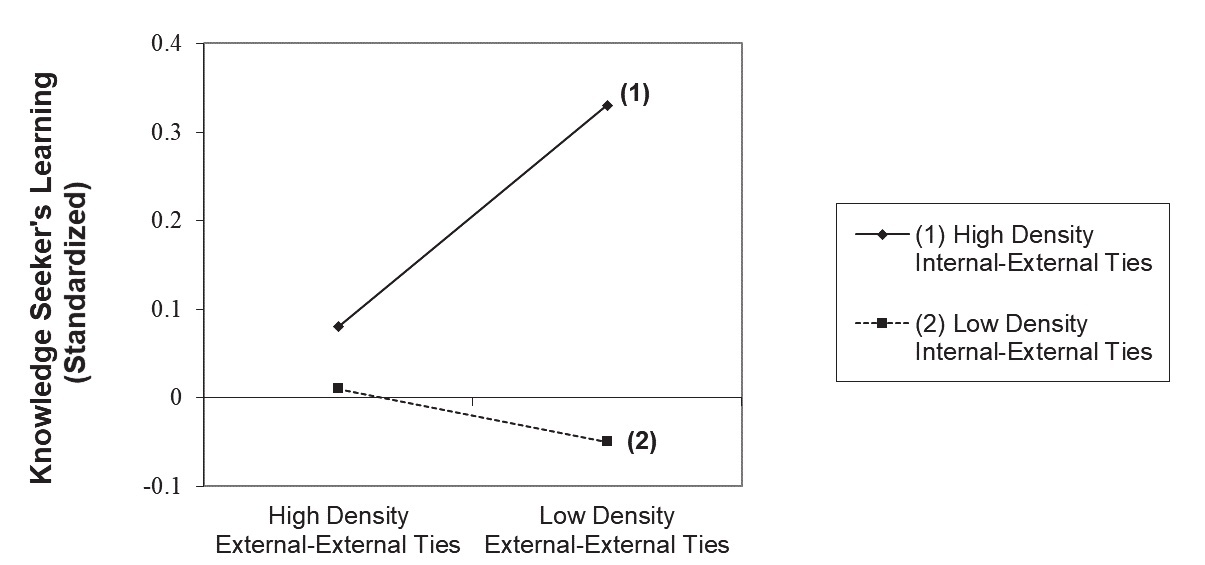
Hypothesis 3 argued that learning is maximized when within-group density is low for both internal and external contributors, and between-group density is high. As shown in Model 10 of Table 4, the three-way interaction term is positive and significant ($\beta = 1.17, p < .05$), providing support for H3. Figure 3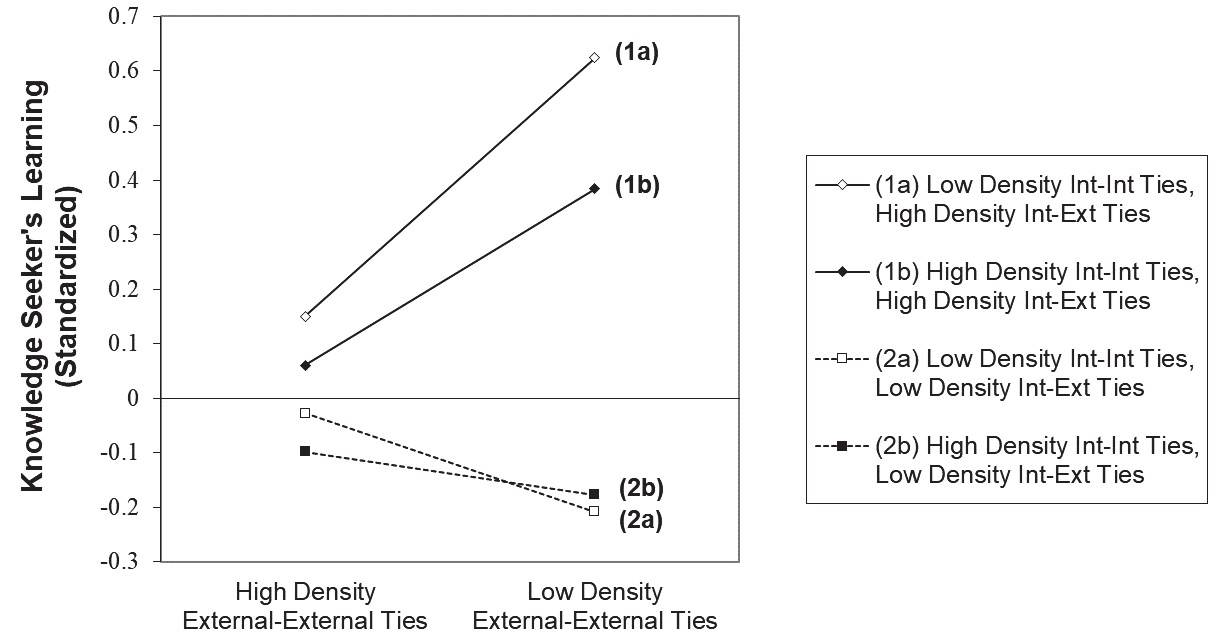
Together, the results show that the network structure surrounding a cross-community discussion thread significantly shapes the seeker’s learning. Sparse intra-community ties, when combined with strong inter-community bridges, promote the integration of diverse perspectives. Conversely, diversity without bridging produces little benefit—or even harm—underscoring the importance of connection in realizing the value of distributed knowledge.
4.3 Robustness Checks
Robustness checks were conducted to validate the findings (See Table 5
Table 5 Results of Robustness Checks
| 1 | 2 | 3 | |
|---|---|---|---|
| Network Density | |||
| Rev.Density INT-INT (Unconnected) | .62* (.08) | .41 (.18) | .39* (.15) |
| Rev.Density EXT-EXT (Unconnected) | .25 (.29) | .17 (.24) | .11 (.18) |
| Density INT-EXT (Connected) | .42 (.25) | .26 (.81) | -.06 (.04) |
| Interactions | |||
| Rv.Dens EXT-EXT Density INT-EXT | .64 (.13) | .41 (.06) | .34** (.08) |
| Rv.Dens EXT-EXT * Rv.Dens INT-INT | .13 (.43) | .07 (.36) | -.01 (.34) |
| Rv.Dens INT- INT * Density INT-EXT | .41 (.27) | .24 (.15) | .14 (.18) |
| Rv.Dens EXT-EXT Density INT-EXT Rv.Dens INT-INT | 2.25* (.77) | 1.18 (.46) | 1.00* (.46) |
Note: N=195; Controls omitted from reporting; Rev.Density = Reverse of Density (1 - Density); p < 0.05, p < 0.01, p < 0.001.
Ⅴ. Discussion and Implications
Digitally enabled firms increasingly rely on enterprise social platforms to facilitate problem solving across expertise boundaries. Intra-organizational broadcast search, whereby a knowledge seeker posts a question to a broad internal audience, has emerged as a powerful mechanism for surfacing diverse perspectives. This study examined such discussions to identify the network structures that best support seekers’ learning—the extent to which they update or reframe their understanding of a technical problem.
5.1 Theoretical Implications
Our findings reveal that the knowledge seeker’s learning is greatest when contributors from the same knowledge subgroup—either internal or external—are sparsely connected among themselves, while connections between internal and external contributors are dense. This structural configuration maximizes access to diverse, nonredundant knowledge while supporting its integration into a coherent understanding. The results offer several contributions to research on knowledge sharing, intra-organizational broadcast search, and organizational networks.
First, we extend the technical marginality view (Jeppesen and Lakhani, 2010; Afuah and Tucci, 2012) by showing that access to contributors from distant domains does not automatically lead to greater learning. Prior research has shown that exposure to diverse perspectives can help reframe problems, but only if those perspectives can be interpreted and synthesized (Carlile and Rebentisch, 2003; Reagans and Mc Evily, 2003). Our results provide evidence that pre-existing connections between internal and external contributors—reflecting familiarity or shared context—play a critical role in enabling that synthesis. Thus, the benefit of marginality is not inherent but contingent on the presence of integration mechanisms.
Second, our study complicates the common assumption that internal contributors—those close to the problem domain—offer only redundant knowledge. The literature often characterizes internal contributors as informationally close to the seeker, and therefore less valuable in surfacing novel insights (Jeppesen and Lakhani, 2010). However, our results suggest that internal contributors also vary in how connected they are to one another. When they are sparsely connected, they are more likely to bring diverse, nonredundant perspectives—even if they are technically close to the seeker. This aligns with prior findings that weak ties and structural diversity support novel idea generation (Burt, 1992; Reagans and Zuckerman, 2001).
Third, this study offers a network-based explanation for inconsistent findings in prior research regarding the relationship between contributor diversity and outcomes such as idea usefulness or perceived value. For example, some studies show that diverse contributors generate novel responses but not necessarily more useful ones (Kudaravalli and Faraj, 2008), while others find an inverted-U relationship between contributor diversity and knowledge-related outcomes (Singh et al., 2011). Our results suggest that such inconsistencies may stem from the challenge of integrating diverse knowledge. While sparse networks promote access to novel, nonredundant inputs, dense networks support the coordination and integration of those inputs into a coherent understanding (Reagans and Mc Evily, 2003; Tortoriello and Krackhardt, 2010). In our context, dense internal-external ties appear to function as boundary-spanning mechanisms that enable cognitive integration, thereby enhancing the seeker’s learning.
Fourth, the study contributes to the growing literature on the ecology of online communities. Prior work has shown that shared members—individuals who participate in multiple communities—can facilitate knowledge flows across community boundaries (Kim et al., 2018; Butler and Wang, 2012; Gu et al., 2007). Our findings add nuance by highlighting that such shared members play an especially important role when they serve as bridges between internal and external contributors. These boundary-spanning actors make it possible to blend unconnected knowledge into coherent understandings, enabling intercommunity learning. This mechanism helps explain how enterprise social media platforms can generate cross-domain value even within a single firm.
Finally, this study speaks to broader debates in network research regarding the tension between sparse and dense structures. Whereas sparse networks are associated with idea generation and dense networks with trust and coordination, these benefits are often assumed to be mutually exclusive (Obstfeld, 2005). Our findings show that when network structure is decomposed into subgroups defined by technical marginality, it is possible to realize the benefits of both sparsity and density. That is, sparse ties within subgroups support diversity, and dense ties across subgroups enable integration. This perspective invites future research to consider how multidimensional network segmentation—by technical field, function, or geography—may unlock complementary network benefits.
5.2 Practical Implications
This study underscores that effective learning through broadcast search in enterprise social platforms requires more than broad participation from contributors across the organization. It depends critically on whether the diverse knowledge brought into cross-community discussions can be meaningfully interpreted and integrated. In other words, knowledge seekers benefit not just from exposure to novel perspectives but from the presence of contributors who can bridge those perspectives with the focal problem.
While external contributors—those from different technical domains—are vital for injecting new ideas, our findings demonstrate that internal contributors, whose expertise is closer to the seeker’s domain, play an equally critical role. These internal contributors can help translate and contextualize external inputs, facilitating the integration necessary for learning. Thus, organizations should view internal and external contributors as complementary—not competing—sources of value in collaborative knowledge sharing.
Enterprise social platforms allow members to participate in multiple communities of practice, and this flexibility presents both opportunities and risks. Wang et al. (2013) argue that community managers should consider restricting members from participating too broadly, to ensure that they devote sufficient time and attention to their primary community. This perspective reflects a concern with resource dilution. However, our findings offer a counterpoint: time spent in other communities can build the integrative social ties necessary for effective knowledge recombination across boundaries. Rather than limiting participation, organizations may benefit from encouraging strategic overlap—where members engage across a range of communities, particularly those that span complementary domains.
Recent evidence from corporate online communities confirms that this remains a significant challenge. Liu et al. (2025) report that departmental boundaries continue to constrain knowledge sharing, even on enterprise social platforms designed to enable cross-boundary collaboration. Employees still show a strong inclination toward intradepartmental exchanges. In other words, while digital platforms overcome physical and temporal constraints, organizational divisions continue to fragment online interaction and limit the potential of cross-community learning.
Our study suggests that organizations must go beyond providing technological infrastructure. They need to actively cultivate the social and structural conditions that enable integration across knowledge domains. Network analysis of contributors’ participation histories can help identify employees who are not only exposed to diverse domains but also positioned to facilitate knowledge integration. Community managers should leverage such insights to involve the right mix of internal and external contributors in discussions, especially when progress stalls due to misaligned frames of reference.
Ultimately, the success of broadcast search in enterprise social platforms hinges not just on who contributes, but also on how those contributors are connected. Our findings show that learning is maximized when contributors are sparsely connected within their respective groups—internal or external—but densely connected across those groups. This network configuration provides access to diverse, non-redundant knowledge while also supporting the integration necessary for constructing a coherent understanding of the problem. Building and supporting cross-community ties that enable such synthesis is key to unlocking the full value of distributed expertise. By identifying this synergistic network structure, the study clarifies the conditions under which intra-organizational broadcast search fosters meaningful cognitive learning from distributed expertise.
5.3 Limitations and Directions for Future Research
This study has several limitations that suggest opportunities for future research. First, our findings are situated in the context of cross-community discussions on enterprise social platforms, where contributors can observe each other’s inputs and engage in follow-up dialogue. The mechanisms we identify—access to diverse knowledge and its integration through network connections—may function differently in settings where contributors respond independently or where problem solving involves more routine or localized knowledge. Future research should examine how broadcast search operates under varying organizational, technological, and task-related conditions.
Second, we infer social connections among contributors based on community co-membership and co-participation in threaded discussions. While reasonable in this context—since most contributors posted primarily in communities where they were registered—this approach may miss shared understanding developed outside the platform. Although we controlled for offline communication between seekers and contributors, we could not observe potential offline ties among contributors. Future work should explore how online and offline networks jointly shape knowledge integration, potentially using multi-modal data or ethnographic methods (Zhang and Venkatesh, 2013; Howison et al., 2011).
Third, although we use network density as a proxy for access to diverse (i.e., non-redundant) knowledge and the capacity for integration, we do not directly measure cognitive processes. While prior work supports the link between sparse structures and diversity, and dense structures and integration (Burt, 2000; Reagans and Zuckerman, 2001), stronger evidence could come from analyzing the content of interactions. Future research should combine network analysis with content analysis or natural language processing to assess the richness, novelty, and integration of exchanged ideas.
Fourth, our analysis focused on the network structure of contributors and controlled for seeker attributes such as experience and prior contributions. However, seekers can also shape outcomes—for example, by posing clear problems, replying to others, or synthesizing inputs. Interviewees in our preliminary study emphasized the value of well-articulated questions. Prior research shows that question quality influences interaction (Ahern et al., 1992), and our unreported analyses found that question length and seeker engagement were positively associated with the number of contributors, though not with learning outcomes. Notably, only 16% of seekers engaged in their threads. Future research should examine how seeker behaviors—such as clarifying questions, follow-up engagement, or synthesis efforts—not only influence participation but also interact with contributor network structure to affect knowledge integration and learning.
〈Appendix A〉 Examples of Discussion Topics
Has anyone put an isolation valve in place under a thief hatch? We have a source service tank farm in which Operations would like to put butterfly valves under each of the thief hatches. This would allow them to isolate any one of the hatches for ease of replacement or repair of the unit. If this has been done, do you treat it as a carsealed valve under a PSV? Would it be necessary to have a person in place to watch the system while the hatch has been removed from service? Was there any issue with the additional valve weight on the top of the tank?
Dear all, we almost completed our visual rigid riser inspection in our BU and we have found some findings during inspection which mostly are external corrosion and coating crack. In terms of mechanical integrity, the findings are still acceptable (no need to have reinforcement) but we need to stop the corrosion growth to prevent it from getting worse. Any suggestion (best practice) to repair these riser findings?
Table 2
| Category | Variable | Description |
|---|---|---|
| Knowledge Seeker Characteristics | Community Tenure | Number of months the knowledge seeker had been a member of the host community. |
| Leadership Role | Dummy variable: 1 = seeker had a formal leadership role in the host community; 0 = otherwise. | |
| Prior Contribution | Number of contributions the seeker made to discussions in the host community before the focal thread. | |
| Expertise Level (Survey) | Seeker's self-assessed understanding, comfort, and confidence related to the topic, measured with three Likert-scale items. | |
| Community Membership Breadth | Number of different online communities the seeker belonged to before the focal discussion. | |
| KS - INT Connection | Proportion of internal contributors with whom the seeker had previously co-participated in past discussions. | |
| KS - EXT Connection | Proportion of external contributors with whom the seeker had previously co-participated in past discussions. | |
| Community and Thread Context | Community Age | Number of months since the host community's creation. |
| Community Size | Number of registered members in the host community at the time of the focal discussion. | |
| Number of Internal Contributors | Count of internal contributors in the discussion thread. | |
| Number of External Contributors | Count of external contributors in the discussion thread. | |
| Contributor Diversity | BU Diversity1 | Blau(1977)'s index based on contributors' affiliations to one of 25 sub-functional units within 7 major business areas. $$1 - \sum_{j=1}^{n} {p_{ij}}^2$$ where n is the total number of BUs existing in the studied company, and pij is the proportion of the contributors in discussion i who belonged to BU j. The BU diversity score is low when most contributors are from the same business unit, and high when they come from different units. |
| Work Location Diversity | (Same as above) Blau(1977)'s index based on contributors' geographic distribution across 15 countries. | |
| Rank Diversity2 | Coefficient of variation based on contributors' organizational ranks, coded by hierarchical distance from CEO (CEO = 0, entry-level = 10). $$\left[ \sum_{i=1}^{n} (R_{ik} - R_{meank})^2 / n \right]^{1/2} / R_{meank}$$ where n is the number of contributors in discussion thread k, Rik is contributor i's rank and Rmeank is the mean rank over n contributors to discussion thread k. |
|
| Gender Diversity | Coefficient of variation in contributors' gender. | |
| Engagement and Contextual Factors | Seeker Engagement | Dummy variable: 1 = seeker posted a reply in the thread; 0 = otherwise. |
| Offline Communication | Dummy variable: 1 = seeker or team contacted contributors outside the platform; 0 = otherwise. | |
| Question Scope | Dummy variable: 1 = topic was intended for cross-community relevance; 0 = otherwise. | |
| Month | Numeric variable indicating the calendar month of the discussion (0 = start of study window). |
1 The organization's structure includes 7 business areas (e.g., operations, strategy, R&D), subdivided into 25 sub-functions, and 131 teams. Sub-functions were used for computing BU diversity, as employee movement occurs primarily within (not across) these units.
2 Each contributor's rank was coded by level from the CEO down (e.g., CEO = 0, senior manager = 3, entry-level = 10). Rank disparity reflects vertical status differences using the coefficient of variation.