
.jpeg)
The Impact of Korean Makeup Trends on Social Media on Vietnamese Consumers’ Brand Awareness and Cosmetics Purchase Intention - A New Perspective on the Theory of Planned Behavior
1 Kyungpook National University
DOI: https://doi.org/10.17287/kmr.2026.55.1.25
Abstract
Korean beauty trends, amplified by Tik Tok, have positioned Vietnam as a critical cultural intersection where digital aesthetics converge with evolving consumer identities. Despite this phenomenon, the specific mechanisms by which this digital fascination translates into brand loyalty and purchasing behavior remain insufficiently theorized. Grounded in the Theory of Planned Behavior (TPB), this study investigates how social media exposure influences Vietnamese consumers’ purchase intentions toward Korean cosmetics. Specifically, it examines the mediating roles of trend adoption-conceptualized as a normative route reflecting transient social conformity and brand awareness, representing an attitudinal route rooted in cognitive trust. Using survey data from 199 respondents, the findings indicate that while social media exposure positively impacts both mediators, brand awareness exerts a significantly more robust influence on purchase intention. Furthermore, cultural affinity was found to moderate these relationships, amplifying the brand awareness-to-intention pathway and the indirect effect of social media exposure. Conversely, cultural affinity exerted limited influence on the trend adoption route. Theoretically, this research extends the TPB by integrating cultural affinity as a dynamic boundary condition and disentangling normative versus attitudinal processes in cross-cultural digital consumption. Practically, the results suggest that in high-affinity markets, long-term consumer loyalty is better sustained through culturally embedded brand narratives rather than ephemeral, trend-based campaigns.
Ⅰ. Introduction
As Korean beauty aesthetics saturate global social media, the cultural epicenter is no longer confined to Seoul. In Saigon, Hanoi, and beyond, cultural adoption has evolved: Korean makeup trends are not merely watched but embodied. Vietnamese youth no longer admire K-pop idols and K-drama heroines from afar; they wear “glass skin,” gradient lips, and soft pink tones as everyday beauty expressions, signaling the internalization of K-beauty into local identity (Kim and Cho, 2024).
This internalization is more than symbolic; it is economically tangible. Beauty products account for 57.1% of purchase intentions for Korean goods among Vietnamese consumers, demonstrating the commercial potency of K-beauty in the Vietnamese market (Ministry of Culture, Sports and Tourism, 2023). UN Comtrade data further reveal that Korean cosmetics exports to Vietnam nearly doubled from USD 59.9 million in 2020 to USD 127.1 million in 2023, placing Vietnam among the fastest-growing importers of K-beauty in Asia (UN Comtrade Database).
Digital platforms amplify this cultural and commercial momentum. Social media has rapidly emerged as a dominant marketing channel, replacing traditional media in delivering brand information to consumers. Platforms such as Facebook, Instagram, and Tik Tok are regarded as highly effective tools for building brand equity, as they enable firms to quickly transmit brand-related content to a large audience (Lee and Park, 2021). Within this context, understanding how social media content influences consumer responses has become a critical issue in marketing research. Tik Tok stands out as the dominant short-form video platform for trend diffusion in Vietnam, reflected in viral hashtag usage #koreanmakeup (326.8K posts), #oliveyoung (115.7K posts), and #koreanstyle (1.4M posts), evidence of its resonant cultural reach (Tik Tok internal analytics, 2025). Parallelly, Google Trends indicates a sharp rise in searches for “Korean cosmetics” (mỹ phẩm Hàn Quốc) and “Korean makeup” (trang điểm Hàn Quốc) between 2022 and 2025 in Vietnam. These data collectively elevate Vietnam beyond a peripheral follower, illustrating Vietnam as one illustrative case of high cultural affinity, where K-beauty is actively woven into consumer culture. Similar mechanisms may also emerge in other markets with strong engagement in Korean popular culture, suggesting that cultural affinity, rather than nationality per se, is the central driver.
However, an essential empirical puzzle remains: does such pervasive Tik Tok exposure lead to brand awareness and sustained purchase intention, or is it merely ephemeral digital visibility? Prior research has primarily centered on mature contexts (South Korea, Japan) or Western markets. Emerging economies like Vietnam, where digital engagement is accelerating, and cultural integration may follow distinct pathways, remain understudied (Cho et al., 2021). Additionally, extant work typically isolates either brand awareness or trend adoption rather than integrating them within a holistic behavioral model.
To fill these gaps, the present study employs the Theory of Planned Behavior (TPB; Ajzen, 1991) using Vietnam as an empirical setting characterized by high cultural affinity. Rather than assuming uniqueness, this study treats Vietnam as a context where affinity with Korean culture is especially salient, allowing us to examine how cultural closeness may condition TPB pathways. We investigate how Tik Tok exposure to Korean makeup trends influences Vietnamese consumers’ purchase intentions via two parallel mediators: trend adoption (representing the expressive/identity pathway) and brand awareness (the cognitive/risk-reduction pathway). We further posit cultural affinity as a moderator that selectively amplifies these mediation pathways, especially the brand awareness $\rightarrow$ purchase intention link, thereby embedding TPB within a culturally nuanced digital framework.
By integrating primary survey data with secondary social media analytics and trade statistics, this study offers dual contributions. Theoretically, it advances TPB by incorporating cultural affinity as a boundary condition, specifying when and how digital exposure influences intention in a culturally resonant context. Practically, it equips marketers with strategic insight into harnessing Tik Tok-driven trend diffusion to foster durable brand engagement in Vietnam, where beauty trends are not just consumed but internalized as everyday cultural identity.
Ⅱ. Literature Review
2.1 Theory of Planned Behavior (TPB)
2.1.1 Research Gaps and Contribution
Although prior studies have offered valuable insights into the influence of social media on cosmetic consumer behavior, significant research gaps remain regarding the Vietnamese context. Much of the foundational work has examined how social media exposure enhances brand awareness and purchase intention in developed markets (Duffett, 2017; Kim and Ko, 2012). However, research rarely addresses emerging economies, where global cultural content is rapidly consumed but localized adoption dynamics may diverge. Vietnam is particularly salient: its youth consumers are deeply engaged with Tik Tok, a platform whose short-form video affordances drive rapid trend diffusion and viral beauty practices (Li et al., 2023; Xu and Pratt, 2018). However, the mechanisms through which Tik Tok exposure translates into durable consumption behaviors remain underexplored.
While Trend Adoption (Rogers et al., 2014) and Brand Awareness (Keller, 1993) have been extensively studied, their differentiated functions in emerging, high-affinity cultural contexts remain insufficiently understood. Prior studies often analyze Trend Adoption and Brand Awareness in isolation, overlooking how they may operate as parallel pathways within consumer decision-making (Sasmita and Suki, 2015). This gap is critical in Vietnam, where Korean beauty trends are not only consumed as information but internalized as identity practices, suggesting that Trend Adoption (expressive/identity route) and Brand Awareness (cognitive/risk-reduction route) may play distinct but complementary roles.
Furthermore, the moderating role of Cultural Affinity has been overlooked in TPB-based consumer research. Although Cultural Affinity has been shown to shape consumer evaluations of foreign products (Cleveland and Laroche, 2007; Vida and Reardon, 2008), no study has examined how it conditions the effects of Trend Adoption and Brand Awareness on Purchase Intention in Vietnam. This is a critical oversight, as Vietnamese consumers exhibit strong affective bonds with Korean culture, and prior research highlights that cultural congruence can significantly amplify consumer trust and willingness to purchase (Han et al., 2010; Park and Rabolt, 2009).
Finally, while the Theory of Planned Behavior (TPB) (Ajzen, 1991) provides a robust framework for predicting consumption, Ajzen himself acknowledged its limitations in capturing habitual and affective processes. In beauty consumption, emotions elicited by aesthetic content and habitual product usage may influence Purchase Intention alongside deliberate reasoning (Pham et al., 2022). By integrating Cultural Affinity into TPB as a boundary condition, this study extends the framework to account for cross-cultural and emotional dynamics, dimensions often missing in prior TPB applications but highly relevant in a globalized beauty market.
2.1.2 Theory of Planned Behavior
The Theory of Planned Behavior initially formulated by Ajzen (1985, 1991), remains one of the most robust frameworks for explaining consumer decision-making. TPB posits that attitudes, subjective norms, and perceived behavioral control shape behavioral intention. While its predictive power has been validated across diverse domains, recent scholarship emphasizes the need to recalibrate TPB in digital and cross-cultural contexts where media exposure and cultural dynamics play pivotal roles (Grabowska et al., 2025).
This study applies TPB as an interpretive lens to examine how Tik Tok-driven exposure to Korean makeup trends influences Vietnamese consumers’ purchase intention. Unlike prior TPB applications that treat attitudinal and normative influences as parallel predictors, this study conceptualizes them as sequential pathways: social media exposure first shapes attitudes and descriptive norms through trend adoption (expressive/identity route) and subsequently reinforces brand awareness (cognitive/risk-reduction route) as a complementary mechanism (Sasmita and Suki, 2015; Singh et al., 2021). Following TPB (Ajzen, 1991), we conceptualize Social Media Exposure and Trend Adoption as reflecting subjective norms, since they create perceived social pressure and descriptive/prescriptive norms. Meanwhile, Brand Awareness and Trend Adoption are interpreted as attitudinal pathways, shaping favorable evaluations and emotional resonance. This operationalization aligns with previous adaptations of TPB that replace abstract constructs (Subjective Norms, Attitude) with context-specific proxies (Erkan and Evans, 2016; Hutter et al., 2013).
In contrast to Attitude and Subjective Norm, Perceived Behavioral Control (PBC) is not represented by a direct proxy in our model. Although factors such as affordability, accessibility, or product usage ability are conceptually relevant to PBC, they were relatively homogeneous within our sample of young, digitally active Vietnamese consumers and thus excluded from empirical measurement. This decision reflects the market reality in which Korean cosmetics are widely available and familiar, making attitudinal and normative routes more salient drivers of intention. Consequently, this study employs TPB as a theoretical lens rather than a full structural test, extending the framework by emphasizing culturally embedded attitudinal and normative influences while acknowledging the limitation of excluding PBC. Future research should explicitly incorporate PBC and employ structural equation modeling (SEM) to validate the TPB pathways comprehensively.
2.2 Social Media Exposure (SME)
In this study, Social Media Exposure refers to exposure to Tik Tok content about Korean makeup trends. Measurement items were adapted to reference Tik Tok explicitly. The choice of Tik Tok is not only to narrow the scope of analysis but also stems from the unique platform characteristics that make Tik Tok a decisive environment in the diffusion of K-beauty in Vietnam. Unlike YouTube (which emphasizes long-term instruction) or Instagram (which focuses on aesthetic images), Tik Tok is characterized by short videos, a “For You Page” distribution algorithm, and high virality, thereby facilitating the formation of continuous exposure habits and trend internalization (Montag et al., 2021; Omar and Dequan, 2020).
Social Media Exposures on Tik Tok include different types of content: (1) product tutorials and reviews, (2) brand-generated content, and (3) user-/influencer-generated content. Each type of content has its impact mechanism: brand videos provide official information and quality assurance, while influencer content creates social norms and perceived authenticity (De Veirman et al., 2017). This diversity helps Tik Tok act as both an information channel and a social environment where normative signals and community consensus are quickly formed (Li et al., 2023). According to the Theory of Planned Behavior (Ajzen, 1991), Social Media exposure on Tik Tok influences Purchase Intention through three mechanisms. First, continuous exposure to K-beauty videos reinforces positive attitudes, combining cognitive beliefs (products are effective, easy to access) and aesthetic emotions (experiencing the Korean style). Second, Tik Tok creates subjective norms when users observe friends, KOLs, or “trendsetters” using the product, thereby forming consensus pressure and aspiration to integrate into the community (Omar and Dequan, 2020). Third, Social Media Exposures enhance perceived behavioral control by providing usage knowledge, online shopping links, and price comparisons, thereby increasing confidence and reducing risk in consumer decisions (La Barbera and Ajzen, 2020). The key point here is that Social Media Exposure is conceptualized as a multifaceted construct rather than a homogeneous one. Different platforms and content formats may vary in their persuasive effects: short-form Tik Tok videos emphasize immediacy and emotional salience; long-form YouTube tutorials highlight credibility and informational depth; Instagram image posts foreground aesthetic identity signaling. Similarly, exposure from influencers may carry social proof and perceived authenticity, whereas brand-generated content provides formal product information and credibility cues. This study identifies two complementary mechanisms: Trend Adoption in the direction of social identity and Brand Awareness in the direction of brand risk perception. While our primary analysis aggregates these exposures for parsimony, we acknowledge that future work should disaggregate these categories to capture the heterogeneous persuasive mechanisms of different social media environments. Based on this theoretical foundation, the study posits:
2.3 Trend Adoption (TA)
In direct relation to Social Media Exposure, Trend Adoption can be understood as the mechanism through which consumers transform exposure into enacted behavior. Rather than being a simple response, it reflects the extent to which individuals appropriate, rehearse, and internalize an aesthetic trend, turning digital content into norms and expressive habits in everyday life (Rogers, 2003; Wang and Lee, 2021). Studies on short-form video platforms highlight how consumers enact trends performatively, through replication, remixing, and social sharing, thereby embedding media-driven practices into their identity projects (Abidin, 2021; Omar and Deans, 2023).
Within the framework of the Theory of Planned Behavior (Ajzen, 1991), Trend Adoption primarily represents the operation of subjective norms. By observing others’ behaviors, consumers experience both descriptive norms (“everyone is doing it”) and injunctive norms (“I should also participate”), while algorithmically amplified content further reinforces favorable affective evaluations (De Veirman et al., 2017; Sykes and Hopner, 2024). In this sense, Trend Adoption is not only about favorable attitudes but about perceived social pressure and identity alignment, making it a distinct normative, behavioral pathway within TPB.
Significantly, this function differentiates Trend Adoption from Brand Awareness. Whereas Brand Awareness corresponds to the attitudinal-cognitive route, enhancing recognition, reducing uncertainty, and building trust (Hutter et al., 2013; Keller, 1993), Trend Adoption captures the social-normative route, embedding trends into peer conformity and expressive identity work (Bonilla Quijada et al., 2022). The co-existence of these two mediators allows SME to influence Purchase Intention via complementary mechanisms: a cognitive risk-reduction pathway (Brand Awareness) and a normative, identity enactment pathway (Trend Adoption).
Based on this theoretical rationale, the study proposes:
2.4 Brand Awareness (BA)
Brand Awareness refers to the extent to which consumers can recognize and recall a brand in a consumption context (Keller, 1993). This study captures the familiarity and recognition Vietnamese consumers hold toward Korean cosmetic brands, shaped by the repetition and reinforcement of brand cues in short-form video environments such as Tik Tok. In algorithm-driven spaces, repeated exposure to branded content fosters top-of-mind salience and enhances mental availability in usage situations (Huang and Sarigöllü, 2012; Vaughan et al., 2021).
Within the framework of the Theory of Planned Behavior (Ajzen, 1991), Brand Awareness primarily represents the attitudinal-cognitive pathway. Unlike Trend Adoption, which reflects a normative and identity-based process, Brand Awareness reduces risk, enhances familiarity, and signals trust and credibility. Consumers with higher awareness can more efficiently evaluate options, feel assured about quality and safety, and develop confidence in purchase decisions (Hutter et al., 2013; Macdonald and Sharp, 2000). Thus, whereas Trend Adoption captures the role of subjective norms and social conformity, Brand Awareness embodies the cognitive-evaluative dimension of attitude formation.
Including Brand Awareness alongside Trend Adoption, therefore, has both theoretical and contextual significance. Theoretically, Brand Awareness enriches the attitudinal component of TPB by showing how recognition and familiarity translate into intention, distinct from the normative pressures captured by Trend Adoption. Contextually, in Vietnam’s highly competitive beauty market, where social media amplifies brand clutter, Brand Awareness provides a trust-based differentiation advantage, turning repeated exposure into confidence and loyalty. By positioning Brand Awareness as a core mediator, this study clarifies that Social Media Exposure influences Purchase Intention not only through social imitation (Trend Adoption) but also through cognitive trust (Brand Awareness), two complementary yet theoretically distinct mechanisms.
Trend Adoption and Brand Awareness represent two theoretically distinct yet complementary mediating pathways through which Social Media Exposure shapes Purchase Intention. Within the Theory of Planned Behavior (Ajzen, 1991), Trend Adoption corresponds to the normative-identity route, whereby consumers adopt behaviors under social pressure and identity alignment with peers and influencers. By contrast, Brand Awareness reflects the attitudinal-cognitive route, where repeated exposure strengthens brand familiarity, reduces uncertainty, and builds trust.
This dual-pathway conceptualization clarifies why both mediators are necessary. If only Trend Adoption were included, Social Media Exposure would appear to influence PI mainly through performative conformity, overlooking the role of cognitive trust in purchase decisions. If only Brand Awareness were included, Social Media Exposure would be reduced to information processing, neglecting the social dynamics of trend diffusion. By modeling both simultaneously, the framework captures how digital exposure translates into intention through parallel processes of social imitation and cognitive evaluation. Empirically, the distinct factor loadings of Trend Adoption and Brand Awareness items confirm that these constructs are not redundant but capture separate latent mechanisms. Theoretically, this integration extends TPB by demonstrating that attitude and subjective norms do not merely operate in parallel but can be disaggregated into specific mediators that illuminate the cognitive and social dimensions of consumer behavior in digital contexts. Thus:
2.5 Cultural Affinity (CA)
While Trend Adoption and Brand Awareness capture essential pathways within the Theory of Planned Behavior, these mechanisms alone cannot fully explain why specific consumers convert exposure into strong purchase intentions while others remain indifferent. This limitation underscores the role of Cultural Affinity, which functions as a boundary condition that shapes how consumers interpret and respond to Korean beauty content.
Cultural Affinity is conceptualized as the psychological closeness and identification Vietnamese consumers feel toward Korean culture, manifested through engagement with K-pop, K-dramas, fashion, or lifestyle. Such affinity reduces perceived cultural distance and provides symbolic meaning to consumption behaviors, thereby influencing whether exposure-driven adoption and awareness translate into genuine purchase intentions (Cleveland and Laroche, 2007; Vida and Reardon, 2008).
Within the TPB framework, Cultural Affinity functions dynamically across multiple components. It strengthens the effect of Subjective Norms, as consumers who identify with Korean culture are more susceptible to perceived social pressure and descriptive norms in adopting K-beauty trends. It enhances Attitudes by attaching symbolic and emotional value to both trend adoption and brand familiarity, thereby reinforcing positive evaluations. It also indirectly shapes Perceived Behavioral Control, since strong cultural affinity reduces psychological distance and increases consumers’ confidence in using culturally aligned products. In this way, Cultural Affinity should not be seen as an isolated moderator, but as a cultural force conditioning how each TPB element translates into purchase intention.
2.5.1 The Moderating Role of Cultural Affinity in the Relationship Between Trend Adoption and Purchase Intention
From the perspective of the Theory of Planned Behavior, while Trend Adoption reflects the behavioral engagement with new styles (e.g., adopting the “dewy skin” or “gradient lip” look), Cultural Affinity influences the motivational strength of behavioral intention. Specifically, Cultural Affinity moderates the relationship between Trend Adoption and Purchase Intention by affecting how strongly the adoption of a trend is translated into actual purchase motivation. This aligns with the attitude, intention link in TPB: consumers with stronger cultural affinity are more likely to assign positive evaluative meaning to their adoption behavior, thereby forming stronger purchase intentions (Ajzen, 1991).
Crucially, Trend Adoption is theoretically distinct from Brand Awareness. While Brand Awareness is a cognitive, emotional mechanism of familiarity, Trend Adoption represents an observable behavioral alignment with cultural aesthetics (Rogers, 2003; Solomon, 2010). This distinction ensures that Trend Adoption is not merely another form of brand familiarity but reflects active experimentation and symbolic self-expression, which is particularly sensitive to cultural affinity (Cleveland and Laroche, 2007; Hofstede, 2001).
Cultural similarity enhances consumer openness toward foreign products, especially when these products represent culturally valued symbols (Hofstede, 2001). Cleveland and Laroche (2007) further emphasize that cultural affinity strengthens consumer trust and reduces psychological distance, which in turn increases the impact of marketing stimuli like trend adoption. In culturally resonant contexts, consumers do not merely adopt trends for aesthetic reasons but view consumption as a means of cultural alignment and identity expression.
In the Vietnamese context, where Korean popular culture holds high social prestige and symbolic capital (Kim and Cho, 2024), the act of purchasing Korean cosmetics becomes more than a functional decision; it is a symbolic reinforcement of cultural admiration. For consumers with high Cultural Affinity, adopting Korean beauty trends is often accompanied by a stronger intention to purchase related products, as a form of cultural participation. Conversely, consumers with low Cultural Affinity may adopt trends due to peer influence or aesthetics, but without the emotional, cultural connection, the purchase intention remains weaker.
This theoretical integration positions Cultural Affinity as a key boundary condition for the Trend Adoption $\rightarrow$ Purchase Intention pathway, addressing a gap in traditional TPB applications, which often overlook cultural dynamics. Hence, we propose the following hypotheses:
H7: Cultural Affinity positively moderates the relationship between Trend Adoption and Purchase Intention, increasing the impact of Trend Adoption on Purchase Intention when Cultural Affinity is high.
H8: Cultural Affinity moderates the indirect impact of Social Media Exposure on Purchase Intention through Trend Adoption, increasing this indirect impact when Cultural Affinity is high.
2.5.2 The Moderating Role of Cultural Affinity in the Relationship Between Brand Awareness and Purchase Intention
In the framework of the Theory of Planned Behavior, Brand Awareness influences attitude toward the behavior by fostering familiarity, credibility, and brand trust, factors known to reduce perceived risk and enhance intention (Fishbein and Ajzen, 1977; Keller, 1993; Macdonald and Sharp, 2000). However, this attitudinal effect is not uniform across consumers. The moderating role of Cultural Affinity helps explain why some consumers, though equally aware of a brand, develop stronger purchase intentions than others.
Cultural Affinity is defined as the emotional closeness or identification a consumer feels with the culture associated with a product or brand (Swift, 1999). In the context of Korean cosmetics, Cultural Affinity reflects the extent to which Vietnamese consumers emotionally connect with Korean culture through K-pop, K-dramas, fashion, or lifestyle. This connection enhances the symbolic value of the brand and intensifies the psychological meaning of brand awareness, turning familiarity into culturally resonant trust.
Brand Awareness as a mediator is functionally distinct from Trend Adoption. Whereas Trend Adoption reflects a behavioral path of aligning with aesthetic practices, Brand Awareness represents a cognitive, emotional path that builds perceived credibility and trust (Aaker, 2009; Hutter et al., 2013). By clarifying this distinction, the model avoids conceptual redundancy and justifies the need for both mediators in explaining intention formation (Kotler and Keller, 2016).
As Cleveland and Laroche (2007) note, Cultural Affinity fosters product acceptance by reducing psychological distance and increasing perceived similarity, especially in culturally symbolic industries such as cosmetics. For instance, awareness of a brand like Missha may only translate into firm purchase intention when the consumer also associates the brand with admired Korean values (e.g., modernity, elegance). In contrast, low Cultural Affinity consumers may remain indifferent despite being aware of the brand, as the symbolic and emotional resonance is missing.
This moderating role of Cultural Affinity also addresses a limitation of the original TPB: the model treats attitude formation as essentially individualistic, without incorporating cultural identification as a conditioning factor. By integrating Cultural Affinity, the model is better adapted to global consumer behavior in culturally influenced markets like Vietnam. It explains how culturally congruent brand awareness leads to higher motivation to act, in this case, the intention to purchase. This moderating role also highlights that the Vietnamese market should not be interpreted as culturally unique per se, but rather as a context where Korean cultural symbols carry exceptional salience. In this sense, the case of Vietnam exemplifies the broader theoretical mechanism by which Cultural Affinity intensifies the cognitive, emotional route from Brand Awareness to Purchase Intention (Cleveland and Laroche, 2007; Hofstede, 2001; Kim and Choo, 2023). Extending these findings, meta-analytic evidence supports the robust role of customer engagement in shaping purchase behaviors. A meta-analysis by Lee, Lee, and Park (2022) confirmed that customer engagement consistently drives purchase intention across diverse social media contexts. Notably, this study also identified cultural background as a key moderator, underscoring that the effectiveness of social media engagement varies depending on consumers’ cultural affinity.
Hence, Cultural Affinity serves as a critical boundary condition that shapes the strength of the Brand Awareness $\rightarrow$ Purchase Intention link, especially where brand meaning is culturally embedded. This leads to the following hypotheses:
H9: Cultural Affinity positively moderates the relationship between Brand Awareness and Purchase Intention, such that the effect of Brand Awareness on Purchase Intention is more substantial when Cultural Affinity is high.
H10: Cultural Affinity moderates the indirect effect of Social Media Exposure on Purchase Intention through Brand Awareness, increasing this indirect effect when Cultural Affinity is high.
In the integrative framework of this study, Trend Adoption and Brand Awareness represent two distinct yet complementary mediating mechanisms that transform Social Media Exposure into purchase motivation. While Trend Adoption reflects a socially expressive pathway, in which consumers internalize aesthetic practices as part of their identity and social interaction. Brand Awareness represents a cognitive, emotional pathway, emphasizing familiarity, credibility, and risk reduction. This theoretical distinction clarifies why both constructs are indispensable: Trend Adoption explains how trends become enacted behaviors, whereas Brand Awareness explains how recognition and trust are converted into intention. Cultural Affinity then operates as a dynamic boundary condition that amplifies the effectiveness of these pathways. Rather than being a static background variable, Cultural Affinity actively shapes the strength of the mediators by embedding either social practice (TA) or cognitive familiarity (BA) with symbolic cultural meaning. In contexts such as Vietnam, where Korean culture carries significant symbolic capital, this dynamic role of Cultural Affinity ensures that adoption of Korean beauty trends and awareness of Korean brands are not only functional responses to exposure but also culturally resonant acts of identity expression. Consequently, the model advances the Theory of Planned Behavior by incorporating cultural identification as a conditioning factor, demonstrating that intention formation is jointly determined by behavioral and cognitive mediators, moderated by cultural resonance. While much attention has been placed on brand-level interactions, recent research highlights the role of platform attachment in sustaining consumer behavior. Ofori, Kang, and Yang (2023) demonstrated that consumer engagement and emotional attachment to digital platforms significantly influence continuous use and recommendation intentions. In the context of beauty marketing, this finding suggests that the appeal of social media platforms themselves, where Korean beauty trends are disseminated, may reinforce consumers’ willingness to follow, adopt, and purchase cosmetic products.
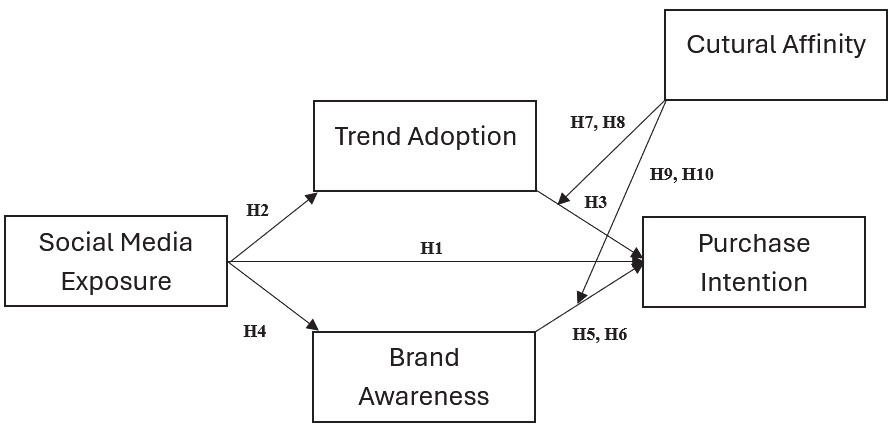
Ⅲ. Method
3.1 Questionnaire development and Sampling
A structured questionnaire was developed to measure the constructs of the research model: Social Media Exposure (SME), Trend Adoption (TA), Brand Awareness (BA), Cultural Affinity (CA), and Purchase Intention (PI). Established scales from prior research were adapted to the context of Korean makeup trends and the Vietnamese market, using a 5-point Likert scale (“Strongly Disagree” to “Strongly Agree”). Data were collected via an online survey (Google Forms).
SME was measured using items adapted from Bruhn et al. (2012) and Duffett (2017), assessing frequency, duration, and intensity of exposure to Korean makeup-related content with Tik Tok as the primary focus. While the original scales were designed to capture general social media use, in this study, they were adapted to reflect Tik Tok-based exposure, given its dominance in short-form beauty content among Vietnamese consumers. However, it is essential to note that these measures do not distinguish between different content formats (e.g., short-form vs. long-form), content creators (influencers vs. brands), or media types (video vs. static image). This operationalization, while consistent with prior studies, limits causal precision and is acknowledged as a key limitation to be addressed in future experimental designs.
TA was measured using a scale from Lim et al. (2017), focusing on the extent to which respondents had incorporated Korean makeup trends (e.g., “glass skin,” “gradient lip,” “blur lip,” “lip gloss”) into their beauty routines.
BA was assessed following Keller (1993) framework, capturing brand recognition and recall of Korean cosmetic brands (e.g., Fwee, Amuse, Romand).
CA was measured using an adapted scale from Swift (1999), evaluating affinity toward Korean culture via preferences for K-pop, K-drama, and Korean beauty standards.
PI was operationalized using Dodds et al. (1991) scale, assessing the likelihood of purchasing Korean makeup products, willingness to recommend, and future purchase intentions.
To ensure contextual appropriateness, items were translated and back-translated between Vietnamese and English. A pilot test with 30 Vietnamese consumers was conducted to refine item clarity. The final questionnaire included multi-item scales for each construct, with modifications to capture the unique dynamics of Korean makeup trends in the Vietnamese context.
3.2 Data Collection
Data were collected through an online survey targeting Vietnamese consumers to assess the impact of Korean makeup trends on social media on brand awareness and purchase intention. The target population included individuals aged 16 and above; participants under 18 confirmed parental consent. Participants were active on social media and potential consumers of cosmetics. The questionnaire The Impact of Korean Makeup Trends on Social Media on Vietnamese Consumers’ Brand Awareness and Cosmetics Purchase Intention - A New Perspective on the Theory of Planned Behavior was distributed via Google Forms and social media platforms (Facebook groups, Instagram stories) from March to May 2025, aligning with the study’s focus on social media exposure and ensuring access to a diverse sample.
A total of 252 responses were collected, with 199 valid responses and 53 missing responses. Of the 252 responses collected, 53 were excluded due to incomplete answers, straight-lining patterns, or failing attention-check questions. The final sample thus included 199 valid responses, ensuring data reliability and measurement quality. The demographic profile of the respondents, as presented in the statistical summary, revealed a balanced gender distribution and a wide age range, reflecting the diverse nature of the sample. Specifically, the sample included 54 males (27.1% of valid responses) and 145 females (72.9% of valid responses), indicating a predominantly female respondent base, which aligns with the higher engagement of women in beauty-related consumption. Regarding age distribution, 41 respondents (20.6%) were under 18 years, 60 (30.2%) were aged 18-25, 78 (39.2%) were aged 25-40, and 20 (10.1%) were over 40, suggesting a broad representation across different age groups, with a significant concentration in the 25-40 age bracket, a key demographic for makeup consumption.
Behavioral data further highlighted the respondents’ engagement with social media and shopping habits. The frequency of video watching, a proxy for social media exposure, showed that 99 respondents (49.7%) watched makeup-related videos every day, 80 (40.2%) watched weekly, and 20 (10.1%) watched monthly, indicating a high level of regular exposure to relevant content. Shopping frequency revealed that 101 respondents (50.8%) shopped for cosmetics weekly, 77 (38.7%) monthly, and 21 (10.6%) occasionally, underscoring a consistent purchasing behavior among the sample. 53 missing responses (21.0% of the total sample) were attributed to incomplete submissions, which were excluded from the final analysis to ensure data integrity.
Table 1 Sample Information
| Variable | Description |
|---|---|
| Gender | 1) Male (27.1%), 2) Female (72.9%) |
| Age | 1) Under 18 (20.6%), 2) 18-25 (30.2%), 3) 25-40 (39.2%), Above 40 (10.1%) |
| Video Watching Frequency | 1) Every day (49.7%), 2) Weekly (40.2%), 3) Monthly (10.1%) |
| Shopping Frequency | 1) Weekly (50.8%), 2) Monthly (38.7%), 3) Occasionally (10.6%) |
Ⅳ. Result
4.1 Reliability and Validity
Reliability and validity tests were conducted using SPSS to ensure the robustness of the measurement scales. Constructs assessed included SME, TA, BA, CA, and PI. Following standard practices (Hair et al., 2010), Cronbach’s Alpha, Exploratory Factor Analysis (EFA), and descriptive statistics were employed.
All constructs demonstrated high internal consistency, with Cronbach’s Alpha values exceeding the .70 threshold: SME (.88), TA (.87), BA (.89), CA (.85), and PI (.86). These results confirm the reliability of the scales.
Construct validity was further examined through Exploratory Factor Analysis (EFA). Results demonstrated that all items loaded strongly (> .70) on their intended constructs (SME, TA, BA, CA, PI), with no significant cross-loadings. In particular, items for Trend Adoption (TA1-TA3) and Brand Awareness (BA1-BA3) loaded on two clearly distinct factors, confirming that these mediators capture separate latent dimensions. This empirical evidence strengthens our theoretical claim that TA and BA are not redundant: TA reflects a social-normative pathway, while BA represents a cognitive-attitudinal pathway. The strong internal consistency of each scale ($\alpha$: TA = .87; BA = .89) further reinforces this distinction, providing empirical support for including both constructs as parallel mediators in the TPB-based model.
Descriptive statistics further confirmed the appropriateness of the sample. Respondents reported high exposure to Korean makeup content, strong trend adoption, high brand awareness, strong cultural affinity, and high purchase intentions, with generally low variability (SD < 1) across most constructs. These results suggest that the measurement instruments were both reliable and valid for further hypothesis testing.
4.2 Hypothesis test
H1 was tested through a simple regression analysis of SME on PI. The study revealed a significant positive effect of SME on PI (SE = .06, $\beta$ = .49, t = 8.03, p < .001), with the model explaining 24.7% of the variance in PI ($r^2$ = .24). While this is interpreted as correlational, given the cross-sectional, self-reported design, this result should be interpreted correlationally. The magnitude indicates that Tik Tok exposure is strongly aligned with heightened purchase intention. This pattern underscores the platform’s persuasive environment: visually rich, emotionally charged, and algorithmically reinforced content creates immediate purchase readiness. Thus, even though causal identification requires experimental designs, the present finding highlights Tik Tok as a uniquely powerful channel in shaping consumer purchase motivation.
Table 2 Factor and Reliability Test
| Variable | Items | Factor loading | Cronbach's Alpha | Mean | SD |
|---|---|---|---|---|---|
| Social Media Exposure | SME1. I often see Korean makeup videos on Tik Tok. | .78 | .88 | 4.39 | .60 |
| SME2. I often follow Korean KOLs/beauty bloggers or Vietnamese people with a Korean makeup style. | .77 | 4.45 | .68 | ||
| SME3. Content about Korean makeup trends influences my beauty routine. | .75 | 4.54 | .72 | ||
| Trend Adoption | TA1. I have tried Korean makeup trends (glass skin, blur lips...) | .79 | .87 | 4.54 | .72 |
| TA2. I often apply some Korean makeup styles to my daily makeup. | .82 | 4.6 | .77 | ||
| TA3. Korean makeup trends influence my makeup style. | .84 | 4.49 | .7 | ||
| Brand Awareness | BA1. I recognize some cosmetic brands associated with Korean makeup trends (eg: Fwee, Amuse, Romand, etc). | .89 | .89 | 4.58 | .74 |
| BA2. I easily remember the names of some Korean cosmetic brands when I see their typical makeup styles. | .88 | 4.62 | .78 | ||
| BA3. I can distinguish Korean cosmetic brands from other brands. | .92 | 4.8 | .79 | ||
| Cultural Affinity | CA1. I love Korean culture (K-pop, K-drama, fashion, lifestyle). | .77 | .85 | 4.52 | .69 |
| CA2. I feel close to the image and style of Korean idols/celebrities. | .84 | 4.59 | .75 | ||
| CA3. I often choose products or brands related to Korea because I love their culture. | .80 | 4.57 | .73 | ||
| Purchase Intention | PI1. I intend to buy cosmetics from Korean brands soon. | .86 | .86 | 4.68 | .79 |
| PI2. I will consider choosing Korean cosmetics when I need to buy new products. | .88 | 4.69 | .78 | ||
| PI3. I will spend money on Korean cosmetics if they suit my favorite makeup style. | .85 | 4.68 | .79 |
H2 was examined through the regression of SME on TA. The results showed a significant positive effect ($\beta = .10$, $SE = .05$, $t = 1.97$, $p < .05$), with the 95% confidence interval excluding zero. Although the model explained a modest 1.94% of the variance in TA ($r^2 = .01$), this pattern is consistent with the idea that adoption requires more than mere exposure; it typically entails skill acquisition, perceived relevance, and identity work, so an aggregate frequency/intensity measure of exposure will relate only weakly to enacted trend behavior. The small effect size is also coherent with our measurement choice: because SME is not disaggregated by Tik Tok content type (e.g., short-form tutorials vs. product reviews; influencer- vs. brand-generated), any format- or source-specific persuasion effects are likely diluted in the composite indicator. Consequently, H2 is supported; nonetheless, the result confirms that exposure correlates with adoption, albeit modestly, consistent with the notion that Tik Tok virality initiates but does not guarantee behavioral uptake.
H3 was evaluated through the regression of TA on PI, controlling for SME. The analysis yielded a significant positive coefficient ($\beta = .31$, SE = .07, t = 5.35, p < .001), with the model explaining 34.27% of the variance in PI ($r^2 = .34$). This supports the idea that enacting Korean makeup trends strengthens intention to buy, in line with TPB: behavior and identity alignment amplify readiness to purchase. Substantively, the findings suggest two coexisting mechanisms: (i) an identity–behavioral route (SME → TA → PI), modest in magnitude under an aggregate SME measure, and (ii) a more immediate affective–persuasive route (SME → PI), which dominates. This duality contributes theoretically by clarifying how social exposure translates into consumer intention: Tik Tok simultaneously operates as a trend incubator and as a direct persuasion engine.
In addition to its direct effect, the analysis also examined the indirect impact of SME on PI through TA, using a simple mediation model (PROCESS Model 4). The results (Table 4) revealed a significant indirect effect ($\beta = .04$, SE = .02, 95% BootCI = [.00, .08]), indicating that part of the influence of SME on PI is mediated by consumers’ adoption of Korean makeup trends. However, the size of this indirect effect is relatively small compared to the direct impact (Direct Effect = .45, Total Effect = .49), suggesting that while Trend Adoption plays a meaningful role in the pathway from SME to PI, much of the influence of SME on purchase intention operates through a more immediate route.
Table 3 Hypothesis testing
| Hypothesis | Path | $\beta$ | SE | t-value | p-value |
|---|---|---|---|---|---|
| H1 | SME → PI | .49 | .06 | 8.03 | .000*** |
| H2 | SME → TA | .10 | .05 | 1.97 | .0495* |
| H3 | TA → PI | .31 | .07 | 5.35 | .000*** |
| H4 | SME → BA | .42 | .06 | 6.77 | .000*** |
| H5 | BA → PI | .59 | .05 | 11 | .000*** |
| Variance Explained $r^2$ | |||||
| Trend Adoption | .01 | ||||
| Brand Awareness | .18 | ||||
| Purchase Intention | .24 | ||||
| .34 | |||||
| .53 |
Note: p < .05, p < .01, p < .001
This indicates that TA partially mediates the relationship, but most of SME’s influence bypasses behavioral adoption and flows directly to purchase readiness. This finding not only addresses concerns about SME as a “black box” but also clarifies that Tik Tok’s power lies in its ability to both inspire enactment and drive immediate intention. Disaggregated designs are needed, but the present study establishes the relative weight of each route.
H4 was tested through a regression analysis of SME on BA. The study revealed a significant positive association ($\beta = .42$, SE = .06, $t = 6.77$, $p < .001$), with the model explaining 18.91% of the variance in BA ($r^2 = .18$). This supports H4 and aligns with brand equity theory (Keller, 1993), suggesting that repeated exposure to Korean cosmetic content on Tik Tok is strongly aligned with reinforced brand recognition. Interpreted correlationally, this implies that Tik Tok not only spreads trends but also serves as a brand-building channel, making BA a key downstream outcome of SME.
H5 was examined by analyzing the relationship between BA and PI. The results showed a highly significant positive effect of BA on PI ($\beta = .59$, SE = .05, $t = 11$, $p < .001$). This finding strongly supports H5, underscoring that consumers who are more aware of Korean cosmetic brands are substantially more likely to intend to purchase their products. Brand familiarity not only fosters trust but also reduces perceived risk, thereby driving purchase intention. In the context of Korean cosmetics, where brand image is closely linked to cultural identity and perceived quality, strong brand awareness serves as a powerful motivator for consumer purchase decisions. In markets saturated with foreign beauty brands, BA acts as a decisive factor in consumer preference.
H6 was evaluated by comparing the standardized coefficients of BA and TA on PI from their respective mediation models. In the current model with BA as the mediator, the standardized coefficient of BA on PI was .59 ($p < .001$). In the previous analysis (with TA as the mediator), the standardized coefficient of TA on PI was .31 ($p < .001$). Comparing these values, BA ($\beta = .59$) has a more substantial impact on PI than TA ($\beta = .31$), with the difference in magnitude ($.59 - .31 = .28$) indicating that BA's effect is nearly twice as strong as TA's. Additionally, the model with BA explained a higher proportion of variance in PI ($r^2 = .53$) compared to the model with TA ($R^2 = .34$), further supporting the more decisive influence of BA. This finding confirms H6. The difference (.28) shows that BA's impact is nearly twice that of TA. This confirms H6 and delivers the study's key insight: while adopting trends matters, brand awareness is the dominant pathway by which Tik Tok exposure translates into consumer intention. This result provides a novel contribution: in the Vietnamese market, Tik Tok's influence is not only about virality but about sustaining brand salience. For marketers, this suggests prioritizing brand-building strategies (e.g., consistent visual identity, repeated presence in algorithmic feeds) over short-lived trend exploitation. Theoretically, it sharpens the distinction between the behavioral identity route (SME $\rightarrow$ TA $\rightarrow$ PI) and the cognitive brand route (SME $\rightarrow$ BA $\rightarrow$ PI), showing the latter's superior strength.
Table 4 Mediating effect of TA
| Path | $\beta$ | SE | t-value | p-value | 95% BootCI |
|---|---|---|---|---|---|
| SME $\rightarrow$ PI (direct) | .45 | .05 | 7.74 | .000*** | [.33, .56] |
| SME $\rightarrow$ PI (total effect) | .49 | .06 | 8.03 | .000*** | [.37, .61] |
| SME $\rightarrow$ PI (indirect via TA) | .04 | .02 | [.00, .08] |
Beyond its direct influence, SME also exhibited a substantial indirect effect on PI through BA, as demonstrated by the mediation analysis. The results (Table 5) revealed a significant indirect impact ($\beta = .25$, SE = .05, 95% BootCI = [.15, .37]), with the completely standardized indirect effect surpassing that observed for TA ($\beta = .04$). This finding underscores the pivotal role of Brand Awareness in the pathway from SME to PI. Notably, the indirect effect through BA accounts for more than half of the total impact of SME on PI (Total Effect = .49), highlighting that brand-related mechanisms, rather than behavioral adoption alone, drive much of the purchasing intention elicited by social media exposure.
This result aligns with brand equity theory (Aaker, 2009; Keller, 1993), which posits that repeated exposure to brand-related content enhances consumers' brand familiarity and trust, thereby facilitating purchase decisions. In the Vietnamese cosmetics market, where Korean brands such as Romand, 3CE, and Innisfree are frequently promoted through visually rich and emotionally engaging social media content, Brand Awareness becomes a critical lever in transforming exposure into actual consumer intent. The strong indirect pathway through BA suggests that while consumers may initially be drawn to Korean beauty content for its aesthetic appeal or trend value, it is ultimately their familiarity and confidence in the brands that most strongly translate into purchase intention.
Table 5 Mediating effect of BA
| Path | $\beta$ | SE | t-value | p-value | 95% BootCI |
|---|---|---|---|---|---|
| SME $\rightarrow$ PI (direct) | .23 | .05 | 4.39 | .000*** | [.12, .34] |
| SME $\rightarrow$ PI (total effect) | .49 | .06 | 8.03 | .000*** | [.37, .61] |
| SME $\rightarrow$ PI (indirect via BA) | .25 | .05 | [.15, .37] |
4.3 Moderating Effect
H7 was tested using PROCESS Model 1. The analysis revealed a significant main effect of TA on PI ($\beta = .39, p < .001$), and a significant moderating effect of CA (interaction term $\beta = .17, p < .05$). Conditional effects indicated that TA had a more substantial positive impact on PI at higher levels of CA: non-significant at low CA, significant and increasing at medium and high CA levels. Conditional effects indicated that TA exerted a non-significant impact on PI at low CA, but the relationship became significant and progressively stronger at medium and high levels of CA.
Rather than interpreting this as a phenomenon unique to Vietnamese consumers, it is more precise to view Vietnam as an illustrative case where K-beauty holds high symbolic capital. For high CA consumers, adopting Korean beauty trends is intertwined with cultural participation and identity expression, amplifying the attitude–intention pathway (Ajzen, 1991; Cleveland and Laroche, 2007). For low CA consumers, adoption may reflect superficial conformity without deep cultural resonance, which explains the weaker translation into purchase intention.
This finding underscores the role of cultural resonance in strengthening behavioral effects, but it does not confirm exclusivity to Vietnam. Similar processes may occur in other contexts where foreign cultural products gain aspirational value, such as K-pop in Thailand or J-beauty in Taiwan. Future research comparing markets will be necessary to determine whether Vietnam represents a particularly distinctive case or part of a broader pattern of cross-cultural adoption.
H8 was tested using PROCESS Model 14, with SME as the independent variable, PI as the dependent variable, TA as the mediator, and CA as the moderator. The conditional indirect effects of SME on PI through TA were estimated as follows: at low CA (-1.10 SD), the indirect impact was .02 (SE = .01, BootLLCI = -.005, BootULCI = .05); at mean CA (.000), the indirect effect was .03 (SE = .01, BootLLCI= .00, BootULCI = .07); and at high CA (1.10 SD), the indirect impact was .04 (SE = .02, BootLLCI = .00, BootULCI = .10). The confidence intervals for all levels included zero, indicating that the indirect effects are not statistically significant at the 5% level. The index of moderated mediation was .012 (SE = .01, BootLLCI = -.00, BootULCI = .03), with a confidence interval including zero, suggesting that the moderation of the indirect effect by CA is not statistically significant. Despite the slight increase in the indirect impact with higher CA (from .02 to .04), the lack of significance in the interaction term and the index of moderated mediation does not support H8. While the indirect effect of SME on PI through TA slightly increased at higher levels of CA, this increase was not statistically meaningful. This result suggests that CA does not significantly moderate the mediation pathway from SME to PI via TA in this context.
Several theoretical and contextual factors may explain this finding. First, from a TPB perspective, while Cultural Affinity can strengthen the attitude-intention link, its role in the earlier stage of trend adoption may be less pronounced. Social Media Exposure tends to directly influence both Trend Adoption and Purchase Intention through information and social cues, mechanisms that operate broadly across consumer groups (Erkan and Evans, 2016). As such, the initial adoption of Korean beauty trends may be driven more by exposure frequency and peer influence than by deep cultural affinity, which becomes more influential in shaping attitudes toward actual purchasing behavior (Ajzen, 1991).
Second, in the Vietnamese context, Korean beauty trends have become highly mainstream, with widespread visibility across various social media channels. Even consumers with low or moderate Cultural Affinity are frequently exposed to and adopt these trends for reasons related to aesthetics, practicality, or peer conformity rather than cultural alignment (Long and Khoi, 2020). Therefore, while CA significantly moderates the direct link between Trend Adoption and Purchase Intention (as shown in H7), it may not substantially influence the initial process of translating social media exposure into behavioral adoption of trends.
Lastly, the widespread normalization of K-beauty trends in Vietnam may reduce the variance in Cultural Affinity’s influence during the trend adoption phase. As these trends increasingly reflect general beauty norms rather than niche cultural symbols, CA’s moderating role becomes less distinct in this pathway. This highlights the complex dynamics of cultural influence in markets where foreign trends have been extensively localized. This result suggests that emotional cultural resonance (via BA) may be more susceptible to cultural affinity than behavioral imitation (via TA), offering a refined view of cultural dynamics in TPB. In sum, although the indirect effect of SME on PI through TA increased slightly at higher levels of CA, these differences were not statistically significant. This indicates that Cultural Affinity does not meaningfully shape the early stage of trend adoption, which in the Vietnamese context has become mainstream and widely normalized. CA instead plays a more decisive role in later stages, where adoption or awareness is translated into purchase intention.
H9 was tested using PROCESS Model 1, with BA as the independent variable, PI as the dependent variable, and CA as the moderator. The analysis revealed a significant main effect of BA on PI ($\beta = .61, p < .001$) and a significant moderating effect of CA ($\beta = .16, p < .001$). Conditional effects showed that the positive influence of BA on PI strengthened as CA increased, supporting H9.
From a TPB perspective, Brand Awareness enhances consumers' attitudes toward Korean cosmetics and reduces perceived behavioral uncertainty (Ajzen, 1991). Cultural Affinity amplifies this process by increasing the evaluative and emotional meaning consumers attach to Korean brands (Cleveland and Laroche, 2007). This suggests that brand familiarity is not uniform across all consumer groups. For those with high CA, Korean brand recognition is also associated with cultural empathy and a sense of self-identification with K-beauty. Therefore, BA in this case becomes a stronger driver for purchase intention. In contrast, for those with low CA, BA is only at the cognitive level; they know the brand, but that awareness is not enough to translate into a strong consumer motivation.
In the context of the Vietnamese market, where K-beauty is both popular and associated with popular cultural icons (K-pop, K-drama), this result suggests that it is the level of cultural attachment that determines whether BA is "activated" as a powerful psychological lever or just superficial familiarity. From there, the study provides a specific perspective: BA is not always uniformly powerful, but its effectiveness depends on the depth of consumer cultural empathy.
H10 was tested using PROCESS Model 14, with SME as the independent variable, BA as the mediator, PI as the dependent variable, and CA as the moderator. The index of moderated mediation was significant (SE = .05, BootLLCI = .01, BootULCI = .10), supporting H10. CA moderates the indirect path from SME to PI through BA. Specifically, the indirect effect of SME on PI increases with the level of CA, while in the low CA group, the SME $\rightarrow$ BA $\rightarrow$ PI path is almost insignificant.
The significance of this result lies in the fact that CA not only strengthens the impact of BA (as in H9) but also shapes the "operability" of BA as an SME transmission mechanism. In the high CA group, SME not only creates brand awareness, but also turns that awareness into an emotional and cultural "bridge",helping it lead to purchase intention. In contrast, in the low CA group, SME still increases the level of brand awareness, but this awareness is superficial, lacking in depth of engagement, so it is not enough to promote PI.
In the context of the Vietnamese market, where Tik Tok is the primary channel for spreading K-beauty, this finding shows that the effectiveness of SMEs is not simply a matter of “more exposure, more purchase intention” but depends on whether consumers decode and engage with the cultural message that the brand represents. In other words, CA determines whether BA stops at “information awareness” or becomes a real behavioral driver.
H9 and H10 clarify two distinct but complementary roles of Cultural Affinity. In H9, CA strengthens Brand Awareness as a direct attitudinal driver of purchase intention; BA becomes more powerful when infused with cultural resonance. In H10, CA determines whether BA can function as an effective transmission channel, enabling Social Media Exposure to convert into purchase intention via brand familiarity. Thus, while H9 highlights how strongly BA drives PI under different cultural conditions, H10 reveals whether BA itself becomes operational as a mediator in the first place.
Table 6 Moderating effect of CA
| Hypothesis | Path | $\beta$ | SE | t-value | p-value | $r^2$ | LLCI | ULCI |
|---|---|---|---|---|---|---|---|---|
| H7 | TA $\times$ CA $\rightarrow$ PI | .17 | .07 | 2.39 | .01* | .02 | .03 | .31 |
| H7 (Conditional) | TA $\rightarrow$ PI at low CA (-1.10 SD) | .20 | .11 | 1.84 | .06 | -.01 | .42 | |
| TA $\rightarrow$ PI at mean CA (.000) | .39 | .08 | 4.62 | .000*** | .22 | .56 | ||
| TA $\rightarrow$ PI at high CA (1.10 SD) | .58 | .12 | 4.83 | .000*** | .34 | .81 | ||
| H8 (Indirect) | SME $\rightarrow$ TA $\rightarrow$ PI at low CA (-1.10 SD) | .02 | .01 | -.005 | .05 | |||
| SME $\rightarrow$ TA $\rightarrow$ PI at mean CA (0.000) | .03 | .01 | .00 | .07 | ||||
| SME $\rightarrow$ TA $\rightarrow$ PI at high CA (1.10 SD) | .04 | .02 | .00 | .01 | ||||
| H9 | BA $\times$ CA $\rightarrow$ PI | .16 | .04 | 4.15 | .000*** | .54 | .08 | .24 |
| H9 (Conditional) | BA $\rightarrow$ PI at low CA (-1.10 SD) | .43 | .07 | 5.73 | .000*** | .28 | .57 | |
| BA $\rightarrow$ PI at mean CA (.000) | .61 | .05 | 11.13 | .000*** | .50 | .72 | ||
| BA $\rightarrow$ PI at high CA (1.10 SD) | .79 | .06 | 12.05 | .000*** | .66 | .92 | ||
| H10 (Indirect) | SME $\rightarrow$ BA $\rightarrow$ PI at low CA (-1.10 SD) | .15 | .05 | .05 | .26 | |||
| SME $\rightarrow$ BA $\rightarrow$ PI at mean CA (0.000) | .21 | .05 | .12 | .32 | ||||
| SME $\rightarrow$ BA $\rightarrow$ PI at high CA (1.10 SD) | .28 | .05 | .17 | .40 |
Note: p < .05, p < .01, p < .001
LLCI and ULCI are 95% confidence intervals; indirect effects are calculated using bootstrap with 5000 samples; indirect effects are significant when the confidence interval does not contain 0.
Ⅴ. Conclusions
5.1 Summary
This study investigated how social media exposure, trend adoption, brand awareness and cultural affinity influence Vietnamese consumers’ purchase intentions toward Korean cosmetics, drawing on the Theory of Planned Behavior. The analysis shows that SME positively predicts both TA, reflecting subjective norms, and BA, reflecting attitudinal pathways. Both mediators are associated with PI, but BA exerts a more substantial influence, suggesting that favorable brand-related attitudes play a more decisive role than social conformity through trend adoption.
CA demonstrated a dynamic moderating role. It strengthened the BA $\rightarrow$ PI link and amplified the SME $\rightarrow$ BA $\rightarrow$ PI mediation, whereas its role in the SME $\rightarrow$ TA $\rightarrow$ PI pathway was not significant. This indicates that cultural closeness primarily intensifies the attitudinal route of TPB (brand awareness) rather than the normative route (trend adoption). In other words, Vietnamese consumers with high cultural affinity are more likely to transform brand familiarity into concrete purchase motivation. At the same time, trend adoption alone does not translate into strong intentions without cultural resonance. Moreover, Cultural Affinity interrelates with all three components of TPB. It strengthens Attitude by transforming brand familiarity into culturally resonant trust; it reinforces Subjective Norms by embedding beauty practices within admired cultural references, making social expectations more salient; and it indirectly facilitates Perceived Behavioral Control, since cultural closeness reduces psychological distance and perceived barriers to purchase (e.g., perceived ease of product use or accessibility). By articulating these links, CA is not only a moderator but also a cultural mechanism that dynamically integrates with the attitudinal, normative, and control components of TPB, thereby enhancing the theory’s explanatory power in cross-cultural markets.
Overall, the findings highlight that in Vietnam, where exposure to Korean cultural content is widespread, brand familiarity and cultural resonance act as key mechanisms through which social media shapes purchase motivation. Rather than positioning Vietnam as culturally unique, this study frames Vietnam as an example of a high-affinity context that illustrates how TPB pathways may operate differently depending on cultural closeness.
5.2 Theoretical Implications
This study contributes to theory by integrating social media dynamics with cultural psychology to explain consumer behavior in an emerging market. By contextualizing global beauty trends within Vietnam’s cultural landscape, the research extends traditional frameworks in brand equity, digital marketing, and cross-cultural consumer behavior.
First, by comparing TA and BA, the findings show that BA provides a more stable and substantial link to PI, while TA’s influence is more limited. This nuance refines Keller’s (1993) brand equity perspective by highlighting the endurance of brand familiarity in rapidly changing digital environments.
Second, CA did not strengthen trend-based pathways but did amplify brand-based pathways, suggesting that cultural closeness influences deeper attitudinal and identity-related mechanisms rather than surface-level behavior. This extends prior work on cultural affinity (Cleveland and Laroche, 2007; Swift, 1999) by showing its selective impact.
Third, the results suggest that in emerging markets like Vietnam, attitudes and perceived control, key elements in TPB (Ajzen, 1991), are shaped by cultural identification. Similarly, innovation adoption (Rogers, 2003) may depend less on cultural affinity for short-term trend uptake but more on long-term brand alignment.
Finally, by applying cultural moderators to digital media effects, the study illustrates how social media-driven exposure interacts with cultural identity, offering a more layered view of consumer decision-making in cross-cultural contexts.
Together, these contributions do not claim universal generalizability but instead provide a grounded understanding of how cultural and digital factors intersect in Vietnam.
5.3 Managerial Implications
This study provides strategic insights for Korean cosmetic brands aiming to expand or consolidate their presence in Vietnam, a digitally active and culturally responsive market. The following implications translate empirical findings into actionable marketing strategies:
Maximize social media exposure through localized content: Social media significantly drives both trend adoption and brand awareness. Brands should invest in localized, platform-specific content, particularly makeup tutorials, influencer collaborations, and user-generated content on Tik Tok, Facebook, YouTube, and Instagram. Collaborations with Vietnamese influencers who embody Korean beauty aesthetics can enhance relatability and drive organic engagement.
5.3.1 Prioritize brand awareness for long-term consumer retention
As brand awareness exerts a more substantial influence on purchase intention than trend adoption, marketers should focus on building a consistent brand identity. This includes visual branding (e.g., logo, packaging) and experiential marketing through sampling events, pop-up stores, and community workshops, strategies that foster trust and familiarity amid competitive global offerings.
5.3.2 Leverage cultural affinity to deepen emotional resonance
Cultural Affinity enhances the effect of brand awareness on purchasing behavior. Brands should embed Korean cultural elements, such as K-pop themes, K-drama references, and Korean festivals, into marketing campaigns. Limited-edition products or collaborative events tied to these cultural moments can trigger emotional connection and brand loyalty among culturally aligned consumers.
5.3.3 Integrate cultural narratives with brand messaging
The more substantial indirect effect of social media on purchase intention through brand awareness, especially under high cultural affinity, suggests that campaigns should blend cultural storytelling with brand value. For example, featuring a K-pop idol using a signature product while sharing a culturally meaningful message can simultaneously evoke emotion and communicate brand identity. Localization in language and visuals is essential for resonance.
5.3.4 Balance trend-driven visibility with loyalty-driven engagement
While beauty trends attract attention, long-term loyalty requires deeper brand engagement. Trend-based content should be followed by strategies that reinforce brand trust, such as testimonials, behind-the-scenes product stories, and loyalty programs, to convert short-term interest into sustained consumer relationships.
5.4 Limitations and Future Research
Despite its contributions, this study is not without limitations. First, the reliance on self-reported, cross-sectional survey data constrains the strength of causal inference and leaves open the possibility of common method bias. Second, the operationalization of “social media exposure” did not fully differentiate across content formats (short-form vs. long-form), content creators (influencer vs. brand-generated), or platforms (Tik Tok, YouTube, Instagram), which may limit construct clarity. Third, while this research highlights Vietnam as a high-affinity context for K-beauty, the findings should not be interpreted as uniquely Vietnamese. Instead, cultural affinity, whether in Vietnam, Thailand, or among global Gen Z consumers, may similarly shape how social media exposure translates into purchase intention. Comparative studies are needed to verify this mechanism across markets.
Future research could address these limitations in several directions. Longitudinal or experimental designs would enable examination of dynamic consumer responses such as trend fatigue, emotional saturation, or coolness decay. Cross-country studies could test boundary conditions of cultural affinity and reveal whether similar mechanisms hold in other emerging or global markets. Greater attention should also be given to platform heterogeneity, since algorithmic logics and content formats may shape persuasion pathways differently across Tik Tok, Instagram, and YouTube. Finally, integrating behavioral trace data (e.g., engagement metrics, purchase histories) with self-reported measures would mitigate standard method concerns and strengthen causal validity. By pursuing these directions, future work can advance theoretical development in digital consumer behavior and provide richer managerial insights for global beauty brands.
Although regression and the PROCESS macro are suitable for testing mediation and moderation, structural equation modeling (SEM) would allow for a more holistic evaluation of TPB’s path structure, including overall model fit and comparative effects among constructs. Future research should adopt SEM to cross-validate the relationships and enhance the robustness of TPB-based explanations.